Thursday, May 15, 2014

Children's Book Week 2014

What a Children's Book Week this has been! And it's not over yet. For me, it's been a celebration involving an amazing mix of talented authors, including best-selling Llama, Llama author/illustrator Anna Dewdney, the quirky genius Maira Kalman, and two-time Newbery Medalist Lois Lowry. A crazy-quilt of styles, right? But a great way to highlight the breadth of children's literature, especially when two of the authors -- Dewdney and Kalman -- made their appearances at *my* library!

I'm cheating a little on the parameters of Children's Book Week, which technically runs from May 12-18 this year. Llama, Llama star Dewdney actually spoke at my library on Thursday, May 8. So it wasn't really Children's Book Week yet. But that certainly didn't matter a whit to the nearly 70 excited kids and their grown-ups that Dewdney delighted at her early-evening program, which was designed to showcase her newest book, Nelly Gnu and Daddy Too (Viking, $17.99, ages 3-6). Dewdney's appearance in our library's Children's Room was thanks to our partnership with Politics & Prose, an independent bookstore in Washington, D.C. The P&P folks are in the lucky position of having too many authors who want to visit, and so P&P uses libraries like ours as alternate venues. It's a win-win situation: we get to host authors whom we could never afford, while P&P can say yes to an author (and, of course, sell some books).

Dewdney clearly knows her audience, some of whom came clutching love-worn stuffed Llama Llamas. She started by drawing Llama, Llama on easel paper, to "invite" him to join the event. The kids loved watching Llama, Llama take shape as Dewdney drew him, and my library loved that she later signed the portrait "Llama, Llama loves the Takoma Park Maryland Library." A signed piece of original artwork from an author who has sold millions of books -- it made our night! Of course, we'll frame it and put it up in the library for all to enjoy.

Then Dewdney launched right into an energetic reading of what is probably her most popular book, Llama, Llama, Red Pajama. It was a great way to warm up the crowd for her new book, which puts Nelly Gnu, a friend of Llama, Llama, in the spotlight. While the kids still clearly are partial to the Llama, Llama books, they also enjoyed hearing Dewdney read about how Nelly Gnu's dad helped her create a special playhouse using a box, some simple tools, and lots of creativity. As usual, Dewdney uses a lilting rhyme to tell her story, and her illustrations are bright and cheerful. Best of all, Nelly Gnu and Daddy Too might just inspire even more parents to spend time on hands-on creative projects with their kids.

In a mega-change of pace two days later, our library hosted Maira Kalman -- she of The New Yorker covers, The New York Times blogs, and such books as And the Pursuit of Happiness (for adults) and Fireboat for kids. (And yes, this was also before the official beginning of Children's Book Week, but we can be flexible....)
Photo by Jeffrey MacMillan
The multi-talented Kalman actually came to town to talk about her non-fiction books for kids, which -- in addition to Fireboat -- includes Looking at Lincoln and her newest book, Thomas Jefferson: Life, Liberty and the Pursuit of Everything (Penguin, $17.99, ages 7-10). I plan to write specifically about Kalman's talk in another blog post, but suffice to say that she brought down the house with her wry, self-deprecating humor, witty observations about life, love and history, and her brilliantly-hued gouache illustrations. My talented neighbor Jeffrey MacMillan, a professional news photographer, attended the event and took this great photo of Kalman in action.

I wish I could say that Lois Lowry, winner of the Newbery Medal for not one, but two books -- Number the Stars and The Giver -- also was a guest at my library. But Lowry actually was the feature attraction at the Library of Congress' Children's Book Week celebration. On Monday morning, Lowry and Nikki Silver, producer of the forthcoming film adaptation of The Giver, spoke to a rapt audience of a couple of hundred school kids (and a smattering of adults like me). In addition to their discussion, we were treated to a fast-paced sneak peek of the film, which will be released this August and which stars Jeff Bridges and Meryl Streep, with a cameo appearance by Taylor Swift. Lowry herself has been involved with the making of the film. Here's one of the official movie trailers -- it's pretty stunning:


Lowry was her typical articulate, thoughtful self as Silver queried her about how she became an author for kids. The kids were fascinated to learn that Lowry,  now 77, dropped out of college to get married, had four kids by the time she was 25, and didn't publish her first book until she was 40.  Yet, Lowry said she wanted to be a writer from an early age; she told the audience that, in a letter she wrote at age 10, and which was published in a magazine, she said "I am writing a novel. It's called A Dog Named Lucky. I'm on Chapter 13."

Many years later, it was a magazine editor who convinced Lowry that she was actually a natural writer for kids and teens. At first, she resisted the notion, but then she realized several things: "I enjoyed it, I was pretty good at it, and when I began to get a response from kids, I began to perceive what a difference books can make in kids' lives. That makes me take what I do very seriously. I never think that it is a lesser thing to write for kids."

Asked by Silver how she got the idea for The Giver, Lowry said that it came out of her visits years ago with her elderly father. During one visit, "I perceived, for the first time, that memories were beginning to disappear for him. I realized that he had forgotten my sister" even though her death at an early age "was surely the worst thing that had happened to my parents." As Lowry was driving home from the visit, she began wondering "what would it be like if we forgot all our sad memories?" As she mulled over the idea, however, she also decided that "we need all those memories (sad and happy) because they make up who we are."

 And thus was born The Giver, in which Lowry tells of a world that is seemingly perfect, in which no one has sadness or cares, and also no real emotional life. But there is one person, "The Giver," who holds all of the society's memories, in case they ever are needed in the future. When a 12-year-old boy, Jonas, is chosen to become the next Giver, he realizes there is a cost to the placid society in which he lives, and he eventually has to choose whether to stay there or flee in a bid to restore his own humanity.

Although Lowry had no idea that she was creating a new genre of fiction, she generally is created with creating the first "dystopian" novel for teens. Since then dystopian fiction has become all the rage, as shown by the success of The Hunger Games, Divergent, and others. Those books have become successful films in recent years, but Silver noted that she had optioned The Giver years before that in hopes that she could produce a film version of it. Turning the interviewer tables, Lowry then asked Silver why she wanted to create a film from The Giver. "It's smart and there are great characters," Silver responded. "The idea of visually creating this world was very exciting."

Still it has taken years for the film to actually happen, Silver said,"noting that there were "many screenplays written." Lowry, meanwhile, noted that while she "cringes" at previous efforts to adapt her work into film, she is hopeful about The Giver movie. "I also happen to be a great lover of movies, so I don't automatically think 'Book good, movie bad.' But a movie can't ever be the same thin as a book." She noted that, while reading a book, "you form pictures in your mind about it, and those pictures are different for everyone. With a movie, everyone has the same pictures." Lowry also noted that in the book version of The Giver, "I could have an ambiguous ending, but in the film, there has to be more of an ending."

 As the event with Lowry and Silver wrapped up, one student asked Lowry what she thought was the message of The Giver. "I don't like the idea of messages in books," Lowry said, noting that "you ruin a book" by beginning with a message. "Yet once the book is finished.... messages will arise for readers." In the case of The Giver, Lowry said she believes the story is a cautionary tale demonstrating that "we should be very, very careful in the choices we make in this life... and the compromises too."

Monday, May 5, 2014

Fact or Fiction?

Picture book non-fiction was in the spotlight at a recent panel moderated by children's literature expert extraordinaire Leonard Marcus. Organized by the folks at Politics & Prose Bookstore, the panel included such non-fiction luminaries as author/artist Brian Floca, winner of the 2014 Caldecott Medal for his book Locomotive (Atheneum, $17.99, ages 7-10),  Richard "Dick" Jackson, the legendary editor who brought us such authors as Judy Blume and such books as Hatchet by Gary Paulsen (as well as Flocca and his "Locomotive"), and artist Susan Roth, who won the 2014 Sibert Medal for her book, Parrots Over Puerto Rico (Lee & Low, $19.95, ages 8-12).

 Marcus, who is both a facile and knowledgeable moderator, kicked things off by noting that "non-fiction is the kind of book I always read growing up." He added: "I think that the kind of stories that appeal to us are reflective of our temperature. Some ask 'What If?' Others are more intersted in 'Is it true?'"

Children's non-fiction "has had its ups and downs," noted Marcus, who is renowned for his knowledge of children's book history and is the author of such books as Minders of Make-Believe: Idealists, Entrepreneurs and the Shaping of Children's Literature. In the 1950's, worried that the Russians were beating us in the science, technology and space war, non-fiction was "a very hot thing," Marcus said.

The interest in non-fiction for kids, however, waned in the 1960's and 1970's. Fiction was king in children's literature, and that was reflected in the children's books which won the top literary awards. Milton Meltzer, a critically-acclaimed author of non-fiction for kids, decried the trend in the 1970's  in an article titled "Where Do All the Prizes Go? The Case for Non-Fiction."

Now the pendulum has swung back to non-fiction, Marcus said, pointing to the "mania" that seems to have developed around the Common Core. Meanwhile, non-fiction has become more of a "literary form," he said, adding: "It's not 'Just the facts, m'am.'" Instead, authors and illustrators are "actually shaping the facts into a story."

Awards like the Sibert Medal, given annually by the American Library Association to the most distinguished informational book for children, also have helped raise the bar, convincing publishers that kids deserve not only a good and true story but also need such things as source notes, bibliographies, etc.

  I served on the 2012 Sibert Medal committee and got to see what great non-fiction is out there for kids; I'm especially proud of our winner, Balloons Over Broadway, written and illustrated by Melissa Sweet and the first picture book winner of the Sibert Medal, which was established in 2001.

Writing and illustrating great non-fiction for kids isn't necessarily easy, as the Politics & Prose panelists noted. For example, Floca said that he had planned to construct Locomotive around the journey of one crew and one locomotive along the Transcontinental Railway, and had actually done quite a bit of work based on that idea when he found out that the engines and crew were changed along the way. That meant that Floca's structure for the book was "blown to pieces" and he had to do some major re-writing.

Roth noted: "You have to tell the truth" as an author and/or illustrator of children's non-fiction. But just how much of the truth to tell is another question that can be vexing for writers of children's non-fiction picture books. Another question is just how much information you can include in the picture book format. Author/artist Duncan Tonatiuh said he had to make some difficult decisions about what facts were most important in his newest book, Separate Is Never Equal: Sylvia Mendez and Her Family's Fight for Desegregation (Abrams, $18.94, ages 7-10).

The beautifully-illustrated book tells the compelling story of a girl whose family challenged segregated schools 10 years before the landmark Brown vs. Board of Education case. It's a key moment in American civil rights, yet Tonatiuh noted that he had to decide "how much to cover when I only had 40 pages to work with." He added that he wanted to "give readers enough information without overwhelming them."

Figuring out how to shape a non-fiction story also is a challenge. Jen Bryant, author of A Splash of Red, a biography about a man named Horace Pippin who persisted in his art despite losing much of the use of his right arm in Word War I, said that each book "is a new adventure." Bryant added that she doesn't really have a method for creating her books except for "sloshing around in a person's life" until "the materials tell you where to focus." (Note: A Splash of Red is illustrated by Melissa Sweet).

While the facts are crucial to good children's non-fiction books, the illustrations also have an important role to play, Jackson said, adding: "From my point of view, non-fiction is particularly interesting because it inspires terrific art."
R. Gregory Christie has illustrated a number of children's non-fiction books, including the recently-published Sugar Hill: Harlem's Historic Neighborhood (written by Carole Boston Weatherford) (Whitman, $16.99, ages 7-10). While photographs can be important in giving an artist a "foundation," Christie said during the Politics & Prose panel discussion, "your talent as an artist and your interpretation is what brings that person to life."


Saturday, May 3, 2014

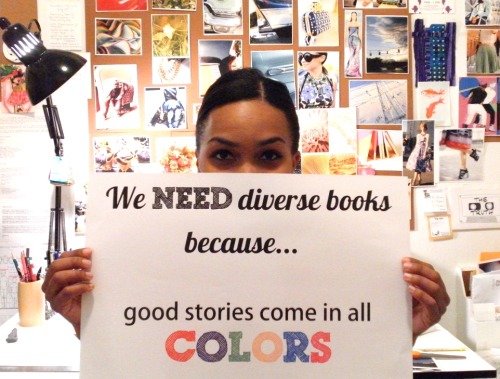
#WeNeedDiverseBooks

We Need Diverse Books. Just four words that are filled with hope, longing and determination to ensure that books for kids and teens truly reflect the rich diversity of our nation. Today marks the end of what I hope is just the initial phase of the #WeNeedDiverseBooks campaign, and it's been incredibly inspiring to witness the outpouring of support from around the world for this effort. Blogger Joyce Valenza offers a good wrap-up of what's been happening so far, as does this L.A. Times article.

There have been some great "next steps" proposed, such as this "white paper" prepared by librarian Jamie Campbell Naidoo for the Association for Library Service to Children, the children's division of the American Library Association. And there's also been a sharing of the resources highlighting what books are currently available that reflect a diversity of characters and setting in children's and teen books.

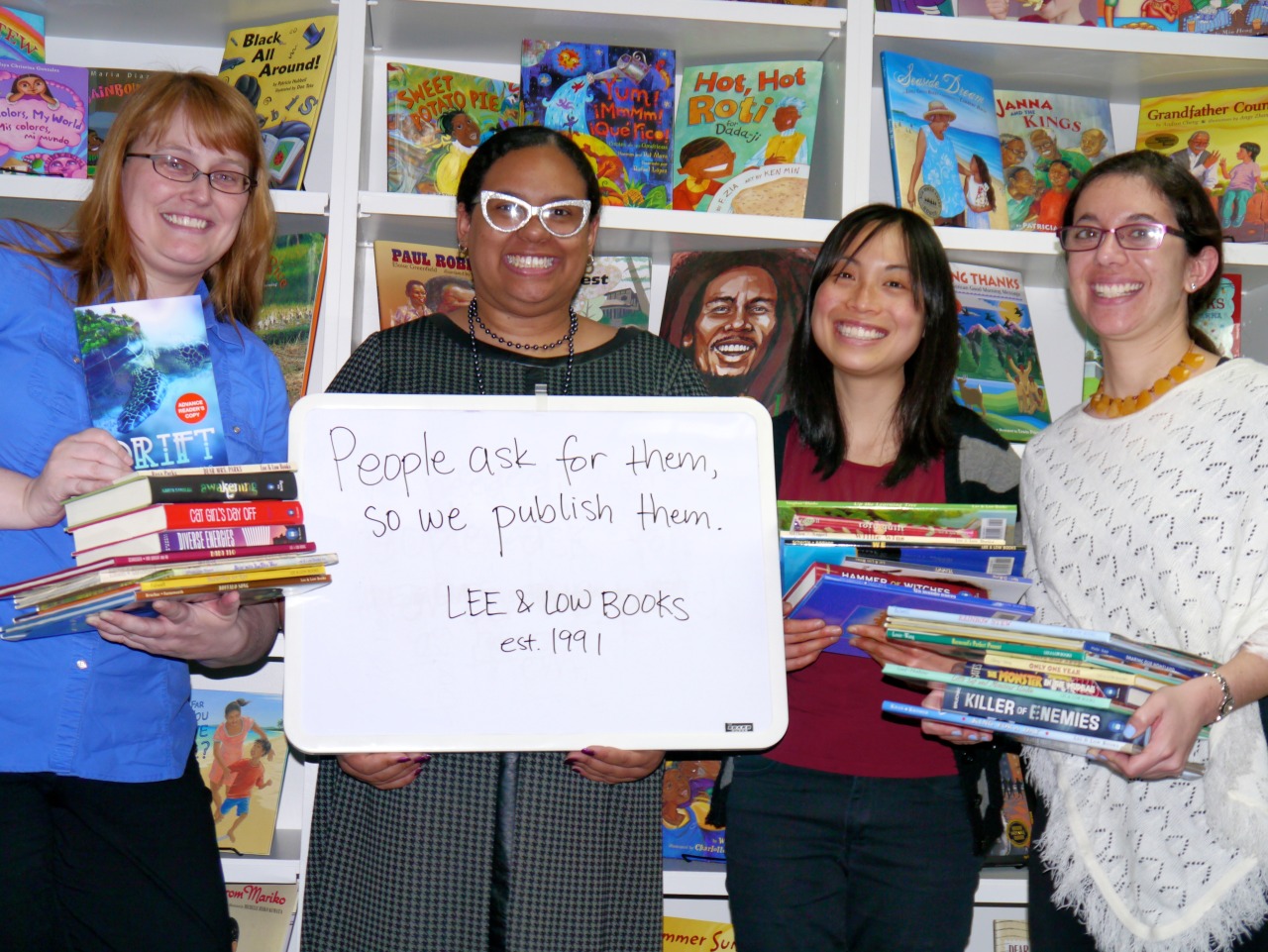
More needs to be done, however. All of us need to make it clear to publishers that we DO want them to publish more children's and teen books featuring all kinds of diversity, including characters who are African-Americans, LBGT,  grappling with physical and mental challenges, etc., etc., etc. There are some publishers out there that already are doing this, publishers like Lee & Low, and we need to support them by buying their books for our collection and then USE them in Story Times, booktalks, displays, etc.  And we need to keep pushing awareness of why having diversity in children's and teen books is so important.

It's a tall order, and it won't be easy. Some people think the problem will once again fade away into the background, just as it has done in years past. But I'm betting that this time is different. This time, with the help of the Internet, we've had such a groundswell of support from all kinds of people from all around the world, that I think the issue CAN'T fade away.

 I'm already inspired to do more, and have begun searching even harder for books that can expand the diversity of our library's collection, and I'm also planning to do more to use these books in programs.

How about you? What are you doing to keep alive the message that #WeNeedDiverseBooks?


Monday, April 28, 2014

Head On Over to the "Poem Depot"

Yes, National Poetry Month is coming to a close, but that doesn't mean we have to put away the poetry books until next April! For me, poetry is an all-around-the-year kind of thing, and I'm thrilled that one of my favorite kids' poets, Douglas Florian, has just published two new books of poetry.

One book is called "Poem Depot: Aisles of Smiles" (Dial, $16.99, ages 7-12) and it contains 170 poems written by Florian, who also has contributed dozens of line drawings in his distinctively childlike style. The idea of a poem "depot" offers Florian lots of scope for his trademark pithy poetic style, and he has fun placing his poems in different aisles, such as "Aisle 5: Willy-Nilly Sillies" and "Aisle 9: Jokes & Pokes and Funny Folks."

Florian sets the tone at the start with "Welcome," the first poem in "Aisle 1: Wit & Whimsy." In that poem he says: "Welcome to Poem Depot/ With smiles in the aisles./ There's laughs galore/ Inside this store,/ And fun that runs for miles." Young readers will find that he fully delivers on this promise, with poems like "Shout Out" in "Aisle 7: Jests & Jives": "Leo let out/Such a stupendous shout/That his outsides are in/And his insides are out."

Then there's "Webbed" from "Aisle 8: Rib-Ticklers & Sidesplitters": "I do not have a website/ Web e-mail, or web log./ But what I've got is four webbed feet/For I'm a worldwide frog." Accompanying this poem, Florian has drawn a frog dressed in a suit, carrying a briefcase and, of course, wearing no shoes so as to better show off his webbed-ness.

I'm betting that a favorite among young readers will be "Peter Picked" from "Aisle 11: Miles of Smiles": "Peter picked his nose./ Pulled out a garden hose,/A herd of sheep, a flock of geese,/ Six chicken who could speak Chinese,/ Ten bumblebees, a speeding train,/ And NEVER picked his nose again." Florian's drawing, showing a boy with chickens coming out of his nostril, is pretty much guaranteed to draw guffaws from young readers.

Florian pairs up with poet J. Patrick Lewis in another new book of poetry, "Poem-Mobiles: Crazy Car Poems" (Schwartz & Wade/Random House, $17.99, ages 5-10). Florian shares a similar quirky sensibility with Lewis, who just completed a two-year term as the U.S. Children's Poet Laureate, and the two clearly love to both play with words and to make kids laugh. In this poetry collection, presented in a picture book format, young readers will find 13 poems about unique vehicles, from a "dragonwagon" to a "Tyranosaurus wreck."

In a poem called "Caterpillar Cab," for example, the two poets write about the cab that: "From time to time it wraps itself/ Inside a silk cocoon,/ Then turns into a butterfly/ That takes us to the moon." The "Eel-ectric Car," meanwhile, features another rather unusual vehicle: "My spark plugs spark --/ now watch me peel!? I'm a battery-powered/ a u t o m o b EEE EE EE EEEL!"

The zaniness of the poetry by Florian and Lewis is highlighted in the illustrations by Jeremy Holmes. Done in watercolor and pencil and then digitally colored, Holmes' imaginative illustrations further expand the book's humor.

(Note: My reviews are based on copies of the books received from the publishers).

Wednesday, April 23, 2014

It's a Happy Birthday

You may have heard the news: the Bard of Avon, William Shakespeare, celebrates his 450th birthday today.  That's definitely a birthday to mark, and I've also got a personal reason for celebrating, for today is the sixtieth anniversary of my own birth.

I've always loved sharing a birthday with the Bard, and over the years I've particularly enjoyed some fun festivities at the Folger Shakespeare Library in Washington, D.C. Each year, they sponsor a day-long "birthday" event with Shakespeare-themed activities for both kids and adults; the celebration culminates with everyone singing "Happy Birthday" as an actress playing Queen Elizabeth cuts a giant birthday cake.

My love for Shakespeare's work goes back to my childhood. When I was eight or so, someone gave me one of the most important books in my life, Stories From Shakespeare by Marchette Chute.

In this volume, Chute transforms Shakespeare's plays into brief, well-written tales that I spent hours reading as a child. It was the perfect introduction to the work of the Bard, and I still use it to refresh my memory about the story essentials before going to see a Shakespeare play. With Chute's storyline fresh in my mind, I can better focus on Shakespeare's marvelous language.

In college, as an English major, I took a year-long course in Shakespeare. We read everything he wrote, immersing ourselves in the villainy of Richard II and the verbal sparks between Beatrice and Benedict in Much Ado About Nothing. It was that year that I happened upon another Shakespeare resource that remains a treasured possession: "Shakespeare" by Mark Van Doren. Here, Van Doren gives readers a collection of incisive essays -- one about each play. I never go to see a Shakespeare play without re-reading what Van Doren has to say about it.

Over the years, I've read many other books about the Bard, both for kids and adults. In the eight years I've been a children's librarian, for example, I've learned that Chute's book is less well-known that the classic Tales From Shakespeare, and subsequent volumes, written by Charles and Mary Lamb. (Chute's book, however, remains a sentimental favorite with me).

Young readers in my library also enjoy the comic-book-style synopses of Shakespeare's plays -- Bravo, Mr. William Shakespeare and More Tales From Shakespeare -- written and illustrated for younger readers by Marcia Williams.

 Then there are artist Gareth Hinds' beautifully-illustrated versions of classic Shakespeare stories: King Lear, The Merchant of Venice, and his newest, Romeo and Juliet. (I'm especially lucky that Hinds lives in my city, and has come to speak at our library about his work).
 
Yes, today is definitely a day to celebrate Shakespeare! But it's also a day to celebrate birthdays in general. Let me conclude this blog post by higlighting one of my all-time favorite birthday books for kids, Benny Bakes a Cake, written and illustrated by Eve Rice.

It's a book I discovered as a parent, and one which my now-grown kids really loved. So it brings back beloved memories, as I remember how my kids gasped when the family dog eats the birthday cake which Benny and his mom have just made for Benny's birthday. And how we all sighed with relief when Benny's dad arrives home shortly afterwards bearing a substitute birthday cake, thanks to an urgent telephone call from Benny's mom.

 Now, I use the book as a children's librarian for our "Twosies" program when our theme is "birthdays." Like my kids did, the young participants revel in how Benny helps make his birthday cake and then are saddened by Benny's tears when the dog eats the cake. Finally, there are big smiles at the happy ending, a perfect conclusion for book about birthdays.

Tuesday, April 15, 2014

Bird Songs!

It’s finally spring (after a too-long winter where I live), and publishers have brought forth a number of picture books focused on birds. Each one of these books is wonderful in its own way, yet they’re all quite different. So there’s a real bonanza of choices for young fans of our feathered friends. Here’s a closer look at what’s out there:

Young readers are treated to a lilting rhyme that introduces them to some common backyard birds in Have You Heard the Nesting Bird? (Houghton Mifflin Harcourt, $16.99, ages 3-7). Author Rita Gray beautifully balances poetry and information as she details the thoughts of two young children as they enjoy a day of bird watching.
But the main story of this book revolves around the children’s curiosity about the robin’s nest they have noticed high in a tree. They wonder why the robin is so silent while the cardinal, chickadee, crow and other birds they have spotted are so noisy. Suddenly, there is a “tapping “ and “cracking,” a “breaking” and a “shaking,” a “ruffling” and a “shuffling,” and the children cry: “The baby birds are here!”

Gray’s text is perfectly matched by artist Kenard Pak’s illustrations, done in watercolor and digital media. Pak uses a palette that mixes delicate spring colors with earth tones, and he has fun playing with time, perspective, white space, and page turns. In one, mostly white two-page spread, for example, he shows a cardinal in mid-flight on one side, and a chickadee hanging upside down from a branch on the other. The way the birds are placed on the pages subtly underlines the sense of flight that pervades the illustrations in the book. And one gorgeous two-page spread of a nighttime scene, showing the robin in its nest as the children sleep in their house, provides a natural way to move the story forward to the birth of the baby robins. For readers looking to learn more, Gray provides a whimsical but fact-packed robin “interview” – “A Word With the Bird” – at the conclusion of her story. And there's even more to enjoy from these interviews with Gray and Pak.

Author/artist Jorey Hurley also has a robin theme in her debut picture book Nest (Simon & Schuster, $16.99, ages 3-6). But Hurley uses only 15 words – one for each two-page spread – to take readers through a year in the life of a robin family. As the book opens, we see a male and female robin perched on the edge of a nest in which there is a blue egg.

The word on the spread is, naturally, “nest.” Several pages later, there’s the word “hatch” as we see a baby robin emerging from the egg.  Further on, we see the baby “grow” as its fed in its nest in a just-blooming tree. And so on through the year until the book ends with the word with which it began – “nest” – as we see the now-grown baby robin making a nest with a mate. Hurley’s background as a textile designer shows in her clear, uncluttered but stylish illustrations, done in Photoshop. An author’s note at the end gives more information about robins that parents can share with their children, and readers can learn more about Hurley from this video.

Nests are front and center in Mama Built a Little Nest (Beach Lane Books/Simon & Schuster, $17.99, ages 4-8). Author Jennifer Ward packs a plethora of facts into her deceptively simple rhyming text. Ward provides a four-line poem on each two-page spread, and each poem begins in a similar way: “Mama built a little nest.”

Since each two-page spread features a different kind of bird, the way the nests are built varies; in one case (a male cactus wren), it’s “Daddy built a little nest,” and in another (falcon), it’s “Mama scraped a little nest.”
Along the way, young readers learn about the different ways that birds build their nests. Ward’s poems, printed on one page of a two-page spread, are paired with more facts, which are provided, in smaller print, on the other page. The illustrations are done by Caldecott Honor artist Steve Jenkins, the master of precise but beautifully rendered collage art.

 OK, Peggy’s a chicken – but she’s still a bird! And the story of her visit to the big city is bound to be a hit with kids, who will readily identify with Peggy’s efforts to find her way in the midst of a busy world filled with unexpected twists and turns, as well as creatures who are much larger than she is.

 In “Peggy: A Brave Chicken on a Big Adventure” (Clarion, $16.99, ages 3-7), author/artist Anna Walker combines uses a spare text and expressive watercolor illustrations to tell the story of an intrepid fowl. As this whimsical story opens, readers learn that Peggy lives on a quiet street and thrives on the routines of her daily life there, from eating her breakfast to watching the pigeons.. One day, however, a gust of wind literally sweeps Peggy into an urban landscape, filled with hurrying people and buildings that touch the sky.
Unruffled, Peggy plunges into the delights of big city life, as she “watched, hopped, jumped, twirled, and tasted,” discovering everything from cupcakes to high heels to escalators. It’s fun, but Peggy eventually misses home and, with a bit of help from her pigeon friends, she makes it safely back to her quiet street, where she revels once again in her everyday life.

Yet Peggy has been smitten by the delights of the metropolis and so, as Walker writes on the book’s final page, she “sometimes caught the train to the city.” “Peggy” is a delight from start to finish, a book that touches the heart – and the funny bone – and also is lovely to look at. Get a taste of Peggy's story with this book trailer.

Little readers can learn basic concepts while following the exploits of a cheerful little red bird in “Early Bird” (Feiwel & Friends, $15.99, ages 2-5). In her debut picture book, author/artist Toni Yuly offers readers illustrations featuring brilliant colors and simple shapes, as well as a story that has a surprising plot twist at the end.
Along the way, readers will learn concepts like “across,” “through” and “under,” yet Yuly’s text is never didactic. Overall, “Early Bird” shows that Yuly is an author/artist who understands the art of both educating and entertaining very young children.

 It’s pretty much impossible to describe “Aviary Wonders Inc.” (Clarion, $17.99, ages 9-12), written and illustrated by Kate Samworth. Despite its picture book format, the book is clearly meant for older readers as Samworth uses irony and advertising lingo to give an idea of what could happen to our flying friends if their natural habitats disappear. The book, which is meant to look like a catalog, is set in the year 2031 and, because so many birds have virtually vanished, the only way to enjoy their presence is to “build your own” by ordering various parts from the Aviary Wonders catalog.

Samworth’s dark humor will capture the interest of some readers, while others may find it disturbing. Still, there’s no denying that Samworth makes her point about the need to protect birds and their habitats in a unique way. But the real scene stealers are Samworth’s illustrations, lush with color and detail and done in oil, ink, graphite and colored pencil. You can get a sense of her work from this book trailer.

 Author/illustrator Edward Gibbs is on a roll with his I Spy books about animals, which include die cut-outs that allow young readers to guess which animal he’s writing about. The latest in the series is I Spy in the Sky (Templar/Candlewick Press, $14.99, ages 4-7), in which young readers can learn a bit about everything from eagles to peacocks. Gibb’s over-sized birds are fun to look at, and kids will enjoy this new twist on the classic game.

So, there you have a it! A plethora of new bird books to enjoy this spring.
And don't forget a couple of my all-time, older favorites: My Spring Robin by Anne Rockwell (now out of print, but worth searching for a paperback copy), and Birds, written by Caldecott Medalist Kevin Henkes and illustrated by his talented spouse, Laura Dronzek.

Sunday, April 13, 2014

Adult Interruptions: "Overwhelmed"

For some time, I had been thinking about interspersing children’s book reviews and notes with a very occasional feature about adult books, just to spice things up a little. While I’m a kids’ book fiend, I will admit that, now and then, I do enjoy reading an adult book. It’s also important for me to have at least some knowledge of adult books – fiction and non-fiction – when I’m staffing the desk at my public library on Saturdays, and patrons ask me for recommendations.

OK, so I was thinking of doing writing occasional pieces about adult books anyway, and thought of calling it "adult interruptions." Then, real life hit – a real adult interruption in my life as a children’s librarian and children’s book reviewer. If you wondered at all why I haven’t updated my blog here’s the reason: my husband had emergency surgery. He spent seven days in the hospital and, thank goodness, is recovering nicely at home.

All this real life stuff, of course, wasn’t conducive to writing blog posts. I did do lots of reading while my husband was napping and I was hanging out in the hospital, keeping him company and hoping to catch his doctors on their rounds. Writing about what I was reading, however, just required more psychic energy than I could muster.

One of the books I read while I was hanging out at the hospital was an adult non-fiction best-seller that had been getting a lot of buzz; I had checked it out from my library on a whim just before our family’s hospital hiatus. Titled “Overwhelmed: Work, Love and Play When No One Has the Time” (FSG, $26), this book is chock-full of information and scientific studies showing why our over-stuffed lives aren’t good for us. Author Brigid Schulte, a Washington Post journalist, skillfully weaves all of this research in and around anecdotes about real people dealing with the stress of trying to do your best at a job that requires 24/7 availability while still trying to have a life and, in many cases, a family.

In particular, I liked the way that Schulte’s information and analysis not only targeted overwhelmed parents, but also anyone who desires a better balance of work and home. That speaks to me, as someone who has an almost empty nest that is allowing me more time and a better work-life balance. But "Overwhelmed" is an even more important book for my older child, a 23-year-old who has just started her first job and is totally consumed by it. Learning ways to cope with this workload – and, even more importantly, ways to resist it! – are really important for young people, especially if they plan to have families. Perhaps they can even lead the much-needed revolution towards a saner work-life balance.

While “Overwhelmed” can seem, at times, overwhelmingly packed with facts and stories, Schulte fortunately provides an appendix where she pulls together everything she has learned. It’s titled “Do One Thing,” and the first item is blunt: “Time is power. Don’t give yours away.” Agreed, but I believe that reading all of “Overwhelmed” – not just the appendix – is worth your time. It resonated with me, someone who was literally on call 24/7 in the nearly 30 years I spent as a journalist, although I was "part-time" (and paid that way) for more than half of those years.

By reading Schulte’s book, I finally gathered a much deeper sense of perspective about my work life. This was especially true for me in her discussion of the “ideal worker,” someone for whom work is the be-all and end-all, and how that impossible ideal permeates not only our workplaces but more importantly our own thinking about ourselves as workers. I plead guilty to always trying to measure up to that ideal worker, but I’ll admit right now that I didn’t consciously realize the psychic burden I placed on myself – and that our work-driven society placed on me -- until I read Schulte’s book. That’s just one of the many things I learned from “Overwhelmed.” (To learn a bit more about the book itself, check out an NPR interview with Schulte).

Eight years ago, I traded my crazy work life as a journalist for new career as a children’s librarian. I’m definitely in a saner situation now, in a job that I love, in a workplace that values work-life balance. Still, I have lived too much of my life feeling overwhelmed by trying to balance work, love and play, and that’s why Schulte’s book seems like an important one for all of us to read. To me, the book compellingly demonstrates that there must – and needs to be – a better way to balance our work and our lives.