Monday, August 25, 2014

Booking It In Savannah

I'm just home from a vacation in Savannah, Ga. a city with a stunningly beautiful historic district and a booming tourism business that's based on one of the best-selling American books of all time, Midnight in the Garden of Good and Evil by John Berendt. Folks flock to Savannah to see the locales where events in the book take place; it seems that you can get a tour -- including an evening jaunt in a specially-outfitted hearse -- anytime, day or night.

"The Book," as it's known in Savannah.
I wasn't there for the tours, as I prefer to do my own exploring. So, instead of jumping on the hearse or taking a nighttime ghost tour, my husband and I spent our week doing our own walking tours of each of Savannah's 23 squares, eating some great meals, and checking out the city's two great museums.

Jepson Center for the Arts, part of the Telfair Museum.
We visited the Jepson Center for the Arts, part of the Telfair Museum, which is situated in the midst of Savannah's historic district. One night while we were in Savannah, the Telfair hosted a reception -- open to the public -- to mark the opening at the Jepson Center of Deep River, an incredibly thought-provoking exhibit on the nature of freedom by artist/MacArthur Fellow Whitfield Lovell.

The other museum we visited was the Savannah College of Art & Design (SCAD) Museum. Interestingly, the SCAD Museum was featuring an exhibit of the photographs of Savannah native Jack Leigh, including the one for which he became internationally famous: the cover photo of Berendt's book. But the exhibit focused much more broadly on Leigh's work, and contained many memorable photographs of the people living and working in the "low country," the coastal areas near Savannah.
SCAD Museum

This was all well and good, and I can unhesitatingly recommend a visit to Savannah, a quite sophisticated city that a friend recently called "the San Francisco of the South." In this blogpost, however, I want to focus on what a bookish city Savannah is. It begins, of course, with the fact that the city's tourism boom (going strongly for a couple of decades) is based on a book (as well as the movie made from Berendt's book). But Savannah also has several interesting independent bookstores and of our visit, my husband and I visited four of them.

The Book Lady Bookstore


The first bookstore, The Book Lady Bookstore, was just steps from where we were staying. It's a treasure trove of used books, as well as those specifically focusing on Savannah and Georgia history.  Here, I found a used copy of The Sweet Life in Paris by David Lebovitz, a book that I had been wanting to read because I am a huge Francophile. It was a bargain at $10, especially because Lebovitz included a number of recipes that I plan to ask my husband, the family chef, to try out. I also found a book, The Law's Delay, by one of my all-time favorite mystery writers, Sara Woods. She wrote more than 40 books featuring a character named Antony Maitland, an English barrister who is constantly "going beyond his brief" in the search for justice. I have read most of Woods' book,s but never this one, which was published in 1977.

A small taste of the Books on Bay series collection.
Next (bookstore) stop was Books on Bay, a "must-visit" bookstore for anyone who is a collector, or just a love, of children's series books like the Nancy Drew or Hardy Boys. The bookstore is close to the popular (and heavily touristed) River Walk, but is enough off the beaten path that I would have missed it except that my friend Tom Swift -- his real name! -- had recommended it. I was so glad to find it and thrilled to spend time with the knowledgeable proprietor, Betsy Holt-Thetford.

Betsy Holt-Thetford
We talked about the Nancy Drew books, and I mentioned that because the books weren't considered appropriate reading for children by librarians when I was a kid in the 1960's, libraries didn't stock them. That meant that I had to use my allowance each week to buy the latest Nancy Drew. Betsy loves to talk with -- and take pictures -- of customers, so I found myself later that week on the Books on Bay Facebook page, with Betsy telling the story of how I had to buy all my own Nancy Drew books. I was then able to chime in with a link to a story that I wrote some years ago on the 75th anniversary of the Nancy Drew books. When I'm next in Savannah (our son is a SCAD student and so I'll be back!), I definitely plan to head back to Books on Bay.

E. Shaver, Bookseller
E. Shaver, Bookseller is a Savannah tradition. Located just behind the Savannah (DeSoto) Hilton, Shaver has an enviable location. Years ago, before I even had kids, my husband and I visited Shaver's and purchased mint-condition copies of Winnie-the-Pooh and The House at Pooh Corner by A.A. Milne. At that point, we were starting to think about having children; I had never read the Milne books, and my husband insisted that we needed to purchase and read them -- together. Two years ago, visiting Savannah as my son was considering SCAD, I returned to Shaver's and purchased Bruno, Chief of Police, the first book in a series by Martin Walker and set in the Dordogne region of France. The series has since become a real favorite series for my husband and me. On this most recent visit, I bought Letters from Yellowstone, an epistolary novel about a woman scientist working in the national park in the days when woman weren't allow to pursue such careers. In addition, I bought Woman in the Dark by Dashiell Hammet for my husband, a true Hammett fan.

Our final Savannah bookstore destination meant leaving the historic district and traveling to a strip mall along the main drag (Victory Drive). But Wiley's Book Exchange was definitely worth the brief drive.
 I bought a number of books, including a $3 copy of The Tale of Despereaux, the Newbery Medal-winning book by Kate DiCamillo. Kate is coming to speak at our library (in partnership with Politics & Prose Bookstore) this coming Friday evening, and I plan to ask her to sign my newly-purchased copy of The Tale of Despereaux.

One last literary note for Savannah: if you go, you must have a coffee or glass of wine at the Gallery Espresso, an atmospheric cafe located on one corner of Chippewa Square. Besides its great, central location in Savannah's historic district, Gallery Expresso features an array of delicious sandwiches and pastry. It's the perfect place to sit with a book.

You also might meet Chris Berinato, a friendly manager-type at the cafe whose passion is working on something called Seersucker Live in his spare time. The tag line for Seersucker Live is a real come on: "Part literary reading. Part talk show. Part cocktail party." Also, we weren't there for the latest Seersucker Live program, but Chris told us about a program he did a while ago with Daniel Handler, also known as Lemony Snicket. It's definitely worth checking out the YouTube video of that program, and it's just one more demonstration that Savannah is indeed a great destination for book lovers.


Monday, August 11, 2014

Best Books for Babies and Toddlers

Books and babies make a natural combination. Creating the best books for the youngest readers, however, can be difficult. The text (if there is one) must be short and snappy, and the illustrations should be straightforward enough for pre-readers to enjoy, and also detailed enough to keep their attention. In other words, creating what appear to be simple books for babies and toddlers actually is anything but simple.

One of the 2014 Best Books for Babies
 It can be just as challenging for parents and other grown-ups to find the best books to read to their babies and toddlers. There is, unfortunately, a lot of schlock out there in the marketplace, such as books that have way too much text for the youngest readers, books with illustrations that don't match the text, etc. In the dizzying array of possibilities, how can parents identify the best books for the youngest readers?

Fortunately, there's an expertly-curated "go-to" resource for parents: the Best Books for Babies list published each year. The list began in 1999 when a group of Pittsburgh-area librarians and children's literacy experts, including the late, great Fred Rogers, decided that there should be a resource for identifying excellent books for the very youngest readers. It's true that the Caldecott Medal (given to the best-illustrated book of the year) and the Newbery Medal (given to the best-written children's book of the year) are aimed at books appropriate for ages birth-14. But those awards rarely, if ever, actually focus on books for babies and toddlers, and in fact, generally skew towards preschoolers on up.

So Rogers and his crew decided to establish their own resource for parents of babies and toddlers. Each year, a group of experts year sift through hundreds of books to choose the 10 best for the youngest readers, and then publish that list as the Best Books for Babies. The project was originally sponsored by a nonprofit Pittsburgh literacy group called Beginning With Books, which closed its doors in 2008 due to budget cuts. But the effort has continued under the auspices of a trio of Pittsburgh groups: the Carnegie Library of Pittsburgh; the Fred Rogers Company; and the Pittsburgh Association for the Education of Young Children.

The three groups have created a dedicated website for their work; besides a list of the current winners, you'll find an archive of previous winners plus information about what makes a good book for babies and toddlers, and also tips for reading aloud to little readers.

Another great resource for choosing books for babies and toddlers is the Born to Read booklist created by the Association for Library Service to Children. And don't forget to talk to your local public librarian -- I'm often asked for book advice by new parents and am more than happy to share what I know. After all, I'm helping to create the next generation of readers!


Meanwhile: I've been looking at some of the latest crop of board books, and have pulled out just a small selection of favorites. (I'll be reviewing more board books in upcoming weeks). Here's a closer look:

Genius children's book creator Mo Willems has created board book versions of two books in his popular Cat the Cat, Who Is That? early reader series: Who Is That, Cat the Cat? and Who Flies, Cat the Cat? (Balzer+ Bray/HarperCollins, $6.99 each, ages infant-3). To accommodate younger readers, the original text has been abbreviated, but the board book versions retain the zany humor of the early reader books. Babies and toddlers will be captivated by Willems' expressive illustrations.


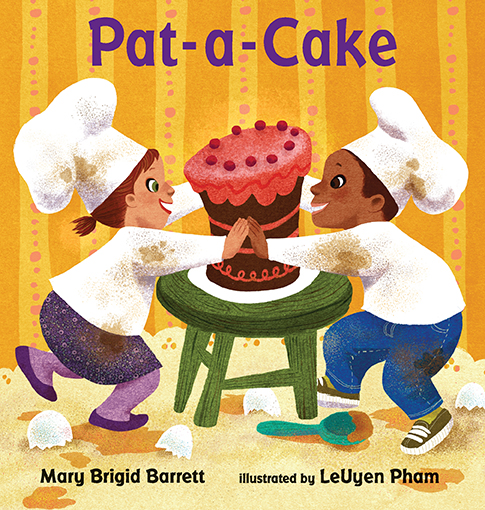
Author Mary Brigid Barrett riffs on traditional nursery rhymes with delightful results in Pat-a-Cake and All Fall Down (Candlewick Press, $6.99 each, ages birth-3). Take her opening lines of Pat-a-Cake, for example: "Pat-a-cake, pat-a-cake/CLAP, CLAP, CLAP/ Pat a pudding, Wibble Wobble/ Pat a puddle, SPLAT!" The merriment inherent in Barrett's text is matched by the gouache-and-watercolor ink illustrations by LeUyen Pham, who depicts a multicultural cast of kids and adults.

 
 Olivia, that irrepressibly bossy picture book piggy, relishes her new job as teacher in Olivia's A. B. C (Atheneum, $7.99, ages 1-3). For each letter of the alphabet, author/illustrator Ian Falconer offers one or more examples; of course Olivia plays a starring role in each one. And it will come as no surprise to Olivia's many young fans that the one example for "Q" is "queen" -- "Queen Olivia" that is. As always, Falconer's illustrations, many of them drawn from previous Olivia books, will elicit chuckles from both young readers and their parents.


Brightly-colored illustrations combine with a "lift-the-flap" format to make Honk, Honk! Baa, Baa! (Candlewick Press, $7.99, ages birth-2) a winner for the youngest readers. Babies and toddlers will enjoy mastering their animal sounds with this book, which was written and illustrated by Petr Horacek.

A group of toddlers spends a busy day together in Baby Animal Farm (Candlewick Press, $6.99, ages birth-2), written and illustrated by Karen Blair. The big attraction on the farm for the young humans are the baby animals, including a kitten, piglet and calf. And it's a helpful puppy who saves the day by finding a teddy bear dropped by one of the toddlers. The pastel-hued illustrations, done in lithographic crayon and watercolor, are charmingly simple, yet never cutesy.


Sunday, August 3, 2014

Caldecott Reading: "Go" by Chip Kidd

This spring, I was elected to the 2016 Caldecott Committee, an honor that thrills me, and also makes me a wee bit intimidated. Yes, I certainly know something about picture books, given my nearly 25 years as a children's book reviewer and eight years as a (second-career) children's librarian. But there's still so much to learn!

Our committee won't actually begin our work until January, as we will be reading eligible books throughout 2015 and awarding one of them the 2016 Caldecott Medal. So, like my fellow committee members, I've decided to use the intervening months to do lots of background reading. The Caldecott Committee manual includes a great suggested reading list, and our committee chair and my fellow members have recommended other books. In addition, there are three recent Caldecott webinars, which were produced by the Association for Library Service to Children.

Recently, I ordered some of the books on the Caldecott reading list from Alibris, and it's been fun seeing the books come in this past week. The books include: Lotus Seeds: Children, Pictures and Books by Marcia Brown (who is one of only two people to win three Caldecott Medals -- David Wiesner is the other one); Writing With Pictures by Caldecott Medalist Uri Shulevitz; Picture This: How Pictures Work by Caldecott Honor illustrator Molly Bang; Art and Design in Children's Picture Books by Lyn Ellen Lacy, and more. I've already dipped into a couple of the books, and it's clear that I'm going to have a fine old time reading them.

Over the next few months, I'll be posting now and then about what I'm reading to prepare for my Caldecott year. I've also decided to use this time as an excuse to read even more widely about art and graphic design -- something I've always wanted to do. I did take a year of art history, but it was through the specific lens of French art, as I was a French minor in college. As a result, my knowledge of other-than-French art history is pretty paltry. By good fortune, my son, who is an industrial design major at the Savannah College of Art & Design, is taking an online course in art history this summer. I've been borrowing his Janson's History of Art: The Western Tradition and leafing through it just for the heck of it.  I also rediscovered a dense little volume that I bought years ago, Learning to Look: A Handbook for the Visual Arts, which is one of a trio of books that have been used in the Humanities 1 course at the University of Chicago. (The other two volumes are Learning to Listen and What Happens in Literature.)

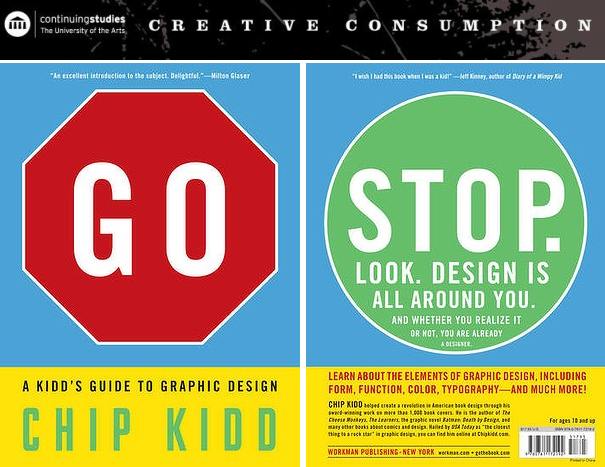
 It's certainly fun to take such a wide-angle look at art and art history as I prepare for my Caldecott year. But I'm trying to do that as a "sidebar" experience, as it were, while spending most of my time reading the volumes most focused on picture books and the Caldecott criteria. With that in mind, I picked up Go: A Kidd's Guide to Graphic Design (Workman Publishing, $17.95, ages 10 up) by Chip Kidd, a noted graphic designer.  Go was one of the five finalists for the Young Adult Library Services Association (YALSA) Award for Excellence in Non-Fiction, so I knew it would definitely be worth reading. Besides, one of the criteria for the Caldecott Medal states that "The committee is to make its decision primarily on the illustration, but other components of a book are to be considered especially when they make a book less effective as a children’s picture book. Such other components might include the written text, the overall design of the book, etc."

 So I figured it would be worth learning more about graphic design, about which I know little. Besides, the cover of Go was calling to me -- how can you resist a book where the title -- Go -- is designed to look exactly like that ubiquitous red-and-white sign that tells us to "Stop"? Besides the cover is printed on board pages -- just like a board book for little ones! -- something that I also found quite intriguing. But the cover was just the beginning of the delights of this book, which I found both educational and entertaining, and impossible to put down.


I learned, for example, about what exactly is graphic design and, perhaps more importantly, why I should care about it. Kidd's answer: "Because it affects you all the time. On average, every person in America is exposed to thousands of images a day, whether through advertising, television, the Internet, packaging, other people's tattoos, or t-shirts....Every single one of those things was designed by someone, a person whose job it was to decide what color it should be, where to put the type, what font to use, and how it should look. Whether it's the fine print on the back of a shampoo bottle, the colors on a box of cereal, or where to put the numbers on your remote control, there's a great deal of thinking that goes into the things you use, read, purchase, play with, and consume" The bottom line? "Everything that is not made by nature is designed by someone."

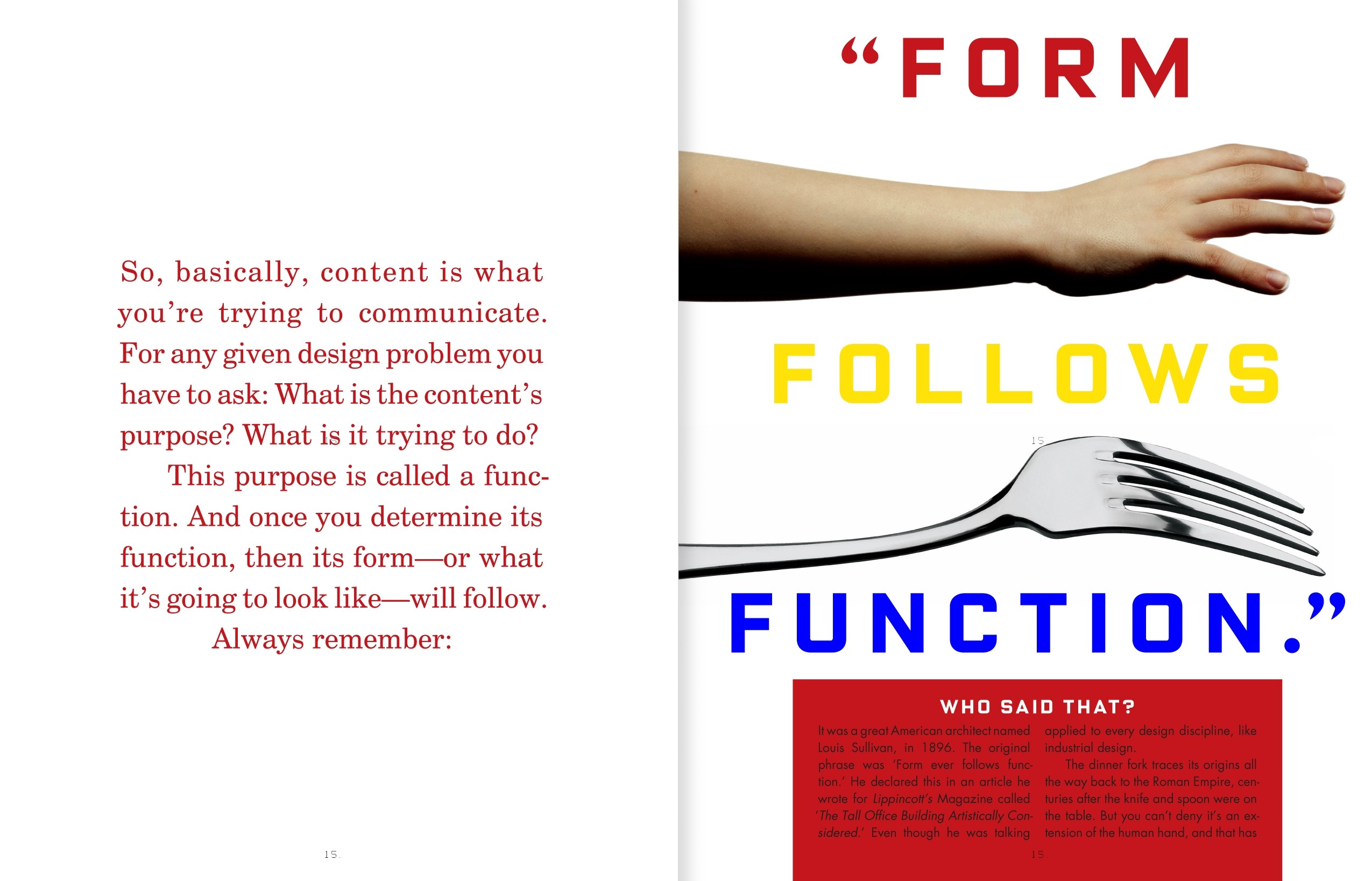
Kidd's book gives readers a tour through the basics of the one of graphic design, looking at major concepts like form, which includes things like color theory, pattern, symmetry, etc. Then there's the fascinating (to me) subject of typography (sans serif, anyone?) and, of course, the actual content. As Kidd notes: "If form is the last thing you consider when making a piece of graphic design, then content is the first.... Content is harder to figure out, but it's what you start with, and it dictates what form you design will take." For example, the fundamental question people may have when they are inside a place is "How do I get out of here?" Using a flowery blue script to spell out the letters on an orange background may look nice but it's hard to read. The typical "Exit" sign, meanwhile, uses straightforward red lettering on a white background, which makes it stand out and easy to spot -- a perfect case, Kidd says, of form following function.


Go was a blast to read, and I learned a ton of basic information about graphic design. Not surprisingly, the book is beautifully designed, and there are many illustrations to visualize Kidd's text. He also uses every part of the book, from the inside front cover to the copyright page to the inside back cover to convey -- both graphically and in written form -- more information about graphic design. Young readers interested in graphic design also will enjoy the 10 inventive design projects that Kidd suggests at the end of the book.

(Note: I used our library's copy of Go to write this review).


Thursday, July 24, 2014

Tales from the Library: Raina Reigns!

It's easy to tell what authors are popular in the Children's Room at our Library. Just look at the multiple -- and dog-eared -- copies of books by Rick Riordan of Percy Jackson fame, Wimpy Kid wizard Jeff Kinney, Rachel Renee Russell, author of the Dork Diaries, Magic Tree House author Mary Pope Osborne, Erin Hunter, author of the Warriors books, and so on.
In our graphic novel section, however, it's Raina who reigns. That's Raina Telgemeier, author/illustrator of the uber-popular Smile (Graphix/Scholastic, $10.99 paperback, ages 8-12), a memoir of her traumatic dental experiences as a young teen. We've got eight copies of Smile, and our young patrons are lucky if they can find one on the shelves. It's been that way since the book was first published in 2010, and the popularity of Smile shows no sign of waning. Kids just devour the true story of how Raina endured major dental surgery and distress during her early teenage years as the result of a freak fall in which she seriously injured her mouth.
 
Smile, of course, is more than a dental drama; it provides s slice-of-life look at being a teenager, dealing with family issues, trying to figure out friends, etc. When I ask kids why they love Smile so much, they do talk about the trauma of Raina's dental issues, but mostly they note how they love reading about a "real" kid who deals with friendship and family challenges, just like they do. Smile won the 2011 Eisner Award for Best Publication for Teens.

Raina, who's married to fellow graphic novelist Dave Roman, decided to mix it up after Smile, publishing Drama (Graphix/Scholastic, $23.99 hardcover, $10.99 paperback, ages10-14) in 2012. I say mix it up because while Smile is a memoir, Drama is fiction, although Raina acknowledges that it is based on her own experiences as a drama geek in middle school. True to its title, Drama is filled with the drama of the pre-teen and teen years: who likes who, who's in and who's out, etc. Raina also tackles the issue of sexual identity, highlighting the way twin boys deal with their homosexuality. Again Raina says the twins are based on some very good friends of hers, twin males who dealt with this issue as teens.

While kids in my library like Drama, they -- like Raina's fans everywhere -- have clamored for a sequel to Smile. On August 26, they'll get their wish as Graphix, an imprint of Scholastic, publishes Sisters ($24.99 hardcover, $10.99 paperback, ages 8-12). Raina says it's not really a sequel but another look back at her life, this time focusing on her often-fraught relationship with her younger sister Amara. I'll save my review of the book until I get a final copy, but suffice to say that my initial impressions from the advance review copy are simple: libraries, you'd better gear up for a run on this book. Young readers will readily identify with Raina's up-and-down connection with the sister she desperately longed for -- until Amara was born. Anyone who has siblings will find themselves in the pages of this book.

Meanwhile, while kids are awaiting the publication of Sisters on August 26, they are loving another graphic novel memoir,  The Dumbest Idea Ever (Graphix/Scholastic, $24.99 hardcover, $11.99 paperback) by Jimmy Gownley, author/illustrator of the popular Amelia Rules books. In his memoir, Jimmy talks about how he got the idea for Amelia Rules and then figured out a way -- with a lot of help from his parents -- to publish the first book in the series. Readers in my library are fascinated by the way that Jimmy broke into the graphic novel business, but they seem just as interested in his teenage travails, including his rollercoaster performance as a student and his friendship challenges. Jimmy does a wonderful job at honestly portraying his teen years, and that seems to really resonate with young readers.


Friday, July 18, 2014

Kate (the Great) DiCamillo Is Coming!

Yes, the current National Ambassador for Young People's Literature AND the current Newbery Medalist is coming to my library! If you're in the Washington, D.C. area, mark your calendars for Friday, August 29 at 7 p.m., when Kate will speak in the auditorium of the Takoma Park (Maryland) Community Center, which connects to our library. I'll be moderating (whoo-hoo!) the program; I've been told that Kate likes to do a Q & A format at her programs. Then she'll sign books afterwards.

How did my library, which is, after all, tiny -- as well as the only small, city-run library in Maryland -- get the honor of hosting the great Kate DiCamillo? Well, chalk it up to our partnership with Politics & Prose Bookstore, the independent bookstore in DC.

A couple of years ago, the P&P folks asked if we'd like to partner with them on author events; we provide the space for the events, and they provide the authors. Talk about a deal for us  See, P&P has more authors for events than they have space and time on their store calendar, which is why they reached out to us and to several other libraries in the area to see if we could form a partnership. The benefits for my library are immense because we get to host authors we never could afford to pay to come. P&P sells books at the events for people who'd like to have the visiting author personally sign their volume, but no purchase is required to attend any of the programs.
Ben Hatke

Recent authors whom we have hosted with P&P include graphic novelist Ben Hatke, of Zita the Spacegirl fame, Llama Llama picture book creator Anna Dewdney, and internationally-acclaimed author/illustrator Maira Kalman.

And now Kate DiCamillo! She's actually coming to DC for the National Book Festival, which will be held indoors for the first time on Saturday, August 30 at the Washington Convention Center. It was Kerri Poore, energetic coordinator of children's & teen events at Politics & Prose, who had the brilliant idea to ask Kate's publisher, Candlewick Press, if she might be willing to tack on an extra event the night before the festival. Lo and behold, she was!

I've interviewed Kate several times and so know how amazingly nice she is. Still I have to admit that I'm a tad nervous about moderating the program.
But I know that Kate will put me, and the audience, right at ease, as we talk about her ambassadorial platform -- "Stories connect us" -- her latest Newbery-winning book, the utterly delightful Flora & Ulysses, her newest book, LeRoy Ninker Saddles Up, and more. It's sure to be a wonderful night, so watch this space for a wrap-up right after it happens.

Kate's not the only author we're co-hosting this fall with P&P at the Takoma Park Maryland Library. Our partnership with P&P has produced a great line-up of children's (and adult) authors who will be speaking in our library's Children's Room (that's where we generally host authors and illustrators; hosting Kate in the auditorium is an exception).

For example, at 7 p.m. on August 28 -- just the night before Kate speaks -- Caldecott Honor author/artist Peter Brown will be talking about his newest picture book, My Teacher Is a Monster! (No I Am Not). It's great timing because that's the first week of school around here, so Brown's pitch-perfect, comic send-up of teacher-student dynamics should draw a good crowd of preschoolers and early elementary-age students.

Other upcoming events include: graphic novelist Eleanor Davis, who will talk about her new adult short story collection, How to Be Happy, on Monday, Sept. 15 at 7:30 p.m.; a trio of middle-grade authors -- Annie Barrows, E.D. Baker and Jessica Day George -- who will talk about their latest books on Thursday, Oct. 9 at 7:30 p.m.; and author Shannon Hale, talking about The Princess in Black, the launch of a new early chapter series, on Tuesday, Oct. 14 at 7:30 p.m. I'll be blogging about each event as they occur, so stay tuned for more!


Tuesday, July 15, 2014

Going Wild with Children's Literature

If you especially love the stories behind the stories of children's literature, you're in for a treat later this summer. That's because August 5 will mark the publication of Wild Things! Acts of Mischief in Children's Literature (Candlewick Press, $22.99), written in tandem by Peter Sieruta, Betsy Bird, and Julie Danielson.


It's a truly awesome line-up of experts. Peter, who died in 2012, was beloved in the children's literature field and had a deep knowledge of children's book collecting. Betsy is the youth materials specialist at the New York Public Library and widely known for her blog A Fuse # 8 Production, which can be found here on School Library Journal's website. And Julie, or Jules as she is known, is the creator of another wonderful, must-read blog, Seven Impossible Things Before Breakfast. Alas, I didn't know Peter, although I read his highly-respected blog, Collecting Children's Books.. But I am a devoted follower of the blogs of Betsy and Jules -- I recommend them highly to folks who love children's literature.

Anyway, Wild Things looks like truly wild fun, as it takes us "behind the scenes" of some of the best-known children's books. I've just gotten a review copy and plan to spend the next few days immersed in it, as I'll be hosting Betsy and Jules here on Children's Corner as they wend their way through a "blog tour" in late August.

 But you don't have to wait until August 5 to read some of the amazing and incredible things that Betsy, Jules and Peter learned as they worked on the book over the last several years. That's because a lot of the original manuscript ended up on the cutting room floor, so to speak, so that the book could remain a manageable size. Betsy and Jules have taken some of those unpublished gems and created a website built around them. The first few posts have been just wonderfully fun to read. My favorite so far is titled "Play Misty for Me," and tells the story of what the Wild Things authors contend is one of the best ALA Conference photos of all time:


You'll have to read the post to figure out why a horse is sitting in the midst of a bunch of be-hatted librarians, who seem to be remarkably unfazed by it all.

It seems like Wild Things -- both the published and unpublished parts of it -- will be a great addition to other classic "behind the scenes" books about children's literature. Several of my favorites were written and/or edited by children's literature expert Anita Silvey, whose books include 100 Best Books for Children, 500 Great Books for Teens, and that indispensable volume Children's Books and Their Creators and its shorter version, The Essential Guide to Children's Books and Their Creators.


I was fortunate enough to contribute an essay to Anita's Everything I Need to Know I Learned From a Children's Book. Anita also is a blogger, and anyone who loves children's literature should have her Children's Book-A-Day Almanac on their list of favorites. It's "must" daily reading for me.

Children's lit historian Leonard Marcus also has authored numerous books that give readers a peek behind the curtain at famous children's books. Leonard's many books include the seminal Minders of Make-Believe: Idealists, Entrepreneurs and the Shaping of American Children's Literature.


And any children's lit lover looking for an irresistible combination of insights and humor about kids's books would do well to read a long-time favorite of mine, Dear Genius: The Letters of Ursula Nordstrom, which Leonard edited.


Sunday, July 13, 2014

Tales from the Library: Happy New Year, Caldecott Club!

Way back in January, I posted about my library's Caldecott Club, calling it a "mock mock Caldecott" because we have patrons ranging from ages three to adult voting for the book they consider the best-illustrated of the selection we choose each month. (More background on our "mock-mock" Caldecott can be found here).

Because it's been so popular with our patrons, we decided earlier this year to expand the Caldecott Club from just a few months of the year to year-round. The Caldecott Club "year" would start in March, and culminate with a final vote in January -- just before the actual Caldecott Medal winner is announced at the American Library Association's Midwinter conference. We'd then discuss the actual winners in February and start the cycle over again in March.

2014 Caldecott Medalist Brian Floca
What with one thing or the other, including the end of the school year and the start of our summer reading program, we actually kicked off the "year" with our July Caldecott Club. No matter -- everyone was happy to be there, the "regulars" as well as some new folks. I started off by sharing a bit about the Newbery-Caldecott Awards banquet, which I had just attended at the ALA's Annual Conference (in Las Vegas, of all places). Mostly, I wanted to share the wonderful banquet program designed, as always by the Caldecott Medalist: in this case, Brian Floca, author/illustrator of Locomotive. The program, fitting the motif in Locomotive, looked like an Old West handbill and featuring just the best pop-up of -- you guessed it -- a locomotive. You can read Brian's speech here. 
(Another fun part of the evening were the short videos of this year's winners of Caldecott and Newbery Medal and Honor Books. My favorite video featured Mr. Wuffles, star of the 2014 Caldecott Honor book, Mr. Wuffles, written and illustrated by David Wiesner.)

Then our real fun of our Caldecott Club began, as we read, discussed and voted on the four books I had selected for the evening. We also looked, briefly, at a few illustrations of another book, Firefly July (Candlewick Press, $16.99), featuring very short poems chosen by Paul Janeczyko and illustrations by Melissa Sweet. While everyone agreed that Sweet's illustrations, done in collage and watercolor, were Caldecott quality, the poems -- while short -- were a bit too sophisticated for our group that night. In choosing books for our Caldecott Club, I generally keep in mind that our group skews towards preschoolers and early elementary kids (and their parents). So even though Caldecott criteria calls for the consideration of books for ages birth through 14, the ones we read tend to be aimed at kids 3-8 or so.

At each Caldecott Club, I'm joined by my library colleague Dave Burbank, who uses the skills he learned as a theater major in college to bring alive the books he reads. Besides, Dave is a real whiz with the ELMO, a special "document camera" that connects with our projector to show the book's pages on a big screen. It works great for a large group because everyone can really see the book as Dave reads it.

On this latest evening, we began with Three Bears in a Boat (Dial, $17.99), written and illustrated by David Soman, who is best known for the best-selling Ladybug Girl books he creates with his wife, Jacky Davis. Three Bears in s Boat was the longest book we would read that night, and I wanted to start off with it first, while energy was fresh. Dave read the book, then we asked everyone to give rate the illustrations, from 1 (worst) to 5 (best). Three Bears in a Boat was a crowd-pleaser, gathering an overall rating of 4; kids liked the way Soman drew the bears, while some of the adults loved his watercolor scenes of the bears in the ocean.


Next up was My Bus (Greenwillow, $16.99), written and illustrated by Byron Barton, a master of picture books for the very youngest readers. My Bus is a follow-up to My Car, which Barton published 13 years ago, and which remains popular with new generations of babies and toddlers at my library. My Bus was our youngest book of the evening, and so predictably drew raves from the toddlers and three-year-olds. While older kids and adults could appreciate Barton's use of color and shape, they were less enthralled with the book, which ended with an overall rating of 3.

 Bad Bye, Good Bye (Houghton Mifflin Harcourt, $16.99) was third on our list. I have to admit that it was definitely my favorite of the night; in fact, it's one of my choices for the 2015 Caldecott.  The simple yet emotion-laden rhyming text by Deborah Underwood is matched perfectly by Jonathan Bean's illustrations. Done in ink and Prismacolor tone, Bean's illustrations are multi-layered. In one layer -- the first layer that readers will focus on because it is done in full color -- shows a family's upheaval at moving to a new home.

 In the background of those illustrations, however, Bean presents other scenes, done in more monochromatic colors, which both move the story along and deepen its heart. For example, there's an entire background set of scenes behind the book's opening sequences. As readers see the family's two hugely upset children trying to prevent the movers from doing their work, the background illustrations depict the movers' relentless pace. Like me, it turned out that our crowd that night also loved the book, which garnered a number of 5s from folks of all ages.

Our final book was Number One Sam (Disney, $16.99, written and illustrated by Greg Pizzoli. I loved Greg's book, The Watermelon Seed, which won the 2013 Geisel Award for Best Beginning Reader, and I figured this new book, highlighting Greg's zany humor and cartoon-like illustrations, would be a crowd-pleaser and great way to end the night. (Check out this book trailer to get a sense of the book). The kids really liked Number One Sam and especially the twist at the end. A round of 4s for this one.

Then it was time to vote on our top book of the evening. People can vote for only one book and I was thrilled to see Bad Bye, Good Bye come out as our clear winner. It will now become one of our finalists when we vote on our Caldecott "winner" in January. You can learn more about the book, as well as the author and illustrator here. Meanwhile, stay tuned for more Caldecott Club fun next month!