|
| One of the 2014 Best Books for Babies |
 Fortunately, there's an expertly-curated "go-to" resource for parents: the Best Books for Babies list published each year. The list began in 1999 when a group of Pittsburgh-area librarians and children's literacy experts, including the late, great Fred Rogers, decided that there should be a resource for identifying excellent books for the very youngest readers. It's true that the Caldecott Medal (given to the best-illustrated book of the year) and the Newbery Medal (given to the best-written children's book of the year) are aimed at books appropriate for ages birth-14. But those awards rarely, if ever, actually focus on books for babies and toddlers, and in fact, generally skew towards preschoolers on up.
So Rogers and his crew decided to establish their own resource for parents of babies and toddlers. Each year, a group of experts year sift through hundreds of books to choose the 10 best for the youngest readers, and then publish that list as the Best Books for Babies. The project was originally sponsored by a nonprofit Pittsburgh literacy group called Beginning With Books, which closed its doors in 2008 due to budget cuts. But the effort has continued under the auspices of a trio of Pittsburgh groups: the Carnegie Library of Pittsburgh; the Fred Rogers Company; and the Pittsburgh Association for the Education of Young Children.
The three groups have created a dedicated website for their work; besides a list of the current winners, you'll find an archive of previous winners plus information about what makes a good book for babies and toddlers, and also tips for reading aloud to little readers.
 Another great resource for choosing books for babies and toddlers is the Born to Read booklist created by the Association for Library Service to Children. And don't forget to talk to your local public librarian -- I'm often asked for book advice by new parents and am more than happy to share what I know. After all, I'm helping to create the next generation of readers!
Meanwhile: I've been looking at some of the latest crop of board books, and have pulled out just a small selection of favorites. (I'll be reviewing more board books in upcoming weeks). Here's a closer look:
 Genius children's book creator Mo Willems has created board book versions of two books in his popular Cat the Cat, Who Is That? early reader series: Who Is That, Cat the Cat? and Who Flies, Cat the Cat? (Balzer+ Bray/HarperCollins, $6.99 each, ages infant-3). To accommodate younger readers, the original text has been abbreviated, but the board book versions retain the zany humor of the early reader books. Babies and toddlers will be captivated by Willems' expressive illustrations.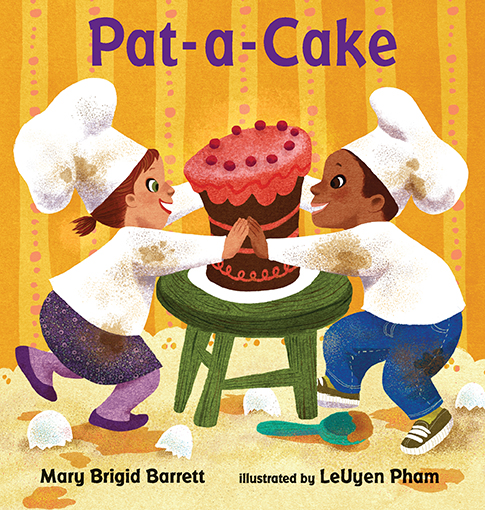
Author Mary Brigid Barrett riffs on traditional nursery rhymes with delightful results in Pat-a-Cake and All Fall Down (Candlewick Press, $6.99 each, ages birth-3). Take her opening lines of Pat-a-Cake, for example: "Pat-a-cake, pat-a-cake/CLAP, CLAP, CLAP/ Pat a pudding, Wibble Wobble/ Pat a puddle, SPLAT!" The merriment inherent in Barrett's text is matched by the gouache-and-watercolor ink illustrations by LeUyen Pham, who depicts a multicultural cast of kids and adults.

Olivia, that irrepressibly bossy picture book piggy, relishes her new job as teacher in Olivia's A. B. C (Atheneum, $7.99, ages 1-3). For each letter of the alphabet, author/illustrator Ian Falconer offers one or more examples; of course Olivia plays a starring role in each one. And it will come as no surprise to Olivia's many young fans that the one example for "Q" is "queen" -- "Queen Olivia" that is. As always, Falconer's illustrations, many of them drawn from previous Olivia books, will elicit chuckles from both young readers and their parents.
 Brightly-colored illustrations combine with a "lift-the-flap" format to make Honk, Honk! Baa, Baa! (Candlewick Press, $7.99, ages birth-2) a winner for the youngest readers. Babies and toddlers will enjoy mastering their animal sounds with this book, which was written and illustrated by Petr Horacek.
 A group of toddlers spends a busy day together in Baby Animal Farm (Candlewick Press, $6.99, ages birth-2), written and illustrated by Karen Blair. The big attraction on the farm for the young humans are the baby animals, including a kitten, piglet and calf. And it's a helpful puppy who saves the day by finding a teddy bear dropped by one of the toddlers. The pastel-hued illustrations, done in lithographic crayon and watercolor, are charmingly simple, yet never cutesy.