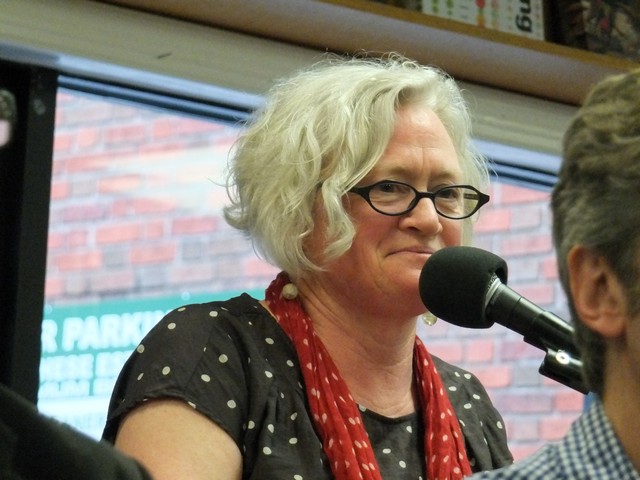
Marla Frazee put it right out there as she began her recent presentation to a group of kids and adults at my library, saying: "I love going to work every day and drawing pictures all day long." And, in a nutshell, that's exactly why Frazee's books are so wonderful: she draws from the heart.
 |
| Photos of Marla Frazee by Jeffrey MacMillan |
Her newest picture book,
The Farmer and the Clown, is just the latest demonstration of the way that Frazee pours her heart and soul into her work.
The Farmer and the Clown focuses on the unlikely bond between an elderly farmer and the young clown he briefly befriends when the clown accidentally falls off his circus train and lands on the farmer's property. The book is wordless, but Frazee's illustrations convey a world of emotions. She shows how the rather monochrome world of the farmer is brightened by the red-and-yellow-suited clown, just as he finds joy in in this new and unexpected friendship. The illustrations are stunning in their power to touch the reader, whether child or adult, and
The Farmer and the Clown already has garnered boatloads of critical acclaim and is being touted by children's book experts as a top possibility for the 2015 Caldecott Medal.
I've long been a Frazee fan, attracted by her keen drawing skill as well as by the way her illustrations reference past illustrators yet still seem so fresh. Her illustrations for the
Clementine books by Sara Pennypacker, for example, bring to mind -- as Frazee hopes -- the classic drawings by Louis Darling for the
Ramona books by Beverly Cleary. Perhaps most importantly, Frazee, a two-time Caldecott Honor winner, is a visual storyteller. She creates illustrations that engage both her emotions and, she hopes, the emotions of her readers. As she tells Roger Sutton, editor of
The Horn Book in a
recent interview: "... I feel like that's the big question when it comes to illustration -- how do you convey emotion in a picture? Not only over the span of the book, but in each individual image, each spread. What are you trying to say emotionally, and how do you show that emotion?"
In person, Frazee is a bundle of energy, and clearly enjoys meeting her fans, particularly young fans. As Frazee told the audience gathered at my library: "Here's a secret -- kids can read pictures better than grown-ups." Frazee then proceeded to lead a demonstration of this statement, briefly showing an illustration of two seemingly identical black-and-white dogs, the stars of her book,
Boot & Shoe, and asking the audience if they saw any difference between the two canines. Adults (including me, I'm afraid) shook their heads, while kids' hands immediately shot into the air. Frazee called on one young participant, who pointed out that one of the dogs had all black legs, while the other dog has white legs, ending in black "socks."
 |
| Marla smiles as I introduce her to the library crowd. |
So it's no wonder that, when she was
interviewed on the children's literature blog,
Seven Impossible Things Before Breakfast, by blogger Julie Danielson, Frazee said: "... the picture book audience (is) the most discerning, observant, critical, and appreciative group that we illustrators will ever have the privilege of serving." Or, as Frazee and her long-time editor, Allyn Johnston, wrote in a
2011 essay for
The Horn Book: "While the words in picture books are meant to be read aloud, children can read the pictures on their own. They don't need to be taught this skill and are, in fact, way better at it than grownups. They study pictures for story, meaning, character, setting, plot, and motivation and for a parallel, counterpoint, or secondary narrative. They notice everything, which obviously includes any mistakes."
Frazee herself was only a child when she knew that she would someday become a children's book illustrator. At her recent presentation, Frazee showed an illustration that she had done when she was little more than a toddler. It was hard to tell exactly what it was supposed to be, but Frazee's mother somehow saw early talent in her daughter and saved numerous drawings like these. Frazee created her first picture book in the third grade, prompted by her somewhat bossy best friend Lisa who said she would write the text and Frazee could illustrate it. Their teacher entered it in a statewide contest and the book won. Two years later, Frazee's fifth grade teacher, Mrs. Holcomb, predicted that Frazee "would illustrate picture books, painting outdoors in a sunlit meadow. So far, no meadow," as Frazee said in an
interview with
Something About the Author.
Actually becoming a children's book illustrator, however, took a lot longer than Frazee ever expected. After graduating with an illustration degree from the Art Center College of Design in Pasadena, Calif., Frazee was readily able to get work as an illustrator for advertisements, magazines and educational publications. She created team characters for the National Football League that were made into plush toys, designed Happy Meal boxes for McDonald's, and did toy design for Mattel, Milton Bradle, and Parker Brothers. But it was twelve long years -- filled with rejections from publishers, before Frazee illustrated her first book,
World Famous Muriel and the Magic Mystery, written by Sue Alexander and published in 1990.
At that point, Frazee thought she was finally on her way to achieving her goal of being a children's book illustrator. But it was actually five more years before she illustrated her second book,
That Kookery!, written by Margaret Walden Froehlich. The book was named a "notable book" by the Association for Library Service to Children, and it marked a turning point in Frazee's career. Looking back in an
interview with WETA's
Reading Rockets, Frazee noted that, until that point, "I wasn't telling stories with my pictures. I was doing something else with illustration, and in other areas of illustration that's appropriate. If you're doing advertising, you might have to communicate a message ... with your pictures. In educational publishing, it's teaching something with your illustrations. In toys and games, it might be a decorative thing that you're trying to do. With children's books, it's storytelling. I didn't have that component really developed."
These days, Frazee is considered a master visual storyteller. She also now writes some of the books she illustrates
; the first book that she both wrote and illustrated was
Roller Coaster, published in 2003 and a favorite among young readers in my library who love to pore over the riders' faces. In 2009, Frazee won her first Caldecott Honor for the hilarious picture book,
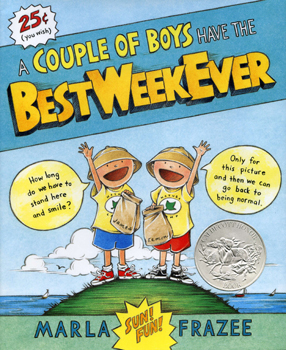
A Couple of Boys Have the Best Week Ever, which she also both wrote. A year later, Frazee won her second Caldecott Honor for
All the World, written by Liz Garton Scanlon. Other favorite Frazee books of mine include
The Seven Silly Eaters, written by Mary Ann Hoberman,
Stars, written by Mary Lynn Ray, and
The Boss Baby, both written and illustrated by Frazee. That book, Frazee told us, is being made into a full-length feature animation film by DreamWorks. She added: "I'm very interested to see how they take a 32-page picture book and create a full-length film!"
Meanwhile, I'm going to place a bet right now that
The Farmer and the Clown wins either a 2015 Caldecott Honor, or the Medal itself. It's just that good. And I'll close this blog with a laugh; in his recent interview with Frazee about the book, Roger Sutton noted that "it's kind of amazing when you think about what we can get away with in picture books. If you just described this situation -- a child gets tossed off a train, in the middle of a desert, and there's this old man, and he comes and takes the child to his house." Frazee responded: "Trust me, I know. Those closest to me will ask, 'What are you working on?' and I'll say something like what you just said, and they'll say, 'Oh my god. Are you serious?'"
End Notes: Thanks to Marla Frazee for a marvelous evening; thanks also to her editor Allyn Johnston for helping things go so smoothly. Thanks to Politics & Prose, especially Kerri Poore, for booking this presentation at my library. Huge thanks to my talented neighbor and friend, professional photographer Jeffrey MacMillan, for taking the photos of Marla that really make this blogpost look great. And finally, thanks to Simon & Schuster for the review copy of
The Farmer & the Clown.