Showing posts with label David Wiesner. Show all posts

Monday, May 2, 2016

Talking About Wordless Picture Books

It may have been a panel about wordless picture books, but the participants -- including three-time Caldecott Medalist David Wiesner and Caldecott Honor illustrator Marla Frazee -- had plenty to say about the topic.

The venue was the annual picture book panel organized by Mary Alice Garber, the chief children's book buyer at Politics & Prose bookstore in Washington, D.C.  This year's topic was "No Words Needed: The Value and Many Uses of Wordless Picture Books," and the panelists, in addition to Wiesner and Frazee, included Henry Cole, Raul Colon, and Stephen Savage. The moderator was Allyn Johnston, publisher of Beach Lane Books, a Simon & Schuster imprint.

L-R: David Wiesner, Henry Cole, Marla Frazee, Raul Colon & Stephen Savage. (Photos by Bruce Guthrie)

Johnston started things off with a friendly, yet pointed broadside, candidly noting that "I'm intimidated by wordless picture books. And maybe I don't even like them -- they make me work too hard to figure out what's going on."
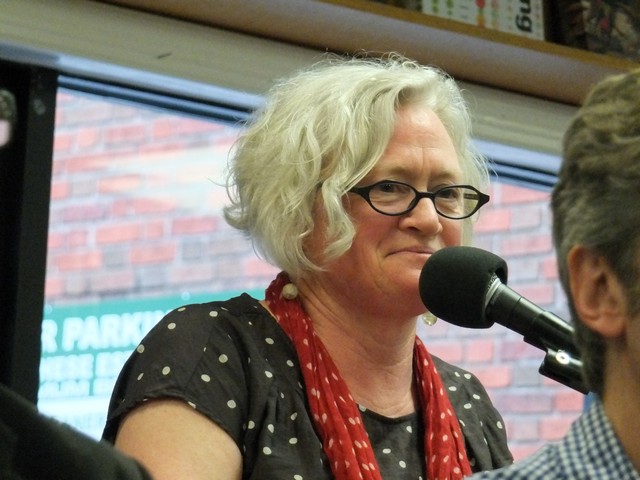
Beach Lane publisher Allyn Johnston
This drew a laugh from the audience, but Johnston's comments were ones that many librarians frequently hear from parents and teachers who wonder about the value of wordless picture books. After all, aren't words much more important than pictures? And why do kids need pictures after they learn to read?

 "For me, the pictures -- I read them like I read words," responded Wiesner, who has won two Caldecott Medals with wordless (or mostly wordless) books, Tuesday and Flotsam. (His third Caldecott Medal was for The Three Pigs). "I have the same reaction to reading words that you have to reading pictures," he told Johnston.

David Wiesner


Frazee, who eschewed words in her brilliant picture book The Farmer and the Clown, added that "it's such an honor to draw pictures for children because they are such expert readers of pictures. Whether it's a wordless picture book or not, children are going to look at the pictures in a way that surpasses what grown-ups can do."

Marla Frazee


Any librarian can tell you that's true, particularly since pre-readers are especially attuned at looking at the pictures as their parent, teacher or other grown-up reads the words to them. And being able to "read" pictures -- being "visually literate" -- actually is now a hugely important skill in today's screen-filled world where it is demonstrated daily that "a picture is worth 1,000 words."

Librarians also can tell you that kids have rebelled, in a big way, against adult efforts to take away the pictures once kids learn to read. Just look at the astounding popularity of author/illustrator Jeff Kinney's Diary of a Wimpy Kid books and other "hybrid" books, which feature an illustration on each page along with text. Or how about the skyrocketing popularity of graphic novels for kids? While both hybrid books and many graphic novels have both words and pictures, the illustrations are definitely as important as the text in these books, and that's clearly how young readers like it.

Yet most adults still don't seem to place much emphasis on pictures. The result? "I find it astonishing and disturbing that visual literacy just dissipates as kids grow up," Wiesner lamented. "When kids learn to read, they lose the ability to look at pictures," Frazee agreed.

Raul Colon
So how does an author/illustrator know when it's best to leave out the words? Sometimes, it's the editor who makes the suggestion, as Colon noted about his one wordless picture book, Draw!. "In my case, I had words in the book, and my editor took them out.... After we decided on that, I had to be sure that the pictures told more than one story." So Colon put in lots of details that aren't immediately apparent. "If you look at the pictures and go through the book really fast, you'll see the story, but you won't see all of the other things," he said.

Henry Cole
Cole, a former teacher, says he believes that wordless books are a great way to spark kids' own storytelling skills. For example, in Unspoken, his wordless book about the Underground Railroad, "kids can actually imagine for themselves what words could be there." And in his newest book, the wordless Spot, the Cat, readers can follow the main story as they look for the cat and his owner, and then go back and find all kinds of other stories by carefully looking at -- reading! -- the many details that Cole has included in his book.

Stephen Savage
Savage, meanwhile, noted that when he published Where's Walrus?, "I wasn't thinking of it being a teaching tool at all. What I liked about the fact that it was wordless was that it broke down the wall. Wordless picture books throw it back at the audience," and make it a more interactive experience. Savage said that he also loves the way that wordless books work with both kids and adults. "When I read my books.... I feel that a variety of ages can laugh at the same joke."

Still, it remains a challenge to convince many adults about the value of wordless picture books, the panelists agreed. Wiesner noted that he's been in bookstores where adults will page through one of his wordless books, remark on the lack of text, and move on to a more word-heavy book. Even worse, some adults will bring their own odd interpretations to wordless books, as was the case with The Farmer and Clown, where some adults felt the book showed the elderly farmer potentially abusing the young clown.


Johnston, who edited the book, clearly is still rankled by such "stranger danger" interpretations, which she called "ridiculous." Frazee agreed that these were "offensive" ideas, adding: "I thought a lot about the differences that adults bring to picture books. And I think that adults read into pictures while kids read pictures."


Then Frazee offered a lovely example of the power of wordless picture books, noting that she had received an email from a grandmother who had read The Farmer and the Clown with her three-year-old granddaughter, who had suffered the loss of several family members. In seeing how the farmer and the clown give each other their distinctive hats at the end, the little girl said: "Now they will remember each other forever." In her email to Frazee, the grandmother noted that The Farmer and the Clown "gave us an opportunity to talk about what it means to lose people and how we can remember them."

End Notes: Thanks to Mary Alice Garber and other Politics & Prose staff for putting together yet another thought-provoking panel on picture books. And thanks to Bruce Guthrie for taking such great photos.




Sunday, August 3, 2014

Caldecott Reading: "Go" by Chip Kidd

This spring, I was elected to the 2016 Caldecott Committee, an honor that thrills me, and also makes me a wee bit intimidated. Yes, I certainly know something about picture books, given my nearly 25 years as a children's book reviewer and eight years as a (second-career) children's librarian. But there's still so much to learn!

Our committee won't actually begin our work until January, as we will be reading eligible books throughout 2015 and awarding one of them the 2016 Caldecott Medal. So, like my fellow committee members, I've decided to use the intervening months to do lots of background reading. The Caldecott Committee manual includes a great suggested reading list, and our committee chair and my fellow members have recommended other books. In addition, there are three recent Caldecott webinars, which were produced by the Association for Library Service to Children.

Recently, I ordered some of the books on the Caldecott reading list from Alibris, and it's been fun seeing the books come in this past week. The books include: Lotus Seeds: Children, Pictures and Books by Marcia Brown (who is one of only two people to win three Caldecott Medals -- David Wiesner is the other one); Writing With Pictures by Caldecott Medalist Uri Shulevitz; Picture This: How Pictures Work by Caldecott Honor illustrator Molly Bang; Art and Design in Children's Picture Books by Lyn Ellen Lacy, and more. I've already dipped into a couple of the books, and it's clear that I'm going to have a fine old time reading them.

Over the next few months, I'll be posting now and then about what I'm reading to prepare for my Caldecott year. I've also decided to use this time as an excuse to read even more widely about art and graphic design -- something I've always wanted to do. I did take a year of art history, but it was through the specific lens of French art, as I was a French minor in college. As a result, my knowledge of other-than-French art history is pretty paltry. By good fortune, my son, who is an industrial design major at the Savannah College of Art & Design, is taking an online course in art history this summer. I've been borrowing his Janson's History of Art: The Western Tradition and leafing through it just for the heck of it.  I also rediscovered a dense little volume that I bought years ago, Learning to Look: A Handbook for the Visual Arts, which is one of a trio of books that have been used in the Humanities 1 course at the University of Chicago. (The other two volumes are Learning to Listen and What Happens in Literature.)

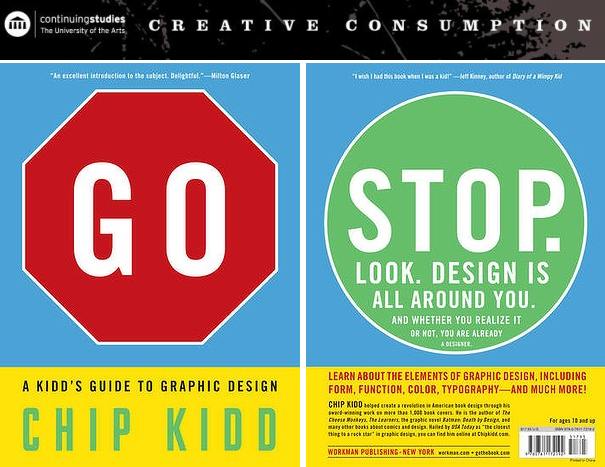
 It's certainly fun to take such a wide-angle look at art and art history as I prepare for my Caldecott year. But I'm trying to do that as a "sidebar" experience, as it were, while spending most of my time reading the volumes most focused on picture books and the Caldecott criteria. With that in mind, I picked up Go: A Kidd's Guide to Graphic Design (Workman Publishing, $17.95, ages 10 up) by Chip Kidd, a noted graphic designer.  Go was one of the five finalists for the Young Adult Library Services Association (YALSA) Award for Excellence in Non-Fiction, so I knew it would definitely be worth reading. Besides, one of the criteria for the Caldecott Medal states that "The committee is to make its decision primarily on the illustration, but other components of a book are to be considered especially when they make a book less effective as a children’s picture book. Such other components might include the written text, the overall design of the book, etc."

 So I figured it would be worth learning more about graphic design, about which I know little. Besides, the cover of Go was calling to me -- how can you resist a book where the title -- Go -- is designed to look exactly like that ubiquitous red-and-white sign that tells us to "Stop"? Besides the cover is printed on board pages -- just like a board book for little ones! -- something that I also found quite intriguing. But the cover was just the beginning of the delights of this book, which I found both educational and entertaining, and impossible to put down.


I learned, for example, about what exactly is graphic design and, perhaps more importantly, why I should care about it. Kidd's answer: "Because it affects you all the time. On average, every person in America is exposed to thousands of images a day, whether through advertising, television, the Internet, packaging, other people's tattoos, or t-shirts....Every single one of those things was designed by someone, a person whose job it was to decide what color it should be, where to put the type, what font to use, and how it should look. Whether it's the fine print on the back of a shampoo bottle, the colors on a box of cereal, or where to put the numbers on your remote control, there's a great deal of thinking that goes into the things you use, read, purchase, play with, and consume" The bottom line? "Everything that is not made by nature is designed by someone."

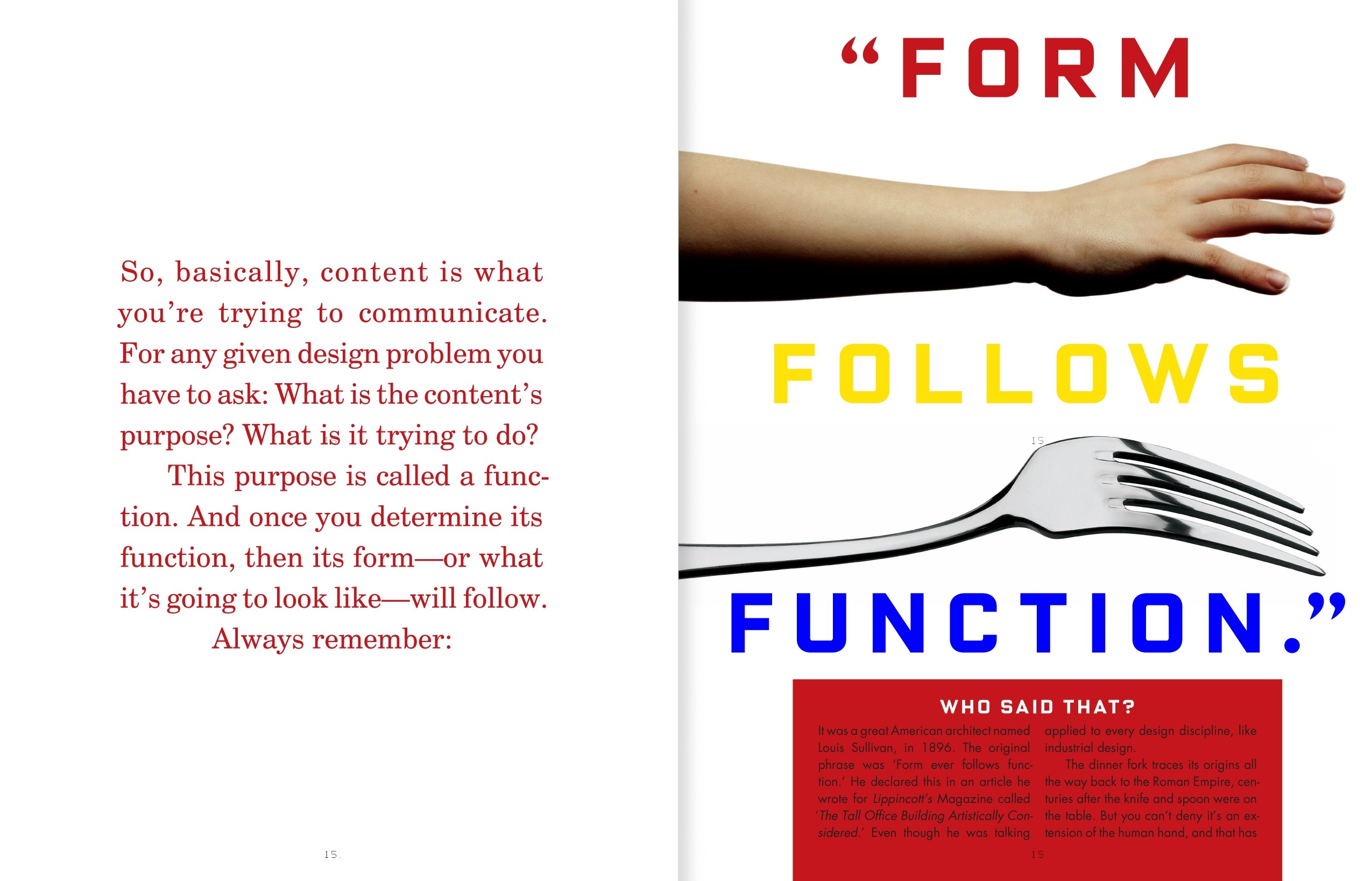
Kidd's book gives readers a tour through the basics of the one of graphic design, looking at major concepts like form, which includes things like color theory, pattern, symmetry, etc. Then there's the fascinating (to me) subject of typography (sans serif, anyone?) and, of course, the actual content. As Kidd notes: "If form is the last thing you consider when making a piece of graphic design, then content is the first.... Content is harder to figure out, but it's what you start with, and it dictates what form you design will take." For example, the fundamental question people may have when they are inside a place is "How do I get out of here?" Using a flowery blue script to spell out the letters on an orange background may look nice but it's hard to read. The typical "Exit" sign, meanwhile, uses straightforward red lettering on a white background, which makes it stand out and easy to spot -- a perfect case, Kidd says, of form following function.


Go was a blast to read, and I learned a ton of basic information about graphic design. Not surprisingly, the book is beautifully designed, and there are many illustrations to visualize Kidd's text. He also uses every part of the book, from the inside front cover to the copyright page to the inside back cover to convey -- both graphically and in written form -- more information about graphic design. Young readers interested in graphic design also will enjoy the 10 inventive design projects that Kidd suggests at the end of the book.

(Note: I used our library's copy of Go to write this review).