Friday, October 10, 2014

Three Times the Magic

What happens when you get three popular fantasy authors for kids together in the same place? We found out last night at my library when authors E.D. (short for Elizabeth Dawson) Baker, Annie Barrows and Jessica Day George gathered to discuss their just-published books at a program we co-sponsored with Politics & Prose Bookstore.
From left: Annie Barrows, Jessica Day George & E.D. Baker
 Although the program wasn't scheduled to begin until 7:30 p.m., excited young fans -- pretty much all girls ages 7-12 and their assorted grown-ups -- started gathering in our library's Children's Room around 6:30 p.m.
Costumed fans
 Some of these fans had driven an hour or more to get to the program, while others even went to the trouble of making their own costumes, based on characters created by one or other of the trio of authors. By the time the program began, our Children's Room was packed, we had run out of places to add chairs, and the excitement in the room was truly palpable.

Well, the fans certainly weren't disappointed. There was a real synergy with this trio of authors, each of whom spoke about how they started writing and why they particularly love magic and fantasy. There are many common threads, including the fact that all three are big on writing books about princesses who are strong females. They all also love to leaven their books with humor.

E.D. Baker (Photo by Kimmy Bender)
 But each author has her own interesting back story. E.D. Baker, for example, lives on a horse farm, where she raises Appaloosas and spends lots of time every day "doing horsey things." Although E.D. has been a writer most of her life, she was a psychology major in college and then worked in business and as a teacher before taking the plunge into full-time writing.  She published her first book, The Frog Princess, in 2002; some years later, it was made into a Disney movie, The Princess and the Frog, although -- as is often the case -- the book and movie don't much resemble each other.

The just-published The Fairy-Tale Matchmaker is E.D.'s 15th book, and launches a new series. The book stars a tooth fairy who ditches her job and discovers some marvelous new magical talents. E.D. already has completed a sequel, which will be published next year.

Last night, E.D. told the audience that she's always enjoyed fairy tales "but I never liked the way young women were portrayed in them." That's exactly why none of E.D.'s protagonists are damsels in distress -- she wants to show her young readers that princesses definitely don't have to wait to be rescued but can go ahead and rescue themselves, and others too!

Annie Barrows, meanwhile, has written books for both kids and adults. Her adult book, written with her late aunt Mary Ann Shaffer, is the best-selling novel, The Guernsey Literary and Potato Peel Pie Society, which has been published in 37 countries and in 32 languages. Annie also has struck gold with her first children's series, the Ivy + Bean books.

Annie Barrows
Annie came late to the job of full-time author, however.  After studying medieval history in college (her online bio notes that Annie "knows more than the average person about 3rd century saints"), Annie worked for a publisher, Chronicle Books, rising through the ranks to become senior editor there.

But Annie really wanted to write, and so left publishing to try to write full-time. The first Ivy + Bean book was published in 2006, and the 10 books in the series have become best-sellers and favorites of kids at the early chapter stage. While the Ivy + Bean books are realistic fiction, Annie longed to try writing a fantasy novel and so, in 2008, she published The Magic Half. Her newest book, Magic in the Mix, is the much-awaited sequel.

Jessica Day George says her life has revolved around the phrase "it's all about the books." She's serious; as she writes on her website: "My criteria for choosing a purse is that it must be able to fit a paperback book inside. I took books on my honeymoon, and bought more while we were there."
Jessica Day George

Jessica collects books about dragons and studied Old Norse in college so she could read the Viking sagas in the original language. Her first book, Dragon Slippers, was published in 2007, and immediately hooked readers with its humor and strong-willed protagonist. Since then Jessica has published nine more books, despite the fact that she has to fit her writing time in around caring for her three young children.

 Jessica's latest book is Thursdays with the Crown, the latest in the Castle Glower series featuring Princess Celie and a moving castle. At our event, Jessica stressed that she writes "the kind of book I would have liked to read when I was younger."

After their presentations, the authors took questions from the audience. One of my favorites was asked by a little girl, tagging along with an older sister but still clearly spellbound. She asked the authors why they were holding up books. After getting over their initial laughter,  the three explained that "this is what we do for work" and the books are the product of that work.
Tired but happy young fans.

 Then it was time for the book signing, with many young fans moving from author to author to have their books signed. And then, sadly, it was time for the program to come to an end, but it was -- fortunately -- a happy ending, with young readers leaving with their noses already buried in their new books.

End notes: Thanks so much to Kerri Poore in the Children's Department of Politics & Prose for organizing the event, and to Lizzy Mason, associate director of publicity at Bloomsbury Children's, for offering us a program with such a great trio of authors. Thanks also to Lizzy for providing review copies to me of The Fairy-Tale Matchmaker, Magic in the Mix, and Thursdays with the Crown.


Sunday, October 5, 2014

Can You Say 'Dork'?

Here's a little something I learned the other night when my library, in conjunction with Politics & Prose Bookstore, hosted the authors and illustrator of the best-selling Dork Diaries series: you don't have to worry about attracting a crowd.

 Even on a school night, we just about filled the Takoma Park Community Center auditorium, which seats more than 100 people. And the excitement was palpable -- a perfect reflection of the OMG!!! and SQUEE!!!! glittery fervor found in the books, written by Rachel Renee Russell, with help from her daughter, Erin, and illustrated by her other daughter, Nikki. Everyone in the audience -- even the adults -- were clearly thrilled to be part of the launch of Dork Diaries Book No. 8: Tales of a Not-So-Happily Ever After.

The crowd was definitely girl-heavy, with just a smattering of boys (who looked like they were just tagging along with their sisters). Yet, here's the interesting thing: it was a wonderfully diverse crowd in terms of race. I mention this because Rachel Russell has been criticized for making her main character, Nikki, white. With the whole "We Need Diverse Books" push these days, lots of people are looking for main characters of color, and here is Rachel Russell -- herself an African-American -- choosing to make her main character white. In an interview with The New York Times last year, Russell defended her decision, saying that she saw Nikki as an “Everygirl, all hues mixed together,” and noted that Nikki's best friends are African-American and Latino, although it's hard to tell because of the stylized, anime-type, black-and-white illustrations. In response to a question from the audience at our event, Rachel Russell reiterated that "I am committed to diversity."

Nikki, Erin & Rachel Russell wearing tiaras for their latest book.
Young Dork Diaries fans certainly don't seem to have any diversity issues with the books. All of the young fans who came to our event the other night readily identified with the middle school challenges faced by Nikki, which include dealing with her bratty younger sister Brianna, her nemesis MacKenzie, and her crush, a boy named Brandon.

 Meanwhile, at our event, the Russell family (Rachel's sister Kim and brother Don were part of the entourage) pulled out all the stops to please their fans. For example, during the Q & A section, Nikki Russell spent most of her time behind an easel doing "dorkifications" -- i.e. portraits in the Dork Diaries style -- of a few lucky questioners. The girls were thrilled when they received their large-scale portraits.

 Nikki Russell also agreed to do a small-scale "dorkification" in one book for each fan when the book signing began. This slowed down the line considerably, but that was no issue with all of the young fans, who were happy to wait for such personalization. (Their parents, however, were a teeny bit less patient as they worried about late bedtimes).

Rachel, Erin and Nikki Russel were gracious with each fan, really taking time to talk with them and personalize each book. Of particular note was their willingness to stop and pose for photographs with a fan; each time they did this, the Russells would say in unison: "On the count of three, say "dork:" 1, 2, 3 -- DORK!"

Fans also were delighted by two pieces of news. The first item is that Rachel and Erin Russell are working on a spin-off series, titled Locker Boy. The main character is, of course, a boy, although Rachel Russell said there's also a strong girl character. The second piece of news is that Lionsgate Summit Entertainment will be making a Dork Diaries movie, set to be released in 2016.

One mother of a young fan provided a nice wrap on the night, saying "Thank you for writing these books!" and telling the Russells that the Dork Diaries had renewed her daughter's interest in reading. There's no higher compliment for an author than that.


Wednesday, October 1, 2014

"Wild Things:" The Real World of Children's Literature

When I first heard about Wild Things: Acts of Mischief in Children's Literature last spring, I immediately made a note of the publication date. I'm one of those folks who is fascinated by the "behind-the-scenes" stuff, especially if it involves children's literature, and this book by three well-known bloggers looked just spectacular.

 Let me just say right now that I wasn't disappointed. Not even one little bit. And that's certainly not surprising, given the kit lit chops of the three authors: Betsy Bird, who blogs at A Fuse # 8 Production, Seven Impossible Things Before Breakfast blogger Julie Danielson, and the late, great Peter D. Sieruta, whose Collecting Children's Books blog remains a gold standard of the kid lit blogosphere. These three did prodigious research to uncover the secrets behind children's literature classics and their authors and illustrators; in fact, they ended up with so much wonderful information that their editor told them they couldn't put it all in the book.

 Fortunately, Betsy and Julie had the terrific idea of creating a separate Wild Things website, where -- in the weeks before publication -- they shared intriguing snippets of the book that ended up on the cutting room floor. (The site continues as a place where we can catch "Sneaky Peek Videos" of new books as a way of celebrating the publication of Wild Things).

There's so much good stuff in Wild Things that I've read the book twice and still feel that I've only scratched the surface. Some of things they include are well-known, such as how Robert McCloskey brought home ducklings to the Greenwich Village apartment he shared with fellow children's book artist Marc Simont so he could really capture their movements in his drawings. And I knew from Anita Silvey's 100 Best Books for Children that McCloskey had plied the ducklings with wine to slow them down so he could better draw them But what I learned from Wild Things took things further, as you'll learn from the interview below.

Then there's an "interlude" titled "Some Hidden Delights of Children's Literature" in which the Wild Things authors take a peek at things like Caldecott Medalist Trina Schart Hyman's "dirty tricks" in two particular books; read on for the specifics, found in the interview below. Such vivid details are the stuff from which Wild Things is constructed. But there's so much more here, including a well-informed look at the key role that GLBT authors and illustrators have played in children's literature and the provocatively-titled chapter on subversive children's literature, "There Should Not Be Any 'Should' in Art."

WILD THINGS!. Illustrations copyright © 2014 by David Roberts. Reproduced by permission of the publisher, Candlewick Press, Somerville, MA.
 

Ok, you can tell that I feel you should run out and get your hands on this book ASAP, either at your local bookstore or library. Meanwhile, I was honored to be part of a blog tour with Betsy and Julie, and I'm now going to turn things over to them in the form of an interview that we did by email. Before I do that, however, I extend apologies to Betsy and Julie for taking so long to get my part of the show on the road; sometimes real life presents gets in the way of my best blogging efforts. With that out of the way, here we go!

Betsy Bird
Me: First, let me tell you how much I enjoyed your book! I’ve read it twice already; the first time I raced through it, delighting in
Julie Danielson
the stories that you told. Then I read it again, taking my time to enjoy the engaging writing. Bravo! Now for the questions….

We are so glad you enjoyed it!

  1. Can you talk a bit about how the book came about? Others before you, including Anita Silvey and Leonard Marcus, have told some of the stories behind children’s stories, but you have managed to come up with a book that really takes a fresh look at children’s literature. Was your initial focus on “acts of mischief” or did that focus develop as you began pulling together threads for the book?

Jules: It really all started with a desire to debunk the romanticized view of children’s literature that is so prevalent, as well as the condescension that sometimes occurs. We initially had a different book in mind, honestly – one that was mostly the wilder stories that go to show that authors and illustrators are grown-ups and don’t live sweet and adorable lives. But we quickly came to realize, in large part thanks to our editor, that we needed more context and analysis – and that the book needed more shaping. So then those wilder, more fun stories became the stuff of the “interlude” chapters, and the chapters that tackle some of the weightier issues (censorship, gatekeeping, etc.) became more of the focus.

As for “acts of mischief” (the very phrase itself), I teach a graduate course on picture books, and I ask my students to read Patricia Lee Gauch’s wonderful lecture on picture books as acts of mischief (http://www.hbook.com/2012/11/using-books/the-picture-book-as-an-act-of-mischief/http://www.hbook.com/2012/11/using-books/the-picture-book-as-an-act-of-mischief/), and it was then I realized that phrase was a perfect fit for our book. We then secured her permission (and the Eric Carle Museum’s permission) to use that wording.


  1. I know that your editor (Liz Bicknell) required you to cut huge swaths of copy, some of which – thankfully – you’ve still been able to share via the Wild Things website. Can each of you tell me which story or section was the hardest for you to part with? Did you ever put your foot down, a la Maurice Sendak and the word “hot” in Where the Wild Things Are, and have a stare-down with your editor?

Betsy: No, I don’t think we ever really disagreed with our editor in that way.  All she told us was the page count to shoot for.  The decision of what to cut then fell entirely onto our little shoulders which, in a way, was much worse.  We didn’t have an editor to blame when our favorites fell by the wayside now! 

I think the hardest cut for me was the Misty of Chincoteague. We’d used that picture of Misty at an ALA meeting in our initial proposal so it felt wrong to lose her.  But lose her we did.  For the greater good, yes?

Jules: It was hard to say goodbye to the tender James Marshall story about his burial site, but we shared it at our site. I’m a big Marshall fan.

  1. I love the illustrations by David Roberts, and the way that they play on one of your central themes: how so many adults are enamored of “fluffy bunny” stories while kids are looking for subversive reads. It really seems that all too many adults have totally forgotten what it’s like to be a kid, “small, courageous people who deal every day with a multitude of problems,” to quote Maurice Sendak.  What do you make of this dichotomy, and, in particular, the idea that so many adults see children as “blank tablets” and thus feel compelled to oversee their reading choices?


Jules: To me, it all boils down to respect for children. I love to see those authors and illustrators who create stories that acknowledge that children are not only, as Sendak said, courageous, but they are also resilient and capable of handling more than many adults assume. It’s hard, because yes, you want to extend the innocence of children. (I think it was Maya Angelou who once used that phrase – to give credit where credit is due.) But I think they can also handle way more than most grown-ups assume. And it’s good for them to face down ogres in the comfy confines of a story, while sitting on mama’s or papa’s lap, because the world is full of ogres of all stripes. And mama’s or papa’s lap is a really safe place to wander through the dark and scary forest.

I always cringe when I see those adults who talk to children as if they are little morons. (It happens. A lot.) It always seems to be accompanied by a raised voice, too (as if the child can’t hear you?) and rampant use of the word “precious.”

  1. Continuing a bit on that theme, you lay out quite nicely how kids tend to love subversive books. Years ago, it was series books that kids flocked to and thus attracting the ire of adults and librarians like Anne Carroll Moore (and forced me to buy my own Nancy Drew books as a kid, since libraries refused to purchase them). Today, as a librarian, I see the same dynamic in play, only the battle is over kids’ love of comics and hybrid books like the Diary of a Wimpy Kid series. Seems like a case of “the more things change, the more they remain the same”! Are we destined, in your opinion, to forever see a literary gulf between kids and adults?

Jules: That’s a good (and tough) question. We definitely see overlap---those books, that is, that both children and gatekeepers love---but even when we don’t … well, it goes back to what I just said about respect for the child reader. We have to let them read what gets them fired up. Sometimes I hear teachers and librarians dismissing a book that is, say, below the reading level of the child (as usually determined by some random test) or maybe they’re dismissing a graphic novel or book on CD as “not reading.” That’s unfortunate. I read this (http://parnassusmusing.net/2014/08/17/jon-scieszka-on-how-to-get-kids-to-read-tip-stopping-telling-them-how-important-reading-is/http://parnassusmusing.net/2014/08/17/jon-scieszka-on-how-to-get-kids-to-read-tip-stopping-telling-them-how-important-reading-is/) from Jon Scieszka recently, and I wish every teacher and librarian in the country could read it. Let them read what they like!

Now, I’m the mother of a fifth-grader who tends to only read fantasy. But we read aloud together a lot, so what do I do? I make sure I sneak in some realism for her, because sure, I want her to be exposed to different things. But I’d never tell her or her sister that they weren’t allowed to read something they found tremendously fun. As Scieszka always says, we need to relax when it comes to children and reading.

Betsy: And if I might raise a flag in defense of librarians, I’d say that there’s a big difference these days between how gatekeepers view comics and comic hybrids today versus even ten years ago.  We’re beginning to see adults really grasping the myriad of forms out there more than ever before.  It’s not universal, but it’s increasing.

In defense of Anne Carroll Moore (a phrase not heard often enough as she tends to be the bogeyman uptight librarian stand-in these days) series were crap back then.  Nancy Drew and Hardy Boys (and Oz books) were the exception to the rule.  90% of the stuff out there was just awful and there were just SO MANY of them that it was really easy to justify not buying them by saying the libraries didn’t buy series.  It was as much a budget decision as a qualitative one.  Nancy just happened to suffer as a result.  


  1. I’m fascinated by your idea that children’s books may evolve more than any other literary genre, especially the ideas that “rather than accompany social change, children’s books have a way of preceding it.” This is another major theme of your book, and I’d love to have you expand on it a bit.

Betsy:  Well, folks have always used children’s literature as a way of promoting their own agendas.  That’s pretty well known.  But other folks have turned to children’s literature as a place of freedom when denied the right to write elsewhere.  That’s a little less well known.  Take the blacklist era during the Red Scare.  Writers left and right were told they couldn’t write books or screenplays anymore so what did some of them do?  They turned to children’s literature and wrote in that field for a while. 

Yet ironically, just because someone’s a great adult author, that doesn’t mean they’re a great children’s author as well.  So society’s mores get challenged in children’s books because the authors are both great writers and, in a sense, ahead of their time.

  1. Given the importance of children’s books, it’s perturbing that those who create them often get so little respect, a problem that you spotlight in your book. As a children’s librarian and children’s book reviewer, it maddens me when people say that a children’s book would be “fun” and “easy” to write, and that any celebrity thinks he or she can do it. In fact, Lois Lowry once told me that, even after winning two Newbery Medals, some people still ask her when she’s going to write a “real” book, i.e. one for adults. Can you talk a bit more about this lack of respect for children’s book creators?

Jules: Well, it’s something I hear about a lot. I don’t understand why it happens. We write in our book that, for whatever reason, it seems that if people work with children in any way in this country, their profession is often condescended to (daycare teachers, children’s librarians, teachers, authors, illustrators). It’s baffling, and I think an entire book could be written about this phenomenon. In fact, Beverly Lyon Clark explores the marginalization and frequent diminishment of children’s literature in her book, Kiddie Lit: The Cultural Construction of Children’s Literature in America, which was published in 2003, so one thing I can do is recommend people read that.

  1. Who do you see as the audience for your book? And what do you hope readers take away from this book?

Betsy: The audience was always a question right from the start.  As we saw it, the book could have gone one of two ways.  Either we were writing for people already in the know (children’s librarians, booksellers, academics, teachers, and maybe the odd parent) or we were writing for the cultural mainstream.  Eventually we realized that we would shoot for the latter while doing everything in our power to make the former happy. 

As for what we hope readers take away from our book, it’s all about R-E-S-P-E-C-T, baby.  Respect for the people writing these books your kids read.  Respect for the book themselves and what they are capable of doing.  And a healthy understanding that books for kids aren’t written by little angels on fluffy clouds.  These people have adult problems and attitudes.  They just also happen to be geniuses at talking to the young. 

  1. I’m blown away by the amount of research you folks did for this book. For each of you: what was the thing you learned from your research that most surprised you?

Betsy: That would be the fate of the Robert McCloskey ducklings.  There were certain facts about their case that I already knew.  I knew that Mr. McCloskey bought a bunch of ducks and put them in his Greenwich Village apartment so that he could draw them and get them just right for Make Way for Ducklings.  I knew that he gave them red wine to slow them down.  And I may even have known that he had a devil of a time getting rid of those ducks once he was finished capturing their ducky waddles on paper.  But what happened to them after that?  That is where our research got interesting.  And tragic!

Jules: It was fun to stumble upon the story of the witch’s table in King Stork, illustrated by Trina Schart Hyman. I read about it (a very brief mention) in her 1985 Caldecott acceptance speech for St. George and the Dragon. None of us knew that story, so it was neat to track down. I can’t say it was terribly surprising, though, since she was fearless. 


  1. You have a fascinating discussion in the book about GLBT authors and illustrators, especially your statement that “it should come as no surprise that the greatest stories written for children are those produced by people who have felt outside of the mainstream in some manner.” Can you please talk more about this?

Betsy:  Absolutely. One of the big shocks I discovered while researching for this chapter was that there has never been a book about GLBT children’s authors and illustrators.  None!  Individual biographies, perhaps, but nothing all-encompassing.  So as I culled from the past and looked through the names of great authors, it became crazy clear that when you put them all together they make up the top names in the business.  Maurice Sendak, Arnold Lobel, Louise Fitzhugh, Margaret Wise Brown (arguably), James Marshall . . . the list goes on and on!  These are people who had private lives at odds with the times in which they lived.  And outsiders, to be perfectly frank, often make the best works for children because kids themselves often feel like outsiders as well.  It’s a match made in heaven.

  1. Finally, you conclude with a look at the future of children’s literature. Can you talk a bit about what you see in your crystal balls?

Jules: I certainly can’t predict the future, but I do hope that we see strides when it comes to tolerance for topics that are now considered taboo, depending on what part of the country you live in. There are still so many people who take issue with characters in children’s lit who fall on the GLBT spectrum. I hope we see less and less of those books challenged. I also hope that diversity in children’s literature becomes commonplace; the stats right now are depressing, as this link makes clear: http://blog.leeandlow.com/2013/06/17/why-hasnt-the-number-of-multicultural-books-increased-in-eighteen-years/.


I think I can safely say that Betsy would agree with me on those points, too.

Betsy: Couldn’t have put it better myself.


Thanks so much, Betsy and Julie, for taking the time to answer these questions!!

Thank you so much, Karen!


Saturday, September 20, 2014

Marla Frazee, Picture Book Creator Extraordinaire

Marla Frazee put it right out there as she began her recent presentation to a group of kids and adults at my library, saying: "I love going to work every day and drawing pictures all day long." And, in a nutshell, that's exactly why Frazee's books are so wonderful: she draws from the heart.


Photos of Marla Frazee by Jeffrey MacMillan

 Her newest picture book, The Farmer and the Clown, is just the latest demonstration of the way that Frazee pours her heart and soul into her work. The Farmer and the Clown focuses on the unlikely bond between an elderly farmer and the young clown he briefly befriends when the clown accidentally falls off his circus train and lands on the farmer's property. The book is wordless, but Frazee's illustrations convey a world of emotions. She shows how the rather monochrome world of the farmer is brightened by the red-and-yellow-suited clown, just as he finds joy in in this new and unexpected friendship. The illustrations are stunning in their power to touch the reader, whether child or adult, and The Farmer and the Clown already has garnered boatloads of critical acclaim and is being touted by children's book experts as a top possibility for the 2015 Caldecott Medal.


I've long been a Frazee fan, attracted by her keen drawing skill as well as by the way her illustrations reference past illustrators yet still seem so fresh. Her illustrations for the Clementine books by Sara Pennypacker, for example, bring to mind -- as Frazee hopes -- the classic drawings by Louis Darling for the Ramona books by Beverly Cleary. Perhaps most importantly, Frazee, a two-time Caldecott Honor winner, is a visual storyteller. She creates illustrations that engage both her emotions and, she hopes, the emotions of her readers. As she tells Roger Sutton, editor of The Horn Book in a recent interview: "... I feel like that's the big question when it comes to illustration -- how do you convey emotion in a picture? Not only over the span of the book, but in each individual image, each spread. What are you trying to say emotionally, and how do you show that emotion?"

In person, Frazee is a bundle of energy, and clearly enjoys meeting her fans, particularly young fans. As Frazee told the audience gathered at my library: "Here's a secret -- kids can read pictures better than grown-ups." Frazee then proceeded to lead a demonstration of this statement, briefly showing an illustration of two seemingly identical black-and-white dogs, the stars of her book,  Boot & Shoe, and asking the audience if they saw any difference between the two canines. Adults (including me, I'm afraid) shook their heads, while kids' hands immediately shot into the air. Frazee called on one young participant, who pointed out that one of the dogs had all black legs, while the other dog has white legs, ending in black "socks."

Marla smiles as I introduce her to the library crowd.

 So it's no wonder that, when she was interviewed on the children's literature blog, Seven Impossible Things Before Breakfast, by blogger Julie Danielson, Frazee said: "... the picture book audience (is) the most discerning, observant, critical, and appreciative group that we illustrators will ever have the privilege of serving." Or, as Frazee and her long-time editor, Allyn Johnston, wrote in a 2011 essay for The Horn Book: "While the words in picture books are meant to be read aloud, children can read the pictures on their own. They don't need to be taught this skill and are, in fact, way better at it than grownups. They study pictures for story, meaning, character, setting, plot, and motivation and for a parallel, counterpoint, or secondary narrative. They notice everything, which obviously includes any mistakes."

Frazee herself was only a child when she knew that she would someday become a children's book illustrator. At her recent presentation, Frazee showed an illustration that she had done when she was little more than a toddler. It was hard to tell exactly what it was supposed to be, but Frazee's mother somehow saw early talent in her daughter and saved numerous drawings like these. Frazee created her first picture book in the third grade, prompted by her somewhat bossy best friend Lisa who said she would write the text and Frazee could illustrate it. Their teacher entered it in a statewide contest and the book won. Two years later, Frazee's fifth grade teacher, Mrs. Holcomb, predicted that Frazee "would illustrate picture books, painting outdoors in a sunlit meadow. So far, no meadow," as Frazee said in an interview with Something About the Author.


Actually becoming a children's book illustrator, however, took a lot longer than Frazee ever expected. After graduating with an illustration degree from the Art Center College of Design in Pasadena, Calif., Frazee was readily able to get work as an illustrator for advertisements, magazines and educational publications. She created team characters for the National Football League that were made into plush toys, designed Happy Meal boxes for McDonald's, and did toy design for Mattel, Milton Bradle, and Parker Brothers. But it was twelve long years -- filled with rejections from publishers, before Frazee illustrated her first book, World Famous Muriel and the Magic Mystery, written by Sue Alexander and published in 1990.


At that point, Frazee thought she was finally on her way to achieving her goal of being a children's book illustrator. But it was actually five more years before she illustrated her second book, That Kookery!, written by Margaret Walden Froehlich. The book was named a "notable book" by the Association for Library Service to Children, and it marked a turning point in Frazee's career. Looking back in an interview with WETA's Reading Rockets, Frazee noted that, until that point, "I wasn't telling stories with my pictures. I was doing something else with illustration, and in other areas of illustration that's appropriate. If you're doing advertising, you might have to communicate a message ... with your pictures. In educational publishing, it's teaching something with your illustrations. In toys and games, it might be a decorative thing that you're trying to do. With children's books, it's storytelling. I didn't have that component really developed."

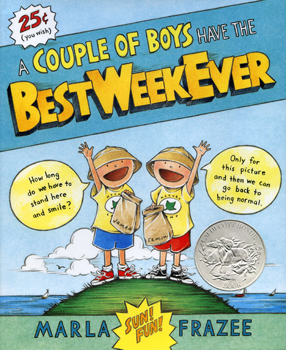
These days, Frazee is considered a master visual storyteller. She also now writes some of the books she illustrates; the first book that she both wrote and illustrated was Roller Coaster, published in 2003 and a favorite among young readers in my library who love to pore over the riders' faces. In 2009, Frazee won her first Caldecott Honor for the hilarious picture book, A Couple of Boys Have the Best Week Ever, which she also both wrote. A year later, Frazee won her second Caldecott Honor for All the World, written by Liz Garton Scanlon. Other favorite Frazee books of mine include The Seven Silly Eaters, written by Mary Ann Hoberman, Stars, written by Mary Lynn Ray, and The Boss Baby, both written and illustrated by Frazee. That book, Frazee told us, is being made into a full-length feature animation film by DreamWorks. She added: "I'm very interested to see how they take a 32-page picture book and create a full-length film!"


Meanwhile, I'm going to place a bet right now that The Farmer and the Clown wins either a 2015 Caldecott Honor, or the Medal itself. It's just that good. And I'll close this blog with a laugh; in his recent interview with Frazee about the book, Roger Sutton noted that "it's kind of amazing when you think about what we can get away with in picture books. If you just described this situation -- a child gets tossed off a train, in the middle of a desert, and there's this old man, and he comes and takes the child to his house." Frazee responded: "Trust me, I know. Those closest to me will ask, 'What are you working on?' and I'll say something like what you just said, and they'll say, 'Oh my god. Are you serious?'"

End Notes: Thanks to Marla Frazee for a marvelous evening; thanks also to her editor Allyn Johnston for helping things go so smoothly. Thanks to Politics & Prose, especially Kerri Poore, for booking this presentation at my library. Huge thanks to my talented neighbor and friend, professional photographer Jeffrey MacMillan, for taking the photos of Marla that really make this blogpost look great. And finally, thanks to Simon & Schuster for the review copy of The Farmer & the Clown.


Wednesday, September 17, 2014

The "Uber-Talented" Eleanor Davis

Eleanor Davis has been a star in our Children's Room for some time. Kids just learning to read love her graphic novel reader, Stinky, while her book, The Secret Science Alliance and the Copycat Crook, is one of our most popular graphic novel check-outs among young readers.

 But Davis' recent presentation at our library (part of our partnership with Politics & Prose) wasn't about kid stuff. Instead, Davis was focused on her new graphic novel for adults, How To Be Happy. Even more than that, her presentation, which was riveting, fascinating and more than a bit confounding, was rated PG-13. (Davis herself gave it that rating because of strong language and discussion of sexual topics).

It was a thought-provoking presentation of truth and lies, woven together and mixed with Davis' lyrical commentary and artwork that is simply stunning in its emotional impact and artistic vision -- much like her new book. After the program, Davis noted that she was tired of talking about her life,  and figured that presenting variations on her life -- mixing truth with falsehood -- would make things more interesting. It certainly did, and it was entertaining for me -- a former reporter -- to be taking notes on Davis' talk and then suddenly be told that the facts presented in that section were "90 percent lies."!

 While I've read How To Be Happy a couple of times and am awestruck by Davis' imagination and artistic talent, I would have a hard time trying to review it. The book is a series of short stories, each done in a different artistic style, so there are many different pieces to interpret and review. And I'm still very much a neophyte when it comes to graphic novels. So let me link to a couple of folks who do know graphic novels and are fans of Davis' work in general and of How To Be Happy in particular.

In his April 19, 2014 blog for Forbidden Planet, Richard Bruton noted that, "Eleanor Davis is, without question, a major young creator," adding: "Despite (her) changing styles, the constant is an incredible storytelling sense....." You can read more here.

Eleanor Davis signs books for a fan.
 And Tim O'Shea, in an interview with Davis published on June 30, 2014 on ComicBookResources.com says that "her work often strikes me as the comics equivalent of an interpretive dance. I have no other way to describe the core response that her work elicits from me. I look repeatedly at some of the pages in this collection (How To Be Happy) and still find something new each time." O'Shea's interview with Davis can be read here.

Best of all, take a look at what my library colleague, graphic novel guru Dave Burbank, has to say about Davis and her work here.

My only disappointment of the evening was when Davis said she wasn't planning to do a sequel to The Secret Science Alliance. Noting that she frequently gets letters from young readers asking for a sequel, Davis said that the book just took too much time, even with the lettering help from her talented graphic novelist husband, Drew Weing. But Davis urged disappointed readers to follow Weing's web comic, The Creepy Casefiles of Margo Magoo, which she likened to The Secret Science Alliance. I've just started reading it, and I'm enjoying it so far. Perhaps Weing will publish a book someday containing the entire story. That's how it goes these days in the comics world. Things that start as web comics can become big sellers in published print form -- just look at the success of Smile, Raina Telgemeier's best-selling graphic novel that started as a web comic.

One last note on Davis. In searching for information about her on the Internet, I discovered that she had been invited to do a Google Doodle a few months ago. Like all of Davis's work, it is quirky, beautiful and incredibly unique. Check it out in this interview that Davis did with Michael Cavna, who covers comics for The Washington Post and who deserves the credit for correctly labeling Davis as "uber-talented."

Sunday, September 7, 2014

The Raina, Dave, and Jimmy Show

If you know a kid who likes graphic novels (and who doesn't?), then you likely are familiar with books by Jimmy Gownley, Dave Roman, and the reigning queen of kids' comics, Raina Telgemeier. So it was no surprise to see a big crowd of excited kids and parents yesterday when the three graphic novelists presented a program at Politics & Prose Bookstore in Washington, D.C.

All three have won top awards for their work, and they've also been among the first wave of those filling the new -- and ever growing -- market for graphic novels for kids. Gownley's Amelia Rules books are beloved by our library's young readers, who especially enjoy the feisty Amelia. Roman's two Astronaut Academy books may be set in outer space, but readers love the fact that the characters face the kind of everyday friendship challenges that every kid understands. And Telgemeier's books, especially her Eisner Award-winning graphic memoir Smile, are among the most popular in our entire library. Kids are just fascinated to read about the emotional consequences of the dental drama that Telegeimer endured in middle school and high school.

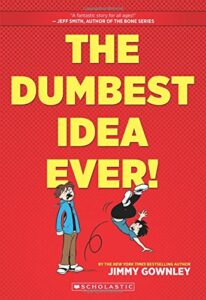
At Saturday's event, the trio focused on presenting their newest books before taking questions from the audience. Gownley went first, talking about his new graphic memoir, The Dumbest Idea Ever!, which details how he created and self-published comics as a teenager. Gownley's initial efforts at creating comics were scorned by his best friend, who told him: "You should make a comic book about kids like us!" As Gownley told the crowd on Saturday: "I thought that was the dumbest idea ever, but it changed my life." Gownley's decision to create comics "about kids like us" resulted in the best-selling Amelia Rules series, which has shot him to stardom in the world of kids' comics.

In my library, kids who have read The Dumbest Idea Ever! have loved it, and it's become a word-of-mouth favorite. As Telgemeier does in Smile and her newest book Sisters, Gownley uses the graphic memoir format to both entertain and inspire kids. This trailer gives a sense of the pleasures readers will find in The Dumbest Idea Ever!.

Roman's Astronaut Academy books, meanwhile, feature wild characters (time-traveling pandas, dinosaurs with wheels, etc.) and over-the-top humor. Roman's books, featuring black-and-white artwork done in a manga/anime kind of mash-up style, are set in an outer space boarding school where the most popular sport is Fireball.  In the first book, Zero Gravity, we meet our spiky-haired hero, Hakata Soy, whose impressive quiff is more than a match for Tintin's. As a new student, Hakata is just trying to figure out the social hierarchy at the astronaut training school when suddenly he must cope with defeating a villain designed to look just like him.


In the second book, Re-Entry, Hakata and other Astronaut Academy students are eagerly awaiting the upcoming Fireball championship. Then disaster strikes, in the form of a shape-shifting monster, who is stealing and eating some of the nine hearts with which each student is endowed. As in the first book, Roman packs each page with action and hilarity; check out this book trailer to get a sense of Roman's style.

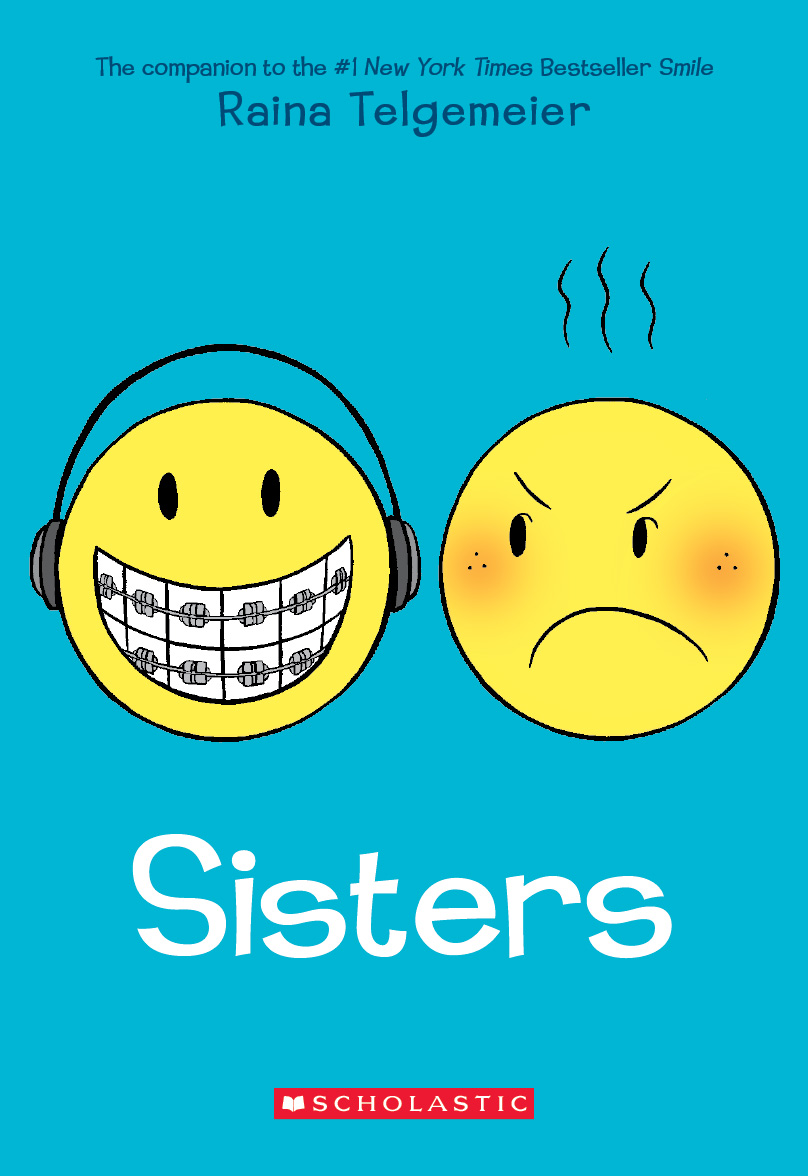
I titled a previous post "Raina Reigns" because her first two books, Smile and Drama, are so popular in my library. Her newest book, Sisters, has already become a "best-seller" among our young patrons. It's easy to see why, since Telgemeier once again displays a natural command of the emotions experienced by kids and teens. As she explained to the crowd at Politics & Prose, Telgemeier hadn't planned on doing another graphic memoir, but the legions of Smile fans kept begging her to tell more about her life. "I decided that since people seemed particularly curious about my sister, I would write a story about our relationship." Telgemeier added her sister was the first reader for the book, and it wouldn't have been published without her approval.

As her "framing device" for telling the story, Telgemeier said she decided to use a roadtrip from California to Colorado that her family took when she was 14 and her sister Amara was nine. As Telgemeier tells of the trip's many ups and downs (a snake plays a pivotal part), she also uses flashbacks to show how much she wanted a sister and how disappointed she was in the sister she got. Woven into the story is the increasing tension between Telegemeier's parents, who eventually divorced. As in Smile, Telegemier displays a genius for deftly combining poignancy and hilarity  as she captures the ups and downs of being a kid. Telgemeier gives a further glimpse into her book and her writing/drawing process in this charming book trailer.

Telgemeier, who clearly delights in meeting her readers, remained unruffled at Saturday's program when a young fan asked during the Q&A time whether she and Roman -- her husband -- would ever have kids. "I like kids very much," she said adding that she enjoys spending time with her baby nephew. "But we'll have to see about kids -- maybe someday." Roman, meanwhile, pointed out that Telgemeier wouldn't have as much time to publish books like Smile and Sisters if they were to have kids. Smile took five years to write and draw, Telgemeier said, adding that she also was working full-time at another job at the time. Sisters took less time because Telgemeier now focuses full-time on making comics, but even so, it didn't happen overnight; Telgemeier said she wrote the "script" or story in a month, and then it took her another year and a half to do the artwork.


Other questioners wanted to know why the trio decided to become graphic novelists. Roman noted that, "for us, comics is what we do. Whenever we get an idea, it's a comic book idea." Gownley added that he was happily stunned when he first discovered comics at the age of nine, and quickly decided that's what he wanted to do with his life. For Telgemeier, reading Calvin and Hobbes for the first time "was like a lightning bolt from the sky that came and hit me over the head... and I said 'I want to do comics!'"

Final note: Happy Birthday to Politics & Prose which is celebrating 30 great years in the book-selling business today!


Friday, September 5, 2014

The Marvelous World of Mouse Guard

The first thing you notice about the Mouse Guard graphic novels by David Petersen is how beautiful they are. Yes, the stories are real rip-roaring animal fantasy yarns, but it's the artwork that really pulls you in and keeps you turning the pages. Petersen has a distinctive artistic style, featuring finely-drawn characters and eye-catching, digitally-colored illustrations. It's a style that has won Petersen numerous fans as well as critical accolades, including the prestigious Eisner Award.

 But Petersen's own artistic vision took years to develop, as he told a crowd of Mouse Guard fans gathered recently at my library. "Early on, I tried to emulate other people whose work I liked," Petersen said. "But I was never really happy with the way my things turned out.... I'm not saying that drawing by copying other people's styles is a bad thing -- that's how we all learn.  I'm just talking about slowly shedding the ideas of other people... so you can learn to be you."

In his talk, Petersen talked about his childhood in Flint, Michigan, a city that many think of as urban and gritty. Yet where Petersen grew up, he could be surrounded by woods in a five minutes' walk, something he believes has totally informed his work. Just take a look at any Mouse Guard book and you'll quickly become immersed in what Petersen calls "the natural world."

 As a fine arts major at Eastern Michigan University, Petersen thought he would become a children's book illustrator. At the library program, he showed part of his portfolio, including an illustrated story that he wrote and illustrated called The Mouse and the Cardinal. Petersen joked that he quickly learned that "inter-species love was off-limits in the children's book world."

Another key influence for Petersen was his love and knowledge of role playing games, such as Dungeons & Dragons. He loved the games, and he enjoyed the friends he made as he played the games. At the program, he showed a picture of three of his good friends -- all role-playing game buddies -- each of whom has become a character in the Mouse Guard books.

The Mouse Guard books "are silly on the surface," Petersen said. "They're about mice who are walking and talking on their hind legs. But it's not a silly story," he added. And he's right -- the Mouse Guard books comprise a range of literary genres and emotions. While the characters are mice, they are stand-ins for human readers who will readily relate to their fears and joys. It's worth reading Petersen's FAQ on his website to learn more background about Mouse Guard, including this statement: "For David, mice became a perfect representation of being an underdog, having the world stacked against you, and having enemies with all the advantages of size and might."

 So far, there are three main Mouse Guard books written and illustrated by Petersen. He says the first book, Fall 1152, "helps readers learn the characters and their stories." Here's how Petersen describes, on his website, the overall world-building scenario for the series: "... mice struggle to live safely and prosper amongst harsh conditions and a host of predators. Thus the Mouse Guard was formed: more than just soldiers, they are guides for common mice looking to journey without confrontation from one village to another. They see to their duty with fearless dedication so that they may not simply exist, but truly live."

The second book, Winter 1152, is a "character-driven story," Petersen said. School Library Journal noted that the book "follows the darkening adventures of the brave troops of the Mouse Guard as they battle the elements, predators, and even other mice in order to secure their way of life. The high-quality artwork found in the first volume carries over into this one." Their final verdict: "Combining a tale of action, romance, comedy, and tragedy with the graphic-novel format results in a top-notch work with wide appeal."

 All of this intricate artwork and story-telling takes time, however. As Petersen told the library crowd: "It was taking me so long to get going on the third book, that I decided to do a spin-off of the series called Legends of the Mouse Guard." Petersen's idea was that he would ask other graphic novelists to contribute stories that members of the Mouse Guard might have told in the local tavern, adding that "I draw the bar scenes." So far, two of these Legends books have been published "and we're about to start on a third volume." Petersen particularly likes to spotlight talented new graphic novelists in these books, as a way to giving back to the community that helped him get his start.

Last year, Petersen published The Black Axe,  the third volume in the Mouse Guard series. "It's a prequel," he said, adding that it is set about 40 years before Fall 1152. This November, he will published another Mouse Guard book, Baldwin the Brave and Other Tales. That book will be a mix of four stories that he wrote for Free Comic Book Day, plus two new tales.

One of Peterson's models for the Mouse Guard books.
Petersen has done other things besides the Mouse Guard books, including doing illustrations for the popular Teenage Mutant Ninja Turtles comics. But it's in the Mouse Guard books that he really can show his prodigious artistic talents, as well as his attention to detail. Petersen wowed the library crowd when he showed slides of the models that he builds -- from cardboard, mainly -- of buildings, ships and other locations that are featured in the books.

 Overall, Petersen's talk was a hit with our library audience, which included both kids and adults.  One young reader asked Petersen during the Q&A why the mice often wear cloaks in his books. The audience loved Petersen's answer: "I had no idea what mice anatomy would look like if mice stood on their hind legs. So I just wrapped a bunch of fabric around them."

Next year is the 10th anniversary of the Mouse Guard books, and Petersen's publisher, Archaia Comics, will be putting out what Petersen calls an "over-sized" collection of his art from the books. Petersen also plans to begin working on a fourth Mouse Guard book about the Weasel War of 1149, something referenced in the other volumes. Clearly, Petersen has plenty more Mouse Guard stories to tell -- good news for all of his fans!

Note: thanks to Dave Burbank, a library assistant and the graphic novel guru at my library. You can read more about Petersen's work on Dave's Comics blog. Also thanks to Esther Kim of Fantom Comics in Washington, D.C. who brought copies of Petersen's books to sell to eager fans.