Showing posts with label Caldecott Medal. Show all posts

Saturday, July 23, 2016

Making Memories with My Calde-crew


The last time the members of the 2016 Caldecott Committee gathered, it was January and we were in snowy Boston where we spent hours in a locked room trying to determine which book would win the 2016 Caldecott Medal. On the morning of January 11th, our choice was announced to the world: Finding Winnie, illustrated by Sophie Blackall. We also chose four Caldecott Honor books (in order by title): Last Stop on Market Street, illustrated by Christian Robinson; Trombone Shorty, illustrated by Bryan Collier; Voice of Freedom, illustrated by Ekua Holmes; and Waiting, illustrated by Kevin Henkes.


It's no secret that being on an awards committee is a real honor, but it's also hard work. There are hundreds of books to read and evaluate followed by a herculean effort to winnow that mountain of books down to a list of finalists, and then the final push to choose a winner. We finished the hard part in January, and then last month, at the American Library Association's Annual conference in hot and muggy Orlando, it was time to celebrate the winners, and be feted for our work on the 2016 Caldecott Committee. And it was also a time to be inspired and energized by talking with some of the best authors and illustrators working in the children's book world today.

First up was a mini-reunion of our Calde-crew at a Thursday night dinner. Not all 15 of us could be there that night, but we had enough of a majority that we decided to present our wonderful chairperson, Rachel Payne of the Brooklyn Public Library, with a memento of the experience: a bracelet specially made by an artist on Etsy featuring tiny images of our Caldecott Medal winner and Caldecott Honor books. In fact, we liked the idea so much that many of us decided to order our own bracelet.


Friday night was devoted to a dinner with the four Caldecott Honor illustrators: Christian Robinson (Last Stop on Market Street); Bryan Collier (Trombone Shorty); Ekua Holmes (Voice of Freedom); and Kevin Henkes (Waiting). Carole Boston Weatherford, author of Voice of Freedom, also attended. The event was hosted by the indefatiguable Jason Welles of Abrams, publisher of Trombone Shorty. Abrams had created special table decorations from illustrations in each of the Caldecott Honor books, and we committee members each got to take one home. Even more importantly, we were given a copy of each of the four Honor books, and were able to spent time with each illustrator as he or she personally signed our copies.


Close-up photos of the table decorations are by my fellow committee member, Elise Katz.

There weren't any formal remarks by the Honor illustrators, so Kevin Henkes later sent us copies of what he had planned to say if there had been a time for speaking. Henkes wrote: "The brilliant publisher, William R. Scott, once said, the picture book is 'the simplest, subtlest, most communicative, most elusive, most challenging book form of them all.' I couldn't agree more. In my book, three gifts appear on the windowsill: a marble, an acorn, and a tiny seashell. Your gift to me is far grander. And, I thank you, Caldecott Committee, for honoring my picture book in such a lovely way."

Saturday evening was another night to remember as our committee dined with Caldecott Medalist Sophie Blackall, her editor Susan Rich and several other folks from the Little, Brown team whose combined efforts made Finding Winnie such a gem. The event was orchestrated by Victoria Stapleton, Little, Brown's publicist extraordinaire, who surprised our committee with specially-saved first edition copies of Finding Winnie for Sophie to personalize for each of us. It was an evening of laughter and happy tears as Sophie described her experience working on the book, beginning with Susan Rich's invitation to illustrate it. Susan then presented Sophie with a one-of-a-kind gift: a hand-embroidered Winnie that Susan had created herself. 

Sophie holds Winnie embroidered by Susan Rich.

The final touch was the amazing poppy corsage/boutoniere -- complete with a tiny watercolor image of Winnie -- that Sophie had hand-crafted for each member of the Calde-crew.


Then came the big event -- the Sunday evening Newbery Caldecott Wilder banquet. It's always a highlight of any ALA Annual conference, as the winners of these most prestigious children's book awards give acceptance speeches that are not only fascinating glimpses into writing and illustrating children's books but also are hugely inspiring. In addition to 2016 Caldecott Medalist Sophie Blackall, the two other speakers were 2016 Newbery Medalist Matt de la Pena, who wrote the text of the Caldecott Honor picture book, Last Stop On Market Street, and 2010 Caldecott Medalist Jerry Pinkney, who won the Wilder Award for his distinguished work over a decades-long career in children's books. (Note: the Caldecott Honor and Newbery Honor recipients are called up to the stage during the program to receive recognition and a plague, but they don't speak at the banquet).

Before the banquet, however, we had one other wonderful chance to mingle with the winners in the pre-banquet "greenroom." 


Sophie  & Kevin Henkes (in back at right) with the Calde-crew.


The banquet head table was quite a picture of diversity. Matt de la Pena is the first Latino man to win the Newbery Medal. Jerry Pinkney was the first African-American man to win the Caldecott Medal (a biracial author/illustrator team, Leo and Diane Dillon, had previously won two Caldecott Medals). And Sophie Blackall added to the number of women who have won the Caldecott Medal, a number that is still significantly smaller than the number of male recipients.


The 2016 Caldecott, Newbery & Wilder honorees

Each of the trio had important and heart-felt things to say about children's literature, and I'm going to link to The Horn Book, which has reprinted their full speeches, each of which is well worth taking the time to read. Also in this link are the profiles of each winner, written by someone close to them. (There are also a few other links, including one to Bryan Collier's speech accepting the 2016 Coretta Scott King Illustrator Award for Trombone Shorty. )

Meanwhile, I will pull out just a few lines from the banquet speeches:

Sophie Blackall: "Winnie the Pooh was the first book I bought with my own money. It was an old, worn edition. A prop in my mother's antique shop.I read it in my secret spot under a table. I used to hide the book so nobody would buy it. Eventually my mother sold it to me for a dollar, and I polished the steps to earn the money. I had never known a book like it. A book with interjections and digressions and ponderings. One that meandered and backtracked, that bounced and hummed, that drew you in so close that you felt you were in the very forest itself, and at the same time allowed you to step back and see the actual form of a book. With characters so endearing you hated to leave them behind. So you didn't.....

"Everything is connected. If I hadn't been bored out of my brain in my mother's antique shop, I wouldn't have resorted to a dusty book. If I hadn't encountered that book at that time, I would have been a very different child. If my mother hadn't kept me supplied with paper, I wouldn't have traced E. H. Shepard's lines over and over again. If my father, to whom Finding Winnie is dedicated, hadn't devoted his life to books, I wouldn't have known what a good life it could be."

Matt de la Pena: "...'Hey mister,' I've heard time and time again, always from kids at the poorer schools. 'Why would you come here?

The subtext is obvious. 

This school is not worth of your time.

We are not worthy of your time.

When I sat dow to write the text of Last Stop On Market Street, this troubling mindset was rattling around in my brain. Nana, the wise grandma in the book, is urging CJ to see the beauty of his surroundings, yes, but she's also steering him toward something much more fundamental. She's teaching CJ to see himself as beautiful. To see himself as worthy. 'Sometimes when you're surrounded by dirt, CJ, you're a better witness for what's beautiful.'

And sometimes when you grow up outside the reach of the American Dream, you're in a better position to record the truth. That we don't all operate under the same set of rules. That our stories aren't all assigned the same value in the eyes of decision makers. "

Jerry Pinkney: "Picture books became a vessel to hold all of the joy and sadness of my growing-up years, all the triumphs and tragedies...... By using my personal history, the work became layered, the drawings more meaningful. Art became the bridge that carried me from the past I wanted to escape into the world I wanted to inhabit. My childhood was limited, but I learned that through my own creativity, the world was limitless....

"I'm saddened that we still have too many children waking up in a world where the odds are stacked against them, where they don't feel safe in their own communities..... Librarians and teachers have the most important job, in a sense: ... they are the keepers of dreams, the dispensers of possibility.

"This was certainly true for me, growing up. So, to all of the people who have supported me through the years, who have opened my books and shared them with others: thank you for your belief in me. It is you whom I have felt nudging me to always stay true to drawing my dream."

It's a tradition for the newly-named Caldecott Medalist to create the program for the banquet, using imagery from their winning book. The program created by Sophie is truly a piece of art, with several die-cut pages at the back, and not-previously-published photographs of the real Winnie on the inside. During the banquet, my fellow committee member Jennifer Ralston and I were lucky enough to sit with Caldecott Honoree Christian Robinson and family, including his beloved Nana. Later, we all got to meet Lindsay Mattick, author of Finding Winnie, which, of course, tells the story of how her great-grandfather purchased a bear cub while on the way to World War 1. 


With the dawn of Monday morning, there was one last thing for the 2016 Calde-crew to do: head to the conference exhibits for a copy of the latest Horn Book, fresh off the presses. Here's why: it's a tradition for the Caldecott medalist to create the cover for the June/July Horn Book, referencing both their own winning book and the winner of the Newbery Medal. We wanted to be among the first to see what Sophie had done with the cover, and we certainly weren't disappointed!

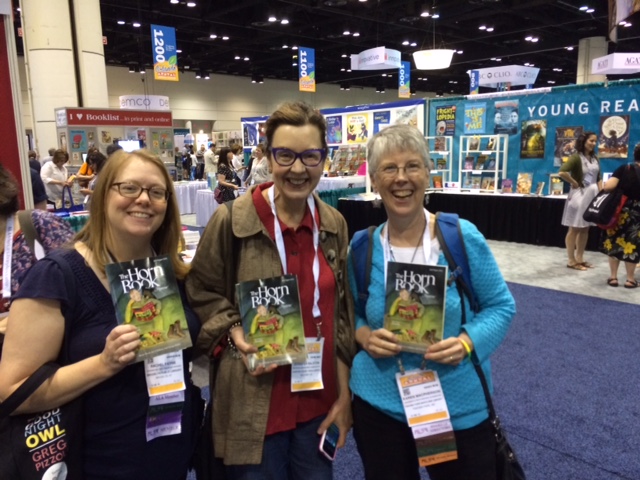


END NOTES: Thanks to all of the publishers who feted our Calde-crew in Orlando: Little, Brown, Abrams, Candlewick Press, Greenwillow/HarperCollins, Putnam/Penguin. Thanks to our Caldecott winner, Sophie Blackall, and our Caldecott Honoroees: Bryan Collier, Kevin Henkes, Ekua Holmes, and Christian Robinson. Thanks to my wonderful Calde-crew for memories that will last a lifetime. As Sophie put it in her speech: "To the 2016 Caldecott committee: we are forever connected, you and I. You are my committee and I am your medalist. To everybody I couldn't thank by name: you know who you are. Publishers, librarians, agents, educators, booksellers, writers, and illustrators, we are all connected by our love of books and the children who read them, and by our profound belief in the power of stories to shape lives. We may never all be in the same room together again, but wherever we go, and whatever happens to us along the way, I will remember you all and this enchanted evening, and be grateful."

Friday, January 22, 2016

Back to the Blog -- After a "Bucket List" Experience

Serving on the 2016 Caldecott Committee was truly a "bucket list" experience. But it also meant that I haven't been able to post on this blog for months because of the rule against posting on social media anything remotely connected to books eligible for the 2016 Caldecott Medal. In the last six months. I've been immersed in Caldecott-eligible books and had little time for anything else. Hence, no blog posts in the last six months! Now, finally, I can get back to regular blogging, and my first post is -- naturally -- a look back at my Caldecott experience.

For some reason, it feels right to begin towards the end of this once-in-a-lifetime experience. The process culminated two weeks ago, when my committee met in Boston for two long (into the evening) days of the most invigorating book discussions in which I have ever participated. It was truly "the book discussion of a lifetime," as we had been told to expect. Sarah Bean Thompson, one of my committee colleagues, perfectly captured the experience in a recent post on the Association for Library Service to Children (ALSC) blog.

Here I am with some of my fellow "Caldecrew;" our wonderful chair, Rachel Payne, is second from right in back. 


(Note: the video works even though the picture doesn't show up!)

Then came the fun of calling the winners, early on the morning on Monday, Jan. 11. Making "The Call" is a time of high emotion -- both for the winners, and for we committee members. Our winning illustrator, Sophie Blackall, burst into sobs when our chair, Rachel Payne of the Brooklyn Public Library, told her the good news. Sophie had to promise to keep the news secret (except from her spouse and editor) until it was announced at the Youth Media Awards (YMAs) a couple of hours later. Interestingly, Sophie and the children's book illustrators with whom she shares studio space have an annual tradition of watching the YMAs together. Sophie somehow managed to keep her secret from her studiomates -- including 2014 Caldecott Medalist Brian Floca -- until it was announced. Brian then captured Sophie's emotions in a photo, and put it on Twitter:


But we committee members weren't done quite yet. After calling Sophie and our other winners, we took our seats at the Youth Media Awards (YMA) program. (If you missed it, check out this archived version). It was a truly electric moment for my committee when the hundreds of librarians packed into the Boston Convention Center room for the YMA program erupted in cheers as ALSC President Andrew Medlar, the program emcee, said: “And the winner of the 2016 Randolph Caldecott Medal for most distinguished American picture book for children is….. Sophie Blackall for Finding Winnie: The True Story of the World’s Most Famous Bear.


2016 Caldecott Committee Chair Rachel Payne places the medal on Finding Winnie at the Little, Brown booth.
As the crowd applauded, my fellow 2016 Caldecott Committee members and I turned to each other with huge smiles. We had done it! After a year of reading, and re-reading (and re-reading…..) hundreds of eligible books, and after two days of intense and deeply meaningful discussions, our work was finally completed.

Throughout the process of choosing the 2016 Caldecott Medal winner, we had been humbled and awed by the fact that we were charged with choosing a book that would be bought by hundreds of libraries and thousands of parents. We knew that the winning illustrator would garner both fame and fortune, as books chosen for the Caldecott Medal virtually never go out of print. There’s a good reason why the Caldecott Medal (and the Newbery Medal, given annually to the “most distinguished contribution to American literature for children”) are often called “the Oscars of the children’s book world.”

My involvement with the Caldecott process actually began in 2013, when I was asked to run for the 2016 Caldecott Committee. There are 15 members of the committee; seven are elected and eight, including the chairperson, are appointed by the leaders of the Association for Library Service to Children (ALSC), a division of the American Library Association.

The elections were held in the spring of 2014, and I won a spot on the committee. But it wasn’t until January 2015 that our real work began. Over the course of 2015, each committee member received hundreds of books from publishers. Contrary to popular understanding of the Caldecott Medal as an award for picture books written for preschoolers, books for children ages birth through 14 are eligible. That wide age meant we received – and read --board books, illustrated non-fiction books, graphic novels and – yes – picture books for both young children and elementary-age kids.

Our job was to evaluate these books according to the Caldecott Medal criteria. Each month, we sent Rachel, our chair, a list of suggested books, ones that we found interesting and thought our colleagues should read.Then, in October, things got really serious. Each committee member has seven nominations – three made in October, and two each in November and December. With so many great books published in 2015, it was excruciating for us to narrow our choices, but we had to. These nominated books then became our “finalists” – the only ones we could discuss when we gathered in Boston to choose our winner. All other books were off the table.

Now, a note about confidentiality: all of our monthly suggestions, all of our nominated books – including how many books were nominated, since people could end up nominating the same book – and all of our discussions in Boston, will forever remain secret. Even our discussion room was designated as “secured,” meaning only committee members could enter. In addition, we never discussed the nominated books, even in email or on the phone, until our deliberations began at 8 a.m. on Friday, Jan. 8. As you can imagine, we were all quite eager to finally discuss books that had consumed so many of our waking hours for a year.


Now the entire world knows our choices. In addition to awarding the 2016 Caldecott Medal to Sophie Blackall for Finding Winnie, (which was written by Lindsay Mattick), our committee chose four Caldecott Honor books. They are (in order by illustrator’s last name): Trombone Shorty, illustrated by Bryan Collier and written by Troy “Trombone Shorty” Andrews; Waiting, written and illustrated by Kevin Henkes; Voice of Freedom: Fannie Lou Hamer, Spirit of the Civil Rights Movement, illustrated by Ekua Holmes and written by Carole Boston Weatherford; and Last Stop on Market Street, illustrated by Christian Robinson and written by Matt de la Pena.

In terms of Caldecott history, the 2016 Caldecott Medal was the 25th won by a woman (some women have won multiple times) since the award was first given in 1938; 47 medals have been won by men, while three Caldecott Medals have been won by husband and wife teams (Diane and Leo Dillon won twice, and Alice and Martin Provensen won once). (Note: I did these calculations based on the information available on the ALSC Caldecott Medal page.) I have to say that it's been particularly fun to read Sophie's reactions to winning the Caldecott Medal. Publishers Weekly talked up her "champagne and donuts" celebration, while NPR noted that Sophie's favorite book as a child was Winnie-the-Pooh, and so she was particularly delighted to have been asked to illustrated Finding Winnie. And the inimitable John Schumacher, better known as Mr. Schu, perfectly captured the joy and drama of winning a Caldecott Medal in his interview with Sophie on his Watch.Connect.Read blog.

Our group of Caldecott Honor books is quite diverse. Our Honor illustrators include three African-American artists (Collier, Holmes and Robinson), a debut illustrator (Holmes), a Caldecott Medalist (Henkes, who won the Medal in 2005 for Kitten’s First Full Moon.), and a previous Caldecott Honor winner (Collier,  who has won three Caldecott Honors for Martin's Big Words, Rosa, and Dave the Potter). And, in a bonus for us, most of our books received awards from other awards committees, underlining their excellence. Perhaps the biggest and best surprise was the fact that one of our Caldecott Honor books,  Last Stop on Market Street, also was awarded the 2016 Newbery Medal for the lyrical and poignant text by author Matt de la Pena. It is only the second time that a picture book has won the Newbery Medal.

Meanwhile, some folks have loved our choices, while others debate them. That goes with the territory. Since we committee members can't discuss our decision-making process, we can't respond very specifically. But I can tell you that we did our very best, and that our decisions were based -- as they must be -- on the Caldecott criteria (which are now burned in my brain forever!). Susan Kusel, who served on the 2015 Caldecott Committee, wrote about the experience in this thoughtful blog post. And Susan references another well-written piece about the issue, written a couple of years ago by my Caldecott colleague Sarah Bean Thompson after she served on the Michael Printz Award committee. 

While our committee’s official work is now done, we now are charged with promoting our winners, using them in programs and talking them up with kids, parents and teachers. Rachel, our chair, started the process with her deftly written guest post for the Calling Caldecott blog on The Horn Book website, in which she describes some of the reasons we chose our award winners. I particularly love Rachel's call to action at the conclusion. Noting that some folks wish we had chosen other books, Rachel concludes: "It was a magical experience for our committee to put gold and silver award seals on these books. Work some magic for the books you love."

Our committee will gather one last time at the American Library Association’s conference in June to hear the acceptance speeches by the winners. And, as a usable souvenir of our extraordinary experience, we’ll always have our committee t-shirt  (created in homage to the beloved Boston-based, 1942 Caldecott Medal winning book Make Way For Ducklings):  “Make Way for Caldecott 2016!”


Monday, February 2, 2015

Surprise & Delight at the Youth Media Awards

Today's Youth Media Awards were filled with high emotion, with the crowd of several hundred alternately gasping in surprise and/or roaring with delight. The awards also were history-making as, for the first time ever, graphic novels won a Newbery Honor (El Deafo, written and illustrated by Cece Bell) and a Caldecott Honor (This One Summer, illustrated by Jillian Tamaki and written by Mariko Tamaki). And the Caldecott Medal winner, The Adventures of Beekle: The Unimaginary Friend), was written and illustrated by Dan Santat who also is well known for his popular graphic novels.

Winner of the 2015 Caldecott Medal


This One Summer also won a Printz Honor (the Printz Award is given for books for readers ages 12-18 and is sometimes called the Newbery Medal for teens). But a graphic novel, American Born Chinese, written and illustrated by Gene Luen Yang, won the top Printz Award way back in 2007, so today wasn't a history-making moment for the Printz. Meanwhile, the 2008 Caldecott Medal winner, The Invention of Hugo Cabret, is considered a hybrid book, not a graphic novel, but it did feature a heavily-woven combination of illustrations and text.


Winner of the 2015 Newbery Medal


The current push for more diversity in children's and teen books, sparked by the We Need Diverse Books movement, also was reflected in today's winners. The Crossover, a novel in verse by Kwame Alexander, is the 2015 Newbery Medal winner. Alexander is the fourth African-American author to win the award, established in 1922. The three previous African-American winners were: Virginia Hamilton, for the 1975 Newbery Medal winning M.C. Higgins, the Great; Mildred Taylor, for the 1977 Newbery Medal book, Roll of Thunder, Hear My Cry; and Christopher Paul Curtis for the 2000 Newbery Medal winner, Bud, Not Buddy.

Brown Girl Dreaming, author Jacqueline Woodson's memoir in verse about growing up in the midst of the civil rights movement, won a 2015 Newbery Honor, as well as this year's  Coretta Scott King Author Award and a 2015 Robert Sibert Honor (the Sibert Medal and Honor books are focused on the best non-fiction books for kids). Brown Girl Dreaming also won the National Book Award for Young People's Literature back in November.

As Nina Lindsay points out in her Heavy Medablog today, poetry also was a big winner in today's awards. Both The Crossover and Brown Girl Dreaming are written in verse, while author Marilyn Nelson uses 50 unrhymed sonnets to tell her story in How I Discovered Poetry. Two other books of poetry won awards: Josphine, a biography of entertainer Josephine Baker written by Patricia Hruby Powell and illustrated by Christian Robinson won both a Coretta Scott King Illustrator Honor and a Sibert Honor, while books by two poets were honored by the Pura Belpre Award committee. I Lived on Butterfly Hill, written by Marjorie Agosin won the Pura Belpre Author Award, while Portraits of Hispanic American Heroes by Juan Felipe Herrara was the lone Pura Belpre Author Honor book.

Woodson's book captured three awards today.

Several committees selected a large number of Honor books (each committee decides how many Honor books, if any, will be named). There were five Sibert Honor books: in addition to Brown Girl Dreaming and Josephine, Sibert Honor books included The Family Romanov by Candace Fleming; Neighborhood Sharks, written and illustrated by Katherine Roy, and Separate Is Never Equal: Sylvia Mendez & Her Family's Fight for Desegregation, written and illustrated by Duncan Tonatiuh.

But it was the six Caldecott Honor books that really produced a gasp, then a roar of approval, from the audience. Apparently there may have been other years where six Honor books were named (I'm still checking!), but it certainly isn't usual. Yet, 2014 was a banner year for picture books, and the crowd was clearly delighted that the committee's decision reflected this fact.

The first graphic novel to win a Caldecott Honor.


In addition to This One Summer, Caldecott Honor books included: Nana in the City, written and illustrated by Lauren Castillo; The Noisy Paint Box, illustrated by Mary GrandPre and written by Barb Rosenstock; Sam & Dave Dig a Hole, illustrated by 2013 Caldecott Medalist Jon Klassen and written by Mac Barnett; Viva Frida, written and illustrated by Yuyi Morales; and The Right Word: Roget and his Thesaurus, illustrated by Melissa Sweet and written by Jen Bryant. The Right Word also won the 2015 Sibert Medal, the second for Sweet, who won the 2012 Sibert Medal for Balloons Over Broadway, which she both wrote and illustrated. (Personal note: I served on the 2012 Sibert Committee).

The 2015 Caldecott Medal winner, The Adventures of Beekle, had been popular with some mocks, but wasn't widely considered a front runner. When it was announced as the winner, however, the audience cheered in approval as the Caldecott Committee members donned crowns, symbolic of the crown sported by Beekle.

As for how my library's Caldecott Club and Mock Caldecott picks measured up? Well, we got a few things right. Our own Mock Caldecott Honor Books included two of the actual 2015 Caldecott Honor Books, The Noisy Paint Box and The Right Word. But our top pick, The Farmer and the Clown, written and illustrated by Marla Frazee, surprisingly didn't win anything. It was a similar situation for our Caldecott Club. Our winner, Quest, written and illustrated by Aaron Becker, didn't win anything. But one of the Club's two Honor books, Sam & Dave Dig a Hole, won a 2015 Caldecott Honor.

The first graphic novel to win a Newbery Honor.

Meanwhile, the 2015 Newbery Committee, like the 2015 Caldecott Committee, also decided to include a graphic novel, El Deafo, as one of their Honor books. (Author/illustrator Cece Bell came to our library in November along with her husband, author/illustrator Tom Angleberger, and authors Jon Scieszka, Mac Barnett and Jory John). The Newbery Committee, sporting t-shirts that read "Trust the Process," named only two Honor books, to the evident disappointment of the audience, who clearly would have liked to have seen more Newbery Honor books.  Brown Girl Dreaming was the other Newbery Honor book.

And let me close this blog post with a shout-out to a long-time mentor of mine, Deb Taylor, who is the coordinator of School and Student Services at the Enoch Pratt Free Library in Baltimore. Deb was my young adult literature professor when I was working towards my master's in library science at the University of Maryland, and she and I also served on the 2012 Sibert Committee together. (She was chair of the 2015 Sibert Committee). Deb has mentored and inspired countless librarians, kids and parents, and I'm thrilled that she was chosen as this year's winner of the Coretta Scott King-Virginia Hamilton Award for Lifetime Achievement. Way to go, Deb!


Deb Taylor and I after she was honored today

PS If you, like me, can't get enough of these awards, check out this wonderful behind the scenes video of today's winners getting "The Call." Thanks to John Schumacher for spotlighting it on his blog, Watch. Connect Read. 


Sunday, February 1, 2015

Books & a Blizzard

Even a Chicago blizzard can't dim the excitement as librarians eagerly await the big "Youth Media Awards" announcements -- always the highlight of the American Library Association's Midwinter conference.


At 8 a.m. CST tomorrow, several hundred librarians will pack into a room at the McCormick Convention to learn which books will win the "Oscars" of the children's literature world: the Caldecott Medal, given for illustrations, and the Newbery Medal, given for text. Those winners will be the last two announced at the hour-long program, during which a number of other awards also will be bestowed; among them, the Coretta Scott King Award (focused on books by African-American authors and illustrators), the Sibert Medal (given to the best non-fiction book for kids), the Pura Belpre Award (spotlighting books by Latino authors and illustrators), and a number of others.

The program will be broadcast live. There's also a couple of fun pre-announcement and post-announcement shows, hosted by librarians Betsy Bird and Lori Prince. Betsy also has compiled a list of all the Mock Caldecott and Mock Newbery winners she could find; it makes interesting reading.


Last week, we held our first-ever Mock Caldecott at my library, and we made our own choices for the 2015 Caldecott. There were a dozen of us, and our nearly unanimous winner was The Farmer and the Clown, written and illustrated by Marla Frazee. The Farmer and the Clown also has won a number of other Mock Caldecotts around the country, and it was the winner on the Calling Caldecott blog, so we're in good company.

Our Mock Caldecott group also chose four Honor books (listed here in order of title): Bad Bye, Good Bye, written by Deborah Underwood and illustrated by Jonathan Bean; The Iridescence of Birds, written by Newbery Medalist Patricia MacLachlan and illustrated by Hadley Hooper; The Noisy Paint Box, written by Barb Rosenstock and illustrated by Mary GrandPre; and The Right Word, written by Jen Bryant and illustrated by Melissa Sweet.

Just a few more hours to see how close we came!


Friday, November 28, 2014

A Wonderful Visit from Jon Klassen

For a picture book superstar, Jon Klassen is a remarkably low-key kind of guy. After all, this is someone who has won the top national and international children's book illustration awards -- the Caldecott Medal here, the Kate Greenaway Medal in Great Britain. He's the first person to win both of those awards, and only the second person to win both a Caldecott Medal and a Caldecott Honor in the same year. Clearly he's superstar, and yet he is an easy-going superstar who really enjoys interacting with his young fans.

Jon giving his 2013 Caldecott acceptance speech.
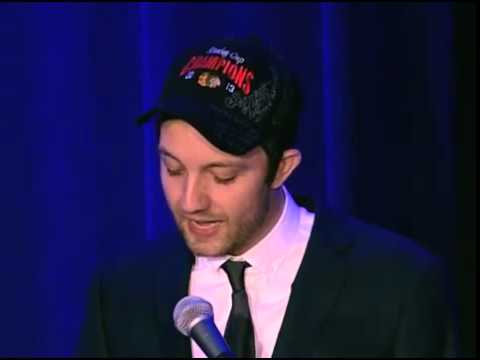
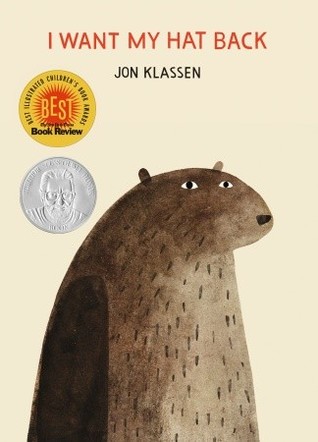
Jon's down-to-earth persona recently was on display at my library, where he gave a presentation on his work, including his newest book, Sam & Dave Dig a Hole (Candlewick Press, $16.99, ages 4-7). Unfazed by making a presentation to dozens of kids and adults crammed into our Children's Room, Jon -- wearing his trademark sports cap -- read calmly from several of his books as he showed the illustrations up on the big screen. First up: I Want My Hat Back.


To mix things up, Jon also offered an amusing drawing demonstration midway through the program.Using Photoshop to draw a picture of a turtle, Jon then showed how to create a number of emotions in the turtle, merely by changing just the position and size of the turtle's eyes. It was a great reminder of how the eyes of the big fish are so important in Jon's 2013 Caldecott Medal-winning book, This Is Not My Hat.


Jon finished up his presentation by reading from one of his own favorite books as a kid, In a Dark, Dark Room and Other Scary Stories, retold by Alvin Schwartz. For fans of Jon's work, it was especially interesting to see in those stories the same kind of dry, slightly dark humor that marks Jon's own books.


At our event, Jon just read one story -- "The Green Ribbon" (a classic tale about how the ribbon allows a woman to keep her severed head attached to her body) --and his audience was rapt. And, despite Jon's reminder that he didn't write that story and so couldn't answer questions about it, several young fans kept circling back to it in the Q&A, much to the amusement of both Jon and the audience.

While Jon is relaxed with fans, however, he's a perfectionist when it comes to his work. When I interviewed him in October 2013, for example, he talked about staying awake all night, worrying about the hand-lettering he did for This Is Not My Hat. At the library program, he spoke of his frustration in trying to get the right look for the all-important yarn in the illustrations for Caldecott Honor-winning Extra Yarn, which was written by Mac Barnett. Finally, Jon said, he went out and purchased an inexpensive sweater, scanned it, and then used those scans to create the illustrations.


Jon's newest book, Sam & Dave Dig a Hole, also was written by Mac Barnett. It features Jon's trademark subtle palette, yet he has managed to create an amazing number of different shades and variations on the all-important brown of the dirt dug up by Sam and Dave. In reading the book at the library program, Jon began by urging the audience to notice the title page. Although he noted that title pages are typically "sad" pages because no one pays attention to them, the title page of Sam & Dave Dig a Hole plays a crucial role in the story.


As Jon read the book, the kids in the audience became more and more voluble as Sam and Dave continued to just miss unearthing bigger and bigger gems hidden in the earth's depths. Just as the audience did in our library's recent Caldecott Club reading of Sam & Dave Dig a Hole, these young fans at Klassen's program were audibly disbelieving of how clueless the two boys seemed to be, unlike their dog. Asked later about the fact that Sam and Dave come so close to finding gems, yet never find them, Jon said: "They always miss them because it's funny."


But the biggest surprise of the book comes at the end, when Sam and Dave (and their dog) fall through the hole and then end up in a place that looks like the place they started -- as shown on the title page! -- but clearly isn't exactly the same. Kids notice this fact right away, while it takes most adults longer to see what's happened. As to where Sam and Dave are at the end of the book, Jon left it to his fans to come up with their own ideas. The kids at the library program clearly were intrigued by this challenge, and came up with various suggestions about what had happened.

The wide-open ending of Sam & Dave Dig a Hole also has been a source of much speculation in the children's literature world since the book was published. In a recent post on his 100 Scope Notes blog, for example, Travis Jonker wrote about several different theories about the ending of the book; the theories range from "The Epic Dream Theory" to "It Was All a Dream, Man Theory" and are fascinating to read. Don't forget to also read the comments that follow the post, which offer even more theories, with one commenter pointing folks to a fascinating interview with Jon and Mac about the book on the "Cynsations" blog.

The book clearly is already popular with fans, and many people believe it could earn Klassen yet another Caldecott Medal or Caldecott Honor. The "Calling Caldecott" blog, which focuses on potential Caldecott winners, recently had an interesting discussion about the book.

Jon finished our library event by spending more than an hour with fans, signing their books, and answering questions. Chief among the questions: what are you working on now? Jon said that he was doing illustrations for another picture book written by Mac Barnett, and also was struggling to write and illustrate the last book in his "hat" trilogy (after I Want My Hat Back and This Is Not My Hat). But Jon acknowledged that it's "terrifying" for him to both write and illustrate a book now that he's won the Caldecott Medal.


All too soon, it was time for Jon to head off at the airport. As he went back into our staff area to claim his jacket and backpack, he noticed an unusual "window" there and asked if he could take a photograph. The "window" used to be a real window, but now looks out onto a brick wall. Some time ago, one of our library staffers used construction paper to create a beach scene on the window's bottom half, but the top half still shows the brick wall. It's not something that attracts any attention from most visitors.  It takes someone with a special eye, a keen sense of a detail, and a darkly witty sense of humor -- someone, in fact, just like Jon Klassen.

Me, Jon & my daughter Sally, a Klassen fan.


END NOTES: Thanks so much to Kerri Poore, children's & teen events coordinator at Politics & Prose Bookstore and Rachel Johnstone of Candlewick Press for bringing Jon to my library. Thanks also to Jon for his memorable presentation. It's not often that you meet such a down-to-earth superstar!


Sunday, November 2, 2014

Caldecott Prep: Museum Visits & Reading

Hooray -- our full roster is finally in place for the 2016 Caldecott Committee! So now it's really time for me to speed up my background preparation for our year of deliberations, which starts in January. It's been suggested that we take in art exhibits and read in-depth about art of all kinds. Hardly a burdensome assignment!

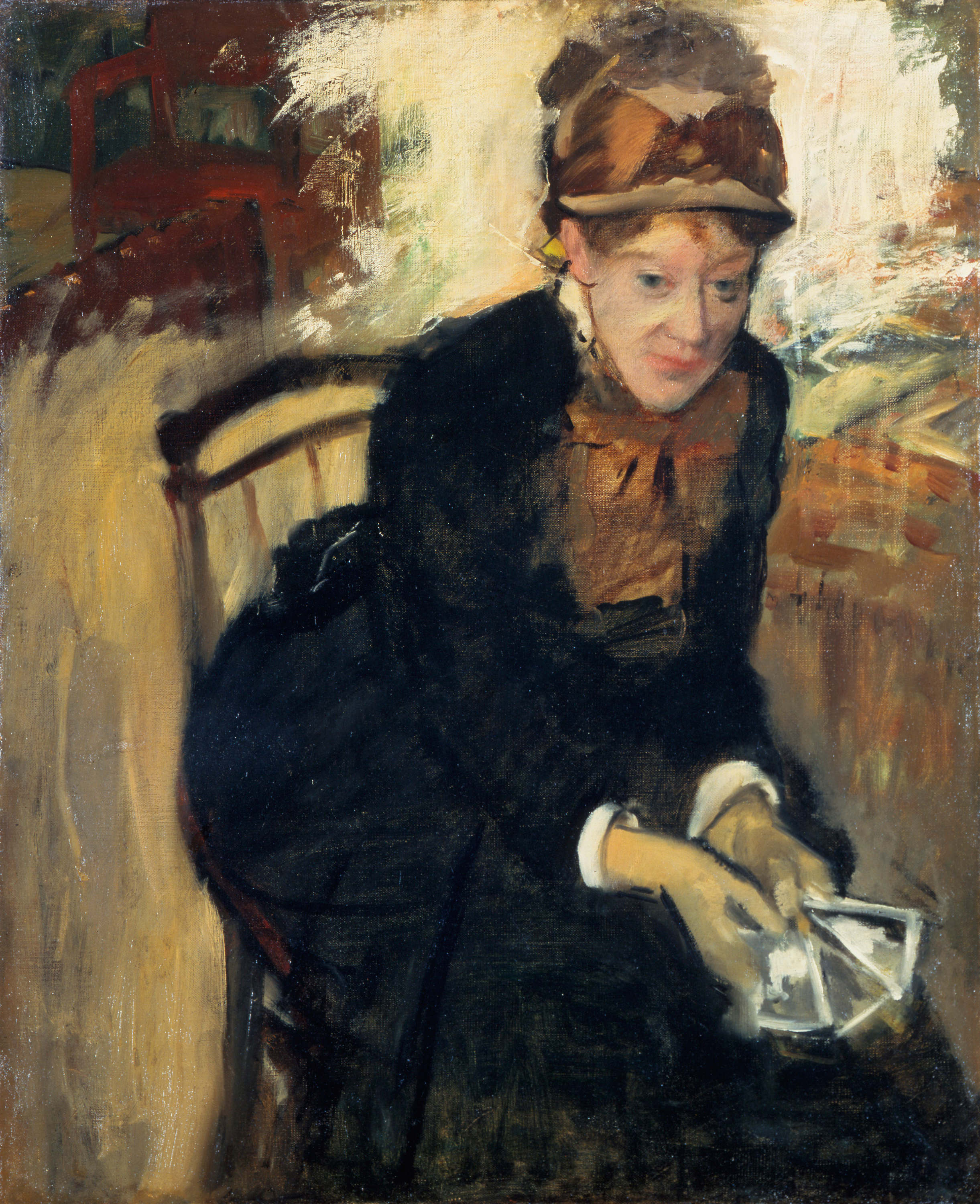
So I've taken time to get to one major art exhibit, "Degas/Cassatt," at the National Gallery of Art in Washington, D.C. Now closed, the exhibit was a fascinating, and rather tantalizing, look at the bond between two artists who clearly were kindred in the way they saw the world.

Mary Cassatt, Little Girl in a Blue Armchair, 1878 oil on canvas. National Gallery of Art, Washington, Collection of Mr. and Mrs. Paul Mellon


Edgas Degas' portrait of Mary Cassatt


After enjoying the Degas/Cassatt exhibit, I took the time to wander around and enjoy the art in some of my favorite galleries at the National Gallery, especially paintings by my-all time favorite artist, Paul Cezanne. I'm far from a Cezanne expert, but I'm fascinated by the way that his work is the bridge between impressionism and modern art -- something that Picasso himself acknowledged.

Such a museum visit is something of an encouraged digression by the folks who have served on previous Caldecott committees and who believe it's important to know as much about all kinds of art as possible before digging into the piles of books we'll receive next year. And I can see how this kind of museum visiting can definitely be helpful; just look at one potential 2015 Caldecott Medal book, "The Iridescence of Birds."


That book, written by Newbery Medal winner Patricia McLachlan, illuminates the life of artist Henri Matisse, through the remarkable illustrations of Hadley Hooper. Although I could certainly do Internet research about Matisse, it's definitely a major plus that I can actually see work by Matisse at the National Gallery (which I did during my recent visit).

Open Window, Collioure, 1905, by Henri Matisse (Nat. Gallery of Art DC)


But seeing art is only one part of my Caldecott preparation. I've also been doing LOTS of reading, and I've found two books that are hugely useful. First, there's From Cover to Cover: Evaluating and Reviewing Children's Books (HarperCollins), by the eminent K.T. Horning. From Cover to Cover was first published in 1997, and then updated in 2010. The other book, just published a couple of months ago, is Reading the Art in Caldecott Award Books: A Guide to the Illustrations (Rowman & Littlefield), written by Heidi K. Hammond and Gail D. Nordstrom.

Both books offer such an invaluable education on picture books that they should required reading for Caldecott committee members. The books also make a perfect pairing. In From Cover to Cover, Horning devotes a chapter to each major type of children's book (fiction, non-fiction, poetry, etc.).


In the chapter about picture books, she begins with a bit of history about picture books, then proceeds to offer a primer on their visual elements, as well as how the text and illustrations must work together. Horning, the director of the Cooperative Children's Book Center of the School of Education at the University of Wisconsin–Madison, does spotlight some specific picture books as examples, but she mainly concentrates on explaining the picture book form and how it works.

By contrast, Reading the Art in Caldecott Award Books takes the opposite approach. This book, which is obviously solely about picture books, focuses on specific Caldecott Medal and Honor books, using those to offer more general information about how to look at the art in the books. Authors Hammond and Nordstrom, librarians who both served on the 2011 Caldecott committee, do include a valuable glossary in the back in which they define key terms like "negative space" as well as explaining different types of materials and mediums used by artists.

Between these two books, I'm getting quite an in-depth education in how picture books work, as well as how to look at them with the Caldecott criteria in mind. While Horning isn't specifically applying Caldecott criteria as she writes about picture books, her insights are important. Each time I re-read her chapter on picture books, I discover something new. As Horning notes:  "Picture books present a special challenge to the critic because they require evaluation of art, text, and how the two work together to create a unique art form... it is important to remember that nothing ever happens accidentally in a picture book. It is a complex, carefully planned work of art that creates a satisfying interplay between text and pictures to tell a story that a small child can understand."


Meanwhile, I've enjoyed reading chapters at whim in Reading the Art in Caldecott Award Books. Each chapter zeroes in on a specific Caldecott Medal or Honor book. Authors Hammond and Nordstrom begin with an analysis of the illustrations, then follow with a section titled "for further consideration," giving information on how the book came to be, based on published interviews with the illustrator. Each chapter concludes with an "illustrator note," filled with background about the winning artist.

One of my favorite Caldecott Medal winners is The Three Pigs by David Wiesner, and so I decided to start with the chapter in Reading the Art in Caldecott Award Books on that book. Despite the fact that I have read The Three Pigs numerous times, both by myself and with classes of kids, I still found myself learning new things about it. These are the kind of things I need to learn to look at as I start my Caldecott year in January.


For example, Hammond and Nordstrom quote children's book expert Anita Silvey as pointing out that Wiesner designed even the cover and endpapers to "reflect the story," with the brick recpresented by the burgundy spin, the sticks by the gray cover, and the straw "by the ochre endpapers." This is such a good reminder that I need to be looking at, and thinking about, EVERY part of a picture book.

So the Caldecott reading continues! And I'd be remiss if I forgot to mention how much I enjoy -- and learn from -- the Calling Caldecott blog on The Horn Book website. If you love picture books and want to gain insight into some potential Caldecott winners, put this blog on your daily reading list!