Showing posts with label Sophie Blackall. Show all posts

Saturday, July 23, 2016

Making Memories with My Calde-crew


The last time the members of the 2016 Caldecott Committee gathered, it was January and we were in snowy Boston where we spent hours in a locked room trying to determine which book would win the 2016 Caldecott Medal. On the morning of January 11th, our choice was announced to the world: Finding Winnie, illustrated by Sophie Blackall. We also chose four Caldecott Honor books (in order by title): Last Stop on Market Street, illustrated by Christian Robinson; Trombone Shorty, illustrated by Bryan Collier; Voice of Freedom, illustrated by Ekua Holmes; and Waiting, illustrated by Kevin Henkes.


It's no secret that being on an awards committee is a real honor, but it's also hard work. There are hundreds of books to read and evaluate followed by a herculean effort to winnow that mountain of books down to a list of finalists, and then the final push to choose a winner. We finished the hard part in January, and then last month, at the American Library Association's Annual conference in hot and muggy Orlando, it was time to celebrate the winners, and be feted for our work on the 2016 Caldecott Committee. And it was also a time to be inspired and energized by talking with some of the best authors and illustrators working in the children's book world today.

First up was a mini-reunion of our Calde-crew at a Thursday night dinner. Not all 15 of us could be there that night, but we had enough of a majority that we decided to present our wonderful chairperson, Rachel Payne of the Brooklyn Public Library, with a memento of the experience: a bracelet specially made by an artist on Etsy featuring tiny images of our Caldecott Medal winner and Caldecott Honor books. In fact, we liked the idea so much that many of us decided to order our own bracelet.


Friday night was devoted to a dinner with the four Caldecott Honor illustrators: Christian Robinson (Last Stop on Market Street); Bryan Collier (Trombone Shorty); Ekua Holmes (Voice of Freedom); and Kevin Henkes (Waiting). Carole Boston Weatherford, author of Voice of Freedom, also attended. The event was hosted by the indefatiguable Jason Welles of Abrams, publisher of Trombone Shorty. Abrams had created special table decorations from illustrations in each of the Caldecott Honor books, and we committee members each got to take one home. Even more importantly, we were given a copy of each of the four Honor books, and were able to spent time with each illustrator as he or she personally signed our copies.


Close-up photos of the table decorations are by my fellow committee member, Elise Katz.

There weren't any formal remarks by the Honor illustrators, so Kevin Henkes later sent us copies of what he had planned to say if there had been a time for speaking. Henkes wrote: "The brilliant publisher, William R. Scott, once said, the picture book is 'the simplest, subtlest, most communicative, most elusive, most challenging book form of them all.' I couldn't agree more. In my book, three gifts appear on the windowsill: a marble, an acorn, and a tiny seashell. Your gift to me is far grander. And, I thank you, Caldecott Committee, for honoring my picture book in such a lovely way."

Saturday evening was another night to remember as our committee dined with Caldecott Medalist Sophie Blackall, her editor Susan Rich and several other folks from the Little, Brown team whose combined efforts made Finding Winnie such a gem. The event was orchestrated by Victoria Stapleton, Little, Brown's publicist extraordinaire, who surprised our committee with specially-saved first edition copies of Finding Winnie for Sophie to personalize for each of us. It was an evening of laughter and happy tears as Sophie described her experience working on the book, beginning with Susan Rich's invitation to illustrate it. Susan then presented Sophie with a one-of-a-kind gift: a hand-embroidered Winnie that Susan had created herself. 

Sophie holds Winnie embroidered by Susan Rich.

The final touch was the amazing poppy corsage/boutoniere -- complete with a tiny watercolor image of Winnie -- that Sophie had hand-crafted for each member of the Calde-crew.


Then came the big event -- the Sunday evening Newbery Caldecott Wilder banquet. It's always a highlight of any ALA Annual conference, as the winners of these most prestigious children's book awards give acceptance speeches that are not only fascinating glimpses into writing and illustrating children's books but also are hugely inspiring. In addition to 2016 Caldecott Medalist Sophie Blackall, the two other speakers were 2016 Newbery Medalist Matt de la Pena, who wrote the text of the Caldecott Honor picture book, Last Stop On Market Street, and 2010 Caldecott Medalist Jerry Pinkney, who won the Wilder Award for his distinguished work over a decades-long career in children's books. (Note: the Caldecott Honor and Newbery Honor recipients are called up to the stage during the program to receive recognition and a plague, but they don't speak at the banquet).

Before the banquet, however, we had one other wonderful chance to mingle with the winners in the pre-banquet "greenroom." 


Sophie  & Kevin Henkes (in back at right) with the Calde-crew.


The banquet head table was quite a picture of diversity. Matt de la Pena is the first Latino man to win the Newbery Medal. Jerry Pinkney was the first African-American man to win the Caldecott Medal (a biracial author/illustrator team, Leo and Diane Dillon, had previously won two Caldecott Medals). And Sophie Blackall added to the number of women who have won the Caldecott Medal, a number that is still significantly smaller than the number of male recipients.


The 2016 Caldecott, Newbery & Wilder honorees

Each of the trio had important and heart-felt things to say about children's literature, and I'm going to link to The Horn Book, which has reprinted their full speeches, each of which is well worth taking the time to read. Also in this link are the profiles of each winner, written by someone close to them. (There are also a few other links, including one to Bryan Collier's speech accepting the 2016 Coretta Scott King Illustrator Award for Trombone Shorty. )

Meanwhile, I will pull out just a few lines from the banquet speeches:

Sophie Blackall: "Winnie the Pooh was the first book I bought with my own money. It was an old, worn edition. A prop in my mother's antique shop.I read it in my secret spot under a table. I used to hide the book so nobody would buy it. Eventually my mother sold it to me for a dollar, and I polished the steps to earn the money. I had never known a book like it. A book with interjections and digressions and ponderings. One that meandered and backtracked, that bounced and hummed, that drew you in so close that you felt you were in the very forest itself, and at the same time allowed you to step back and see the actual form of a book. With characters so endearing you hated to leave them behind. So you didn't.....

"Everything is connected. If I hadn't been bored out of my brain in my mother's antique shop, I wouldn't have resorted to a dusty book. If I hadn't encountered that book at that time, I would have been a very different child. If my mother hadn't kept me supplied with paper, I wouldn't have traced E. H. Shepard's lines over and over again. If my father, to whom Finding Winnie is dedicated, hadn't devoted his life to books, I wouldn't have known what a good life it could be."

Matt de la Pena: "...'Hey mister,' I've heard time and time again, always from kids at the poorer schools. 'Why would you come here?

The subtext is obvious. 

This school is not worth of your time.

We are not worthy of your time.

When I sat dow to write the text of Last Stop On Market Street, this troubling mindset was rattling around in my brain. Nana, the wise grandma in the book, is urging CJ to see the beauty of his surroundings, yes, but she's also steering him toward something much more fundamental. She's teaching CJ to see himself as beautiful. To see himself as worthy. 'Sometimes when you're surrounded by dirt, CJ, you're a better witness for what's beautiful.'

And sometimes when you grow up outside the reach of the American Dream, you're in a better position to record the truth. That we don't all operate under the same set of rules. That our stories aren't all assigned the same value in the eyes of decision makers. "

Jerry Pinkney: "Picture books became a vessel to hold all of the joy and sadness of my growing-up years, all the triumphs and tragedies...... By using my personal history, the work became layered, the drawings more meaningful. Art became the bridge that carried me from the past I wanted to escape into the world I wanted to inhabit. My childhood was limited, but I learned that through my own creativity, the world was limitless....

"I'm saddened that we still have too many children waking up in a world where the odds are stacked against them, where they don't feel safe in their own communities..... Librarians and teachers have the most important job, in a sense: ... they are the keepers of dreams, the dispensers of possibility.

"This was certainly true for me, growing up. So, to all of the people who have supported me through the years, who have opened my books and shared them with others: thank you for your belief in me. It is you whom I have felt nudging me to always stay true to drawing my dream."

It's a tradition for the newly-named Caldecott Medalist to create the program for the banquet, using imagery from their winning book. The program created by Sophie is truly a piece of art, with several die-cut pages at the back, and not-previously-published photographs of the real Winnie on the inside. During the banquet, my fellow committee member Jennifer Ralston and I were lucky enough to sit with Caldecott Honoree Christian Robinson and family, including his beloved Nana. Later, we all got to meet Lindsay Mattick, author of Finding Winnie, which, of course, tells the story of how her great-grandfather purchased a bear cub while on the way to World War 1. 


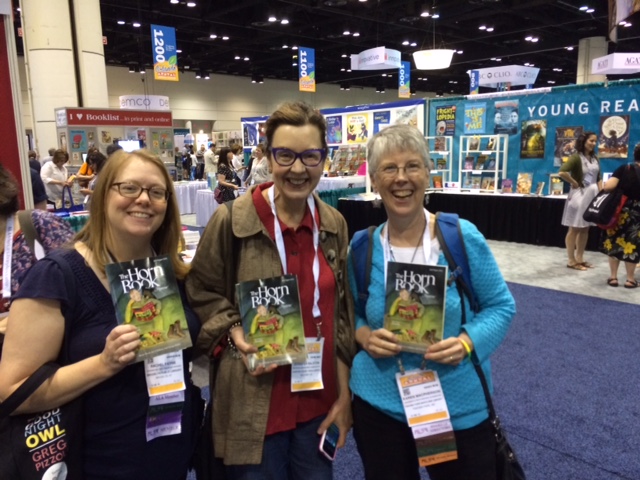
With the dawn of Monday morning, there was one last thing for the 2016 Calde-crew to do: head to the conference exhibits for a copy of the latest Horn Book, fresh off the presses. Here's why: it's a tradition for the Caldecott medalist to create the cover for the June/July Horn Book, referencing both their own winning book and the winner of the Newbery Medal. We wanted to be among the first to see what Sophie had done with the cover, and we certainly weren't disappointed!



END NOTES: Thanks to all of the publishers who feted our Calde-crew in Orlando: Little, Brown, Abrams, Candlewick Press, Greenwillow/HarperCollins, Putnam/Penguin. Thanks to our Caldecott winner, Sophie Blackall, and our Caldecott Honoroees: Bryan Collier, Kevin Henkes, Ekua Holmes, and Christian Robinson. Thanks to my wonderful Calde-crew for memories that will last a lifetime. As Sophie put it in her speech: "To the 2016 Caldecott committee: we are forever connected, you and I. You are my committee and I am your medalist. To everybody I couldn't thank by name: you know who you are. Publishers, librarians, agents, educators, booksellers, writers, and illustrators, we are all connected by our love of books and the children who read them, and by our profound belief in the power of stories to shape lives. We may never all be in the same room together again, but wherever we go, and whatever happens to us along the way, I will remember you all and this enchanted evening, and be grateful."

Sunday, May 22, 2016

Blackall & Marciano Stir Up a Great "Witches" Brew

It's a truth universally acknowledged that having a Caldecott Medalist visit your library is a dream come true for a children's librarian. So I was expecting to be thrilled when 2016 Caldecott Medalist Sophie Blackall recently came to do a program at my library; it was particularly thrilling because I was a member of the 2016 Caldecott Committee that awarded Sophie the medal for her illustrations in Finding Winnie: The True Story of the World's Most Famous Bear.


But I admit that I was unprepared for the delights of the program that Sophie and author John Bemelmans Marciano recently presented to the appreciative audience of kids and adults gathered in my library's Children's Room. You see, the reason that Sophie has been visiting lots of libraries and schools is because she is on a book tour with John (or "Johnny," as Sophie affectionately calls him) for a new chapter book series, The Witches of Benevento. John wrote the books, while Sophie created the illustrations that grace nearly every page. The beautifully designed books are a smaller-than-usual size than most hardcover kids' fiction, but are, as John noted, just the right size to fit comfortably in a child's hand.


The series, aimed at ages 7-10, focuses on five cousins and the way they outwit the many witches who live in their hometown of Benevento, Italy.  Sophie and John have been working on the books for several years, and clearly are having loads of fun creating them. School Library Journal noted of the first book, Mischief Season: "Magical spells and amusing characters with distinctive personalities, coupled with an engaging story with a twist, will captivate readers and leave them clamoring for future stories...."

Sophie and John demonstrate how the books literally fit together.

Not only are the books (the second book, The All-Powerful Ring, was co-published with Mischief Season) captivating, but Sophie and John also have developed a presentation that is fast-paced and funny. It certainly was a hit with our audience, who loved learning all about the different kinds of witches that supposedly hang out in droves in Benevento. My husband, who attended the program, said he wondered at first whether kids would be confused by all the details about the different witches and ways to ward them off. But the kids aced the witches quiz at the program's conclusion, proving once again that we adults too often underestimate kids.


It was marvelous to see the way that Sophie and John would so easily toss the program reins, so to speak, back and forth to each other, as well as their easy camaraderie. That's not surprising given that they share a studio in Brooklyn, along with three other children's book authors and illustrators: 2014 Caldecott Medalist Brian Floca, Sergio Ruzzier, and Eddie Hemingway. (Interestingly, two of the five studio mates have famous grandfathers: John's grandfather was Ludwig Bemelmans, who created the Madeline books, while Eddie is the youngest grandson of Ernest Hemingway).


A young artist adds a bit more to the drawing, at Sophie's request.

Our program concluded with Sophie gamely drawing ideas shouted out by audience members as to what a Janara, a type of witch found in Benevento, might look like. No one has ever seen a Janara -- that's part of their magic -- so the sky was the limit when it came to kids' suggestions. But Sophie was more than capable of keeping up with them! The resulting illustration was both charming and comic.


Overall, it was a memorable evening, both a rare chance to host the "reigning" Caldecott Medalist ,as well as an opportunity to see two talented children's book creators work together to create some literary magic for a roomful of kids and adults.

Sophie, me & Finding Winnie!

Sophie, John, Me & Library Assistant Dave Burbank


END NOTES: Thanks to Sophie Blackall and John Bemelmans Mariano for stirring up such a wonderful "witches" brew of a program. Thanks also to Politics & Prose and Penguin Kids for making the program possible. And thanks to photographers Maurice Belanger and Bruce Guthrie for capturing the fun.


Friday, January 22, 2016

Back to the Blog -- After a "Bucket List" Experience

Serving on the 2016 Caldecott Committee was truly a "bucket list" experience. But it also meant that I haven't been able to post on this blog for months because of the rule against posting on social media anything remotely connected to books eligible for the 2016 Caldecott Medal. In the last six months. I've been immersed in Caldecott-eligible books and had little time for anything else. Hence, no blog posts in the last six months! Now, finally, I can get back to regular blogging, and my first post is -- naturally -- a look back at my Caldecott experience.

For some reason, it feels right to begin towards the end of this once-in-a-lifetime experience. The process culminated two weeks ago, when my committee met in Boston for two long (into the evening) days of the most invigorating book discussions in which I have ever participated. It was truly "the book discussion of a lifetime," as we had been told to expect. Sarah Bean Thompson, one of my committee colleagues, perfectly captured the experience in a recent post on the Association for Library Service to Children (ALSC) blog.

Here I am with some of my fellow "Caldecrew;" our wonderful chair, Rachel Payne, is second from right in back. 


(Note: the video works even though the picture doesn't show up!)

Then came the fun of calling the winners, early on the morning on Monday, Jan. 11. Making "The Call" is a time of high emotion -- both for the winners, and for we committee members. Our winning illustrator, Sophie Blackall, burst into sobs when our chair, Rachel Payne of the Brooklyn Public Library, told her the good news. Sophie had to promise to keep the news secret (except from her spouse and editor) until it was announced at the Youth Media Awards (YMAs) a couple of hours later. Interestingly, Sophie and the children's book illustrators with whom she shares studio space have an annual tradition of watching the YMAs together. Sophie somehow managed to keep her secret from her studiomates -- including 2014 Caldecott Medalist Brian Floca -- until it was announced. Brian then captured Sophie's emotions in a photo, and put it on Twitter:


But we committee members weren't done quite yet. After calling Sophie and our other winners, we took our seats at the Youth Media Awards (YMA) program. (If you missed it, check out this archived version). It was a truly electric moment for my committee when the hundreds of librarians packed into the Boston Convention Center room for the YMA program erupted in cheers as ALSC President Andrew Medlar, the program emcee, said: “And the winner of the 2016 Randolph Caldecott Medal for most distinguished American picture book for children is….. Sophie Blackall for Finding Winnie: The True Story of the World’s Most Famous Bear.


2016 Caldecott Committee Chair Rachel Payne places the medal on Finding Winnie at the Little, Brown booth.
As the crowd applauded, my fellow 2016 Caldecott Committee members and I turned to each other with huge smiles. We had done it! After a year of reading, and re-reading (and re-reading…..) hundreds of eligible books, and after two days of intense and deeply meaningful discussions, our work was finally completed.

Throughout the process of choosing the 2016 Caldecott Medal winner, we had been humbled and awed by the fact that we were charged with choosing a book that would be bought by hundreds of libraries and thousands of parents. We knew that the winning illustrator would garner both fame and fortune, as books chosen for the Caldecott Medal virtually never go out of print. There’s a good reason why the Caldecott Medal (and the Newbery Medal, given annually to the “most distinguished contribution to American literature for children”) are often called “the Oscars of the children’s book world.”

My involvement with the Caldecott process actually began in 2013, when I was asked to run for the 2016 Caldecott Committee. There are 15 members of the committee; seven are elected and eight, including the chairperson, are appointed by the leaders of the Association for Library Service to Children (ALSC), a division of the American Library Association.

The elections were held in the spring of 2014, and I won a spot on the committee. But it wasn’t until January 2015 that our real work began. Over the course of 2015, each committee member received hundreds of books from publishers. Contrary to popular understanding of the Caldecott Medal as an award for picture books written for preschoolers, books for children ages birth through 14 are eligible. That wide age meant we received – and read --board books, illustrated non-fiction books, graphic novels and – yes – picture books for both young children and elementary-age kids.

Our job was to evaluate these books according to the Caldecott Medal criteria. Each month, we sent Rachel, our chair, a list of suggested books, ones that we found interesting and thought our colleagues should read.Then, in October, things got really serious. Each committee member has seven nominations – three made in October, and two each in November and December. With so many great books published in 2015, it was excruciating for us to narrow our choices, but we had to. These nominated books then became our “finalists” – the only ones we could discuss when we gathered in Boston to choose our winner. All other books were off the table.

Now, a note about confidentiality: all of our monthly suggestions, all of our nominated books – including how many books were nominated, since people could end up nominating the same book – and all of our discussions in Boston, will forever remain secret. Even our discussion room was designated as “secured,” meaning only committee members could enter. In addition, we never discussed the nominated books, even in email or on the phone, until our deliberations began at 8 a.m. on Friday, Jan. 8. As you can imagine, we were all quite eager to finally discuss books that had consumed so many of our waking hours for a year.


Now the entire world knows our choices. In addition to awarding the 2016 Caldecott Medal to Sophie Blackall for Finding Winnie, (which was written by Lindsay Mattick), our committee chose four Caldecott Honor books. They are (in order by illustrator’s last name): Trombone Shorty, illustrated by Bryan Collier and written by Troy “Trombone Shorty” Andrews; Waiting, written and illustrated by Kevin Henkes; Voice of Freedom: Fannie Lou Hamer, Spirit of the Civil Rights Movement, illustrated by Ekua Holmes and written by Carole Boston Weatherford; and Last Stop on Market Street, illustrated by Christian Robinson and written by Matt de la Pena.

In terms of Caldecott history, the 2016 Caldecott Medal was the 25th won by a woman (some women have won multiple times) since the award was first given in 1938; 47 medals have been won by men, while three Caldecott Medals have been won by husband and wife teams (Diane and Leo Dillon won twice, and Alice and Martin Provensen won once). (Note: I did these calculations based on the information available on the ALSC Caldecott Medal page.) I have to say that it's been particularly fun to read Sophie's reactions to winning the Caldecott Medal. Publishers Weekly talked up her "champagne and donuts" celebration, while NPR noted that Sophie's favorite book as a child was Winnie-the-Pooh, and so she was particularly delighted to have been asked to illustrated Finding Winnie. And the inimitable John Schumacher, better known as Mr. Schu, perfectly captured the joy and drama of winning a Caldecott Medal in his interview with Sophie on his Watch.Connect.Read blog.

Our group of Caldecott Honor books is quite diverse. Our Honor illustrators include three African-American artists (Collier, Holmes and Robinson), a debut illustrator (Holmes), a Caldecott Medalist (Henkes, who won the Medal in 2005 for Kitten’s First Full Moon.), and a previous Caldecott Honor winner (Collier,  who has won three Caldecott Honors for Martin's Big Words, Rosa, and Dave the Potter). And, in a bonus for us, most of our books received awards from other awards committees, underlining their excellence. Perhaps the biggest and best surprise was the fact that one of our Caldecott Honor books,  Last Stop on Market Street, also was awarded the 2016 Newbery Medal for the lyrical and poignant text by author Matt de la Pena. It is only the second time that a picture book has won the Newbery Medal.

Meanwhile, some folks have loved our choices, while others debate them. That goes with the territory. Since we committee members can't discuss our decision-making process, we can't respond very specifically. But I can tell you that we did our very best, and that our decisions were based -- as they must be -- on the Caldecott criteria (which are now burned in my brain forever!). Susan Kusel, who served on the 2015 Caldecott Committee, wrote about the experience in this thoughtful blog post. And Susan references another well-written piece about the issue, written a couple of years ago by my Caldecott colleague Sarah Bean Thompson after she served on the Michael Printz Award committee. 

While our committee’s official work is now done, we now are charged with promoting our winners, using them in programs and talking them up with kids, parents and teachers. Rachel, our chair, started the process with her deftly written guest post for the Calling Caldecott blog on The Horn Book website, in which she describes some of the reasons we chose our award winners. I particularly love Rachel's call to action at the conclusion. Noting that some folks wish we had chosen other books, Rachel concludes: "It was a magical experience for our committee to put gold and silver award seals on these books. Work some magic for the books you love."

Our committee will gather one last time at the American Library Association’s conference in June to hear the acceptance speeches by the winners. And, as a usable souvenir of our extraordinary experience, we’ll always have our committee t-shirt  (created in homage to the beloved Boston-based, 1942 Caldecott Medal winning book Make Way For Ducklings):  “Make Way for Caldecott 2016!”