Sunday, May 22, 2016

Blackall & Marciano Stir Up a Great "Witches" Brew

It's a truth universally acknowledged that having a Caldecott Medalist visit your library is a dream come true for a children's librarian. So I was expecting to be thrilled when 2016 Caldecott Medalist Sophie Blackall recently came to do a program at my library; it was particularly thrilling because I was a member of the 2016 Caldecott Committee that awarded Sophie the medal for her illustrations in Finding Winnie: The True Story of the World's Most Famous Bear.


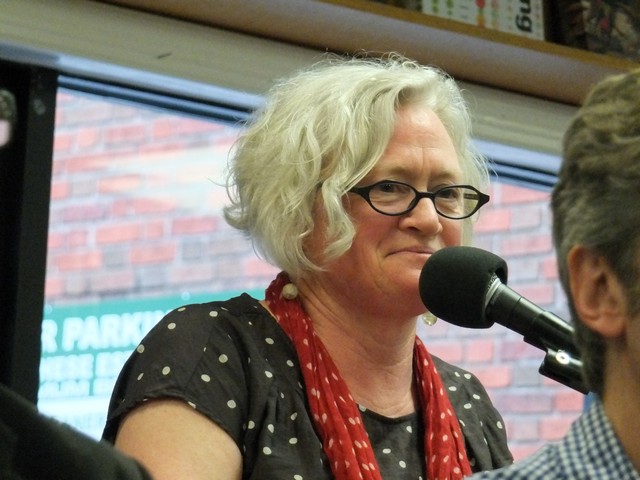
But I admit that I was unprepared for the delights of the program that Sophie and author John Bemelmans Marciano recently presented to the appreciative audience of kids and adults gathered in my library's Children's Room. You see, the reason that Sophie has been visiting lots of libraries and schools is because she is on a book tour with John (or "Johnny," as Sophie affectionately calls him) for a new chapter book series, The Witches of Benevento. John wrote the books, while Sophie created the illustrations that grace nearly every page. The beautifully designed books are a smaller-than-usual size than most hardcover kids' fiction, but are, as John noted, just the right size to fit comfortably in a child's hand.


The series, aimed at ages 7-10, focuses on five cousins and the way they outwit the many witches who live in their hometown of Benevento, Italy.  Sophie and John have been working on the books for several years, and clearly are having loads of fun creating them. School Library Journal noted of the first book, Mischief Season: "Magical spells and amusing characters with distinctive personalities, coupled with an engaging story with a twist, will captivate readers and leave them clamoring for future stories...."

Sophie and John demonstrate how the books literally fit together.

Not only are the books (the second book, The All-Powerful Ring, was co-published with Mischief Season) captivating, but Sophie and John also have developed a presentation that is fast-paced and funny. It certainly was a hit with our audience, who loved learning all about the different kinds of witches that supposedly hang out in droves in Benevento. My husband, who attended the program, said he wondered at first whether kids would be confused by all the details about the different witches and ways to ward them off. But the kids aced the witches quiz at the program's conclusion, proving once again that we adults too often underestimate kids.


It was marvelous to see the way that Sophie and John would so easily toss the program reins, so to speak, back and forth to each other, as well as their easy camaraderie. That's not surprising given that they share a studio in Brooklyn, along with three other children's book authors and illustrators: 2014 Caldecott Medalist Brian Floca, Sergio Ruzzier, and Eddie Hemingway. (Interestingly, two of the five studio mates have famous grandfathers: John's grandfather was Ludwig Bemelmans, who created the Madeline books, while Eddie is the youngest grandson of Ernest Hemingway).


A young artist adds a bit more to the drawing, at Sophie's request.

Our program concluded with Sophie gamely drawing ideas shouted out by audience members as to what a Janara, a type of witch found in Benevento, might look like. No one has ever seen a Janara -- that's part of their magic -- so the sky was the limit when it came to kids' suggestions. But Sophie was more than capable of keeping up with them! The resulting illustration was both charming and comic.


Overall, it was a memorable evening, both a rare chance to host the "reigning" Caldecott Medalist ,as well as an opportunity to see two talented children's book creators work together to create some literary magic for a roomful of kids and adults.

Sophie, me & Finding Winnie!

Sophie, John, Me & Library Assistant Dave Burbank


END NOTES: Thanks to Sophie Blackall and John Bemelmans Mariano for stirring up such a wonderful "witches" brew of a program. Thanks also to Politics & Prose and Penguin Kids for making the program possible. And thanks to photographers Maurice Belanger and Bruce Guthrie for capturing the fun.


Wednesday, May 4, 2016

Mac and Matt Rule the House

Mac and Matt recently visited my library and, to no one's surprise, they ruled the house.

Mac, of course, is the inimitable Mac Barnett, superstar picture book author of such Caldecott Honor-winning gems as Sam & Dave Dig a Hole and Extra Yarn. Matt is Matt Myers, illustrator of such books as the What James Said, one of the favorites of my library's mock Caldecott programs last year.

Author Mac Barnett and illustrator Matt Myers (Photo credits: Bruce Guthrie)
A few years ago, Mac and Matt worked together -- along with the great Jon Scieszka - on a wonderful, quirky book called Battle Bunny. If you've never seen it, go check it out. It is a brilliant send-up of the kind of sentimental picture books often beloved by well-meaning adults and loathed by young readers.

Now, the two of them have teamed up again on Rules of the House, the kind of subversive book that kids love. And, as part of my library's partnership with Politics & Prose bookstore, both Mac and Matt recently came to read and discuss Rules of the House to an enthusiastic crowd of kids and adults.

Mac Barnett
In Barnett's text, chronic rule-breaker Jenny scoffs at her younger brother Ian, who believes that rules are made to be followed. When Jenny and Ian's family heads to a cabin in the woods for a get-away, Jenny naturally opens the cabin's red door after reading it should never be opened. The consequences? A bearskin rug, oven and bathtub that want to eat her. Ian at first is inclined to let Jenny just suffer the consequences of her rule-breaking, but then decides that he will come to her rescue -- breaking a few rules himself. Myers's oil-painted illustrations wonderfully exaggerate the emotions in Barnett's text -- both the tension between Jenny and Ian, and the scariness of the creatures who want to devour Jenny. And Myers's depiction of the cabin -- both its natural darkness and its isolation-- is spot on.

Matt Myers
In its review, Publishers Weekly noted that, in Rules of the House, "Barnett focuses his inimitable blend of energy and fiendish imagination on children's fascination with the rules." PW added: "Myers's acrylics revel in horror-movie parody, like the hellish light emitted by the red door and the bearskin rug stalking the siblings in their bunk beds." Overall, said the PW reviewer, in Rules of the House, there's "no solemn moralizing, just a rib-tickling, slightly subversion readaloud."

Matt and Mac with a young fan.


At our event, Mac read the book, then Matt talked about how the illustrations had changed over time. Then it was time for questions. A young boy raised his hand. "Yes?" Mac asked. "What's your question?" "I loved your book!" the little boy said, echoing the opinion of the audience.

Book signing time.


Mac and Matt signed books after that, but then had to dash for a train to Philadelphia. No worries -- it was clear that everyone had a good time while Mac and Matt ruled the house. In fact, a Rule of the House should be: Make sure to ask Mac and Matt to present at your library -- it's a guaranteed good time for all ages.

Mac with 2016 debut picture book author Minh Le, his wife Aimee & their boys.

End Notes: Thanks to Mary Ann Zissimos of Disney for sending Mac and Matt on tour A huge, heartfelt thanks to Kerri Poor of Politics & Prose for doing such a wonderful time as the kids/teen author events coordinator there. This was Kerri's last event before she moves on to a new job-- I will miss her! Thanks to Bruce Guthrie for his fabulous photos, and the permission to use them. And a huge thanks to Mac and Matt -- you're welcome back anytime to the Takoma Park Maryland Library.


Monday, May 2, 2016

Talking About Wordless Picture Books

It may have been a panel about wordless picture books, but the participants -- including three-time Caldecott Medalist David Wiesner and Caldecott Honor illustrator Marla Frazee -- had plenty to say about the topic.

The venue was the annual picture book panel organized by Mary Alice Garber, the chief children's book buyer at Politics & Prose bookstore in Washington, D.C.  This year's topic was "No Words Needed: The Value and Many Uses of Wordless Picture Books," and the panelists, in addition to Wiesner and Frazee, included Henry Cole, Raul Colon, and Stephen Savage. The moderator was Allyn Johnston, publisher of Beach Lane Books, a Simon & Schuster imprint.

L-R: David Wiesner, Henry Cole, Marla Frazee, Raul Colon & Stephen Savage. (Photos by Bruce Guthrie)

Johnston started things off with a friendly, yet pointed broadside, candidly noting that "I'm intimidated by wordless picture books. And maybe I don't even like them -- they make me work too hard to figure out what's going on."

Beach Lane publisher Allyn Johnston
This drew a laugh from the audience, but Johnston's comments were ones that many librarians frequently hear from parents and teachers who wonder about the value of wordless picture books. After all, aren't words much more important than pictures? And why do kids need pictures after they learn to read?

 "For me, the pictures -- I read them like I read words," responded Wiesner, who has won two Caldecott Medals with wordless (or mostly wordless) books, Tuesday and Flotsam. (His third Caldecott Medal was for The Three Pigs). "I have the same reaction to reading words that you have to reading pictures," he told Johnston.

David Wiesner


Frazee, who eschewed words in her brilliant picture book The Farmer and the Clown, added that "it's such an honor to draw pictures for children because they are such expert readers of pictures. Whether it's a wordless picture book or not, children are going to look at the pictures in a way that surpasses what grown-ups can do."

Marla Frazee


Any librarian can tell you that's true, particularly since pre-readers are especially attuned at looking at the pictures as their parent, teacher or other grown-up reads the words to them. And being able to "read" pictures -- being "visually literate" -- actually is now a hugely important skill in today's screen-filled world where it is demonstrated daily that "a picture is worth 1,000 words."

Librarians also can tell you that kids have rebelled, in a big way, against adult efforts to take away the pictures once kids learn to read. Just look at the astounding popularity of author/illustrator Jeff Kinney's Diary of a Wimpy Kid books and other "hybrid" books, which feature an illustration on each page along with text. Or how about the skyrocketing popularity of graphic novels for kids? While both hybrid books and many graphic novels have both words and pictures, the illustrations are definitely as important as the text in these books, and that's clearly how young readers like it.

Yet most adults still don't seem to place much emphasis on pictures. The result? "I find it astonishing and disturbing that visual literacy just dissipates as kids grow up," Wiesner lamented. "When kids learn to read, they lose the ability to look at pictures," Frazee agreed.

Raul Colon
So how does an author/illustrator know when it's best to leave out the words? Sometimes, it's the editor who makes the suggestion, as Colon noted about his one wordless picture book, Draw!. "In my case, I had words in the book, and my editor took them out.... After we decided on that, I had to be sure that the pictures told more than one story." So Colon put in lots of details that aren't immediately apparent. "If you look at the pictures and go through the book really fast, you'll see the story, but you won't see all of the other things," he said.

Henry Cole
Cole, a former teacher, says he believes that wordless books are a great way to spark kids' own storytelling skills. For example, in Unspoken, his wordless book about the Underground Railroad, "kids can actually imagine for themselves what words could be there." And in his newest book, the wordless Spot, the Cat, readers can follow the main story as they look for the cat and his owner, and then go back and find all kinds of other stories by carefully looking at -- reading! -- the many details that Cole has included in his book.

Stephen Savage
Savage, meanwhile, noted that when he published Where's Walrus?, "I wasn't thinking of it being a teaching tool at all. What I liked about the fact that it was wordless was that it broke down the wall. Wordless picture books throw it back at the audience," and make it a more interactive experience. Savage said that he also loves the way that wordless books work with both kids and adults. "When I read my books.... I feel that a variety of ages can laugh at the same joke."

Still, it remains a challenge to convince many adults about the value of wordless picture books, the panelists agreed. Wiesner noted that he's been in bookstores where adults will page through one of his wordless books, remark on the lack of text, and move on to a more word-heavy book. Even worse, some adults will bring their own odd interpretations to wordless books, as was the case with The Farmer and Clown, where some adults felt the book showed the elderly farmer potentially abusing the young clown.


Johnston, who edited the book, clearly is still rankled by such "stranger danger" interpretations, which she called "ridiculous." Frazee agreed that these were "offensive" ideas, adding: "I thought a lot about the differences that adults bring to picture books. And I think that adults read into pictures while kids read pictures."


Then Frazee offered a lovely example of the power of wordless picture books, noting that she had received an email from a grandmother who had read The Farmer and the Clown with her three-year-old granddaughter, who had suffered the loss of several family members. In seeing how the farmer and the clown give each other their distinctive hats at the end, the little girl said: "Now they will remember each other forever." In her email to Frazee, the grandmother noted that The Farmer and the Clown "gave us an opportunity to talk about what it means to lose people and how we can remember them."

End Notes: Thanks to Mary Alice Garber and other Politics & Prose staff for putting together yet another thought-provoking panel on picture books. And thanks to Bruce Guthrie for taking such great photos.


Tuesday, April 12, 2016

Fun with Authors @ My Library

What do a cat wearing a party hat and a cheese doodle sporting a Samurai helmet have in common? They were both recently featured at author programs at my library -- true story!

First up was Origami Yoda author Tom Angleberger, who visited last Wednesday evening and entertained the crowd by doing  -- among a number of other things -- some live drawing of the characters from the first book in his wacky new Rocket and Groot series, Stranded on Planet Strip Mall. Rocket and Groot are two characters from Marvel's Guardians of the Galaxy; Rocket is an adventuresome raccoon with energy to spare, while Groot is a tree, whose only words are "I am Groot." For the series, Tom added a fabulously quirky new character, a talking -- and opinionated -- tape dispenser named Veronica.

In their first book, Rocket, Groot and Veronica crash-land onto a planet composed entirely of strip malls, and they must battle hungry toilets, murderous robots, and a "Grandma" washing machine with chainsaw arms to survive. In its review, School Library Journal called the book "a slapstick romp," and that it is.


Speaking of a "slapstick romp," that's pretty much what Tom's presentation was like. He warmed up the crowd with a demonstration of his prowess in juggling Sharpies and then Tom talked about -- and drew -- the characters from his best-selling Origami Yoda series before launching into a lively presentation of his new book. Tom joked about the fact that the Marvel folks had chosen him to both write and illustrate the Rocket and Groot series, noting: "It turns out that the art was supposed to look like that of an insane raccoon, and I'm almost up to that."


The Killer Grandma Washing Machine


At one point, Tom got a bit of help from award-winning graphic novelist Gareth Hinds (a patron at my library!), who put a Samurai helmet on Tom's cheese doodle in homage to the illustrations Gareth did for author Pamela Turner's new book, "Samurai Rising." At another point, in a brilliant piece of improvisational drawing, Tom asked kids to name their favorite books (other than his!) and then created a drawing tying them all together.

Gareth Hinds adds a Samurai helmet to Tom's cheese doodle.

Throughout the evening, it seemed like Tom was a whirling dervish of humor and motion, and the crowd especially loved how he called every kid "Larry." The evening ended with Tom showing everyone how to create their own Origami Yoda finger puppet. Everyone got a little green rectangle and followed Tom, who used a giant piece of green paper and got a bit of folding bit of help from a young fan. All in all, it was a wonderfully fun evening for both kids and adults.


The next evening's author program was quite different, but no less fun. The featured author/illustrator was Ruth Chan, whose first picture book, Where's the Party?, has just been released. To celebrate the book and its theme, we decided to throw a party, complete with cake, party hats, noisemakers, and party favors. (Full disclosure: Macmillan, Ruth's publisher, provided funds for the cake and sent several packets of party hats, while we provided lemonade, party favors and the people-power required to figure out how to put together the party hats).

Note: All photos of Ruth's event were taken by Bruce Guthrie.


In her presentation, Ruth talked about how the close friendship between her beagle-like dog Feta and her cat Georgie gave her the idea for Where's the Party? 

Local debut author Minh Le and his boys meet Ruth.


In the book, Georgie the cat wants to have a party but can't find any willing guests. Fortunately, there's a happy surprise for Georgie at the end. Publishers Weekly noted that Ruth's ink-and-watercolor illustrations are "full of playful details to enjoy."


After a number of years in education, Ruth's new career as a picture book creator is off to a flying start. She's already got a second Georgie & Friends book ready to go, titled "Georgie's Best Bad Day. We got a sneak peek at the book, which will be published next spring.

The real Georgie and his best friend Feta the hound dog.
Ruth also has another book coming out this year for which she did the illustrations, Mervin the Sloth Is About to Do the Best Thing in the World. Written by Colleen AF Venable, that book will be published in September, and Ruth already is signed on to do the illustrations for a second book by Colleen.


Once Ruth finished her presentation, everyone headed for cake and lemonade. We gave out the party favors, which were pencils and bracelets with a "reading is fun" theme, and then everyone got to pick a noisemaker as they left the library. It's safe to say that a good time was had by all!

The Library's Dave Burbank presents his sketch of Ruth.

END NOTES: Thanks to Seale Ballenger of Disney for working to set up Tom Angleberger's program, and for providing a review copy of Stranded on Planet Strip Mall.  Thanks also to Molly Brouillette of Macmillan for setting up Ruth Chan's program, and providing the cake, party hats, and a review copy of Where's the Party? Thanks, as always, to Kerri Poore of Politics & Prose for booking these wonderful programs at my library. And a rousing thanks to Bruce Guthrie for the great photos of Ruth's event.


Thursday, April 7, 2016

Bob Shea & Ursula Vernon: Two High Voltage Authors

Before we launch into a new season of author visits, I wanted to write a brief wrap-up of our two final winter programs with picture book creator Bob Shea and author/illustrator Ursula Vernon.

Yes, these two are very different in the kinds of books they publish. Yet they have one very important thing in common: they are consummate crowd pleasers.

Bob came in late February to talk about the new book in his popular Ballet Cat beginning reader series. Titled Dance! Dance! Underpants!, the book's silly story and comic  illustrations are just the kind of humor that beginning readers need. As expected, Bob's presentation was just as funny as his books. He began by reading one of his Dinosaur Vs. books -- Dinosaur Vs. the Potty -- then segued into the new Ballet Cat book before giving us a preview of his upcoming book.


Of course, Bob also did some drawing of both Dinosaur and Ballet Cat. He got us all drawing along with him as well, even the adults. Throughout the program, we did a lot of ROARing -- just like Dinosaur. Perhaps my favorite thing was the way that Bob talked all of us into regularly chanting: "Bob Shea is my favorite author!"


Bob clearly is both a fun guy and a nice guy. Recently I read about his presentation in Parma, Michigan, at the school of teacher/blogger Colby Sharp. It's a pretty amazing story: https://sharpread.wordpress.com/2016/03/23/bob-sheas-totally-secret-secret/


While we had a mostly younger crowd of kids (and their parents) for Bob, our program featuring Ursula Vernon drew a range of ages. It turns out that Ursula has a number of adult fans, who love her science fiction as well as the podcasts she does with her husband, such as Kevin and Ursula Eat Cheap.


Ursula is obviously a seasoned presenter, and readily rolled with the combination kid-adult crowd. She got everyone involved in helping her decide the elements of a fairy tale that she then amazingly created right on the spot. Titled The Princess and the Mosquito, it was a wacky but comic tale -- vintage Vernon.


Of course, Ursula was actually at the library to talk about the second book in her Hamster Princess series, Of Mice and Magic. The series focuses on a "warrior princess" named Harriet who "prefers sword-fighting and fractions to sighing and fainting." Just like Vernon's best-selling Dragonbreath series, the Hamster Princess books are highly illustrated -- a type of book that we label as a "hybrid" in my library. Hybrid books are hugely popular with young readers; think Diary of a Wimpy Kid, Dork Diaries, Big Nate, etc.


So, two great authors, two great programs. Now.... it's on to the spring season!

Thursday, March 31, 2016

"Radioactive!" Spotlight on Some Fab Women Scientists

As we close out Women's History Month, I want to give a shout-out to a great new book for readers ages 12 up by Winifred Conkling about some women scientists who have largely been forgotten -- but shouldn't have been. Titled Radioactive! How Irene Curie and Lise Meitner Revolutionized Science and Changed the World," Conkling's book shines a spotlight on the major accomplishments of these two women in the field of nuclear science.

Recently, as part of our partnership with Politics & Prose Bookstore, Winifred came to my library to talk about her book. She noted that Meitner, who was memorialized in element 109, was a co-discoverer of nuclear fission, while Curie was a co-discoverer of artificial radiation and winner of the 1935 Nobel Prize in chemistry. (She also was the daughter of Marie and Pierre Curie.) In a starred review of "Radioactive!," Booklist  praised it it as "a thorough and engaging study of two female scientists worth their weight in radium." School Library Journal, meanwhile, called "Radioactive" "luminous and fascinating."


During the program, Winifred talked about the research that went into the book. She noted that she's no scientific expert, so had to learn the basics about nuclear science so she could understand the accomplishments of Lise Meitner and Irene Curie. Winifred added that lack of expertise wasn't necessarily a bad thing, as it meant that she came to the subject with a fresh outlook, but she did have experts vet what she wrote. If you haven't had a chance to read Radioactive, I highly recommend it. Besides being well-written narrative non-fiction, the book is important in helping young readers -- especially girls -- learn more about the largely overlooked achievements of some amazing women scientists. But it's also a great book for adults: I felt like it really highlighted for me the way sexism has both held back women scientists and also obscured their accomplishments.


Winifred has written two other books for young readers, and both of them focus on the lives and achievements of girls and women. In Sylvia & Aki, Winifred tells the well-researched but fictionalized story of how institutionalized racism connected two real girls in the United States during World War 2. When Aki Munemitsu's family was forced to move to a Japanese internment camp, Sylvia Mendez' family moved into the Munemitsu home, and Sylvia's father became the plaintiff in a landmark case challenging California's segregated schools law. 


Winifred's other book, Passenger on the Pearl, is a fictionalized account of a slave named Emily Edmonson, who was part of the largest slave escape in U.S. history in 1848. Although she was recaptured, Edmonson later won her freedom, went to Oberlin College, and became  a teacher in the first school in Washington, D.C. dedicated to the education of African-American girls.


Women's History Month 2016 may be over, but if you're looking for a good read that's full of inspiration, I would recommend one -- or all -- of Winifred's books. And I'm already looking forward to her next one!


End Notes: Thanks to Kerri Poore of Politics & Prose for helping to make this event happen. Thanks also to Jacquelynn Burke, senior publicist at Algonquin Books for setting things up with Winifred and sending both photos and a review copy of Radioactive! And a special "merci"to my friend Mandy Bolgiano who told me that her cousin wrote great books -- she was right!


Saturday, March 5, 2016

Gareth Hinds & Samurai Rising

Gareth Hinds has won critical acclaim for his elegantly-illustrated graphic novel adaptations of classic stories, including Shakespeare's Macbeth and Romeo & Juliet, The Odyssey and Beowulf. But Gareth's latest book, Samurai Rising, is something quite different. For one thing, it's not a classic -- just yet. Another difference is that it's not a graphic novel; Gareth provided illustrations for the beginning of each chapter, as well as a wonderfully "in your face" cover that just begs kids to pick up the book to find out more.


Gareth came to my library recently to talk about the book, which is published by Charlesbridge and aimed at ages 10 up. Samurai Rising already has received four starred reviews from professional journals: Booklist, Kirkus, School Library Journal and The Bulletin of the Center for Children's Books. Written by Pamela Turner, Samurai Rising tells the story of -- as the subtitle notes -- The Epic Life of Minamoto Yoshitsune. The phrase "epic life" actually might be a bit of an understatement. Just look at the back cover, which gives fair warning about the contents of the book: "Warning: Very few people in this story die of natural causes." Yes, that's true, but it's also true that readers ages 10 up will be riveted by Pamela's meticulously-researched text, which combines humor, drama and an ironic writing style that allows readers to see parallels between Yoshitsune's long-ago life and their own. Here's an example: "... Yoshitsune, an unskilled teenager... wanting to be a warrior! It was like a boy who had never played Little League showing up for spring training with the Yankees." Or this: "When your half-brother sends assassins to kill you, it's a strong hint that your relationship is beyond repair." As The Bulletin of the Center for Children's Books said of Samurai Rising: "Hand this to long-faced kids whining that they 'have to write a history report.'"


Gareth's black-and-white chapter illustrations further expand the the interest and energy of the book's text. Done in a loose brush-and-ink, his artwork is both stunning to look at and helpful to understanding the bloody world of Yoshitsune. Gareth also did several maps that are found throughout the book and really help readers keep track of the action. In fact, it turns out that Gareth was the perfect choice to illustrate the book. As Gareth told us at the library event, he had done some karate and aikido in his childhood and studied Japanese culture and language during high school and college. In 1990, Gareth visited Japan, where he met a famous Japanese swordmaker; swords, of course, play a key role in many parts of Samurai Rising. In addition, Gareth has been seriously practicing aikido for 15 years, and is a third-degree black belt. One more interesting connection: in college, Gareth actually did an illustration project on Yoshitsune, so he already knew the basics of the warrior's story.

At the library program, Gareth talked about the process of illustrating Samurai Rising, showing us pages from his sketchbooks where he did rough pencil sketches for each chapter. Once he and the book's art editor, Susan Sherman, decided on a sketch, Gareth then went to work with his brushes. As he describes the process in a fascinating post on his website: "In order to do a loose brush painting, I actually needed to work out a fairly precise drawing, often with more information in it than the finished illustration would have. Then I put the drawing on a light table and painted over it, laying down the solid blacks first, then the grey tones. I used some carefully distressed, bristly brushes I’ve cultivated over the years (a good inking brush, as it ages, tends to lose its ability to keep a sharp point, but sometimes gains other magical qualities!)."

I'll admit that I was a bit reluctant at first to read Sanurai Rising because I had already heard about the high body count. Once I began reading, however, I was totally hooked, both by the text and the illustrations. If you've got -- or know -- a reluctant young reader who is interested in history, Japanese culture, samurais, and/or manga/anime, Samurai Rising is a book you should know. I've already successfully booktalked it to two young readers, and both were thrilled with it. And I'll get out my crystal ball, early in the season, and say that I think Samurai Rising should be a top contender for the 2017 Sibert Medal and the 2017 Newbery Medal. Fingers crossed!

End notes: Thanks to Donna Spurlock at Charlesbridge for helping to set up Gareth's event at the library, and for sending a review copy of Samurai Rising. Thanks also to Kerri Poore of Politics & Prose for helping to "book" the event at the library.